
NMN and NR both raise circulating NAD+ in human studies, and current evidence does not establish one as the universal better precursor. The larger direct comparison in 2026 found that 1,000 mg/day of either NR or NMN roughly doubled whole-blood NAD+ after 14 days. A separate six-person crossover study found a larger blood NAD response with 1,200 mg/day NR over eight days.[1][2]
The useful answer is therefore more precise than “NMN wins” or “NR wins.” Both engage NAD metabolism. NR has the longer human research history. NMN now has a substantial clinical literature of its own, including trials in older adults and postmenopausal women. The best choice depends on which evidence matters to you and the quality of the actual product you are comparing.
NR and NMN are close relatives in NAD+ biology. NR stands for nicotinamide riboside. NMN stands for nicotinamide mononucleotide. Cells can use both as inputs for NAD+ synthesis, and both have been tested orally in people.
The old way to compare them was to draw the salvage pathway and count biochemical steps. The newer human evidence is more useful. We can now compare what happened when people actually took NR and NMN under the same study conditions.
NMN vs NR at a glance
| Question | NMN | NR |
|---|---|---|
| Full name | Beta-nicotinamide mononucleotide | Nicotinamide riboside |
| Relationship to NAD+ | Direct substrate for NMNAT enzymes that form NAD+ | Converted through NAD+ biosynthetic pathways that include NMN |
| Direct 2026 human comparison | Raised whole-blood NAD+ in both head-to-head studies | Raised whole-blood NAD+ in both head-to-head studies |
| Research history | Human clinical literature expanded rapidly from 2019 onward | Longer human clinical research history, with the first supplementation trials appearing earlier |
| Examples of human outcome research | Physical function, muscle insulin sensitivity, sleep, blood pressure and NAD-related biomarkers | Blood pressure and arterial stiffness, peripheral artery disease walking performance, inflammation, muscle biology and NAD-related biomarkers |
| What the comparison can establish today | Both are credible oral NAD+ precursors. Direct studies compare blood NAD responses, not long-term health outcomes. | |
If you want the molecule basics before the comparison, use What Is NMN? and What Is Nicotinamide Riboside?. This page stays focused on the head-to-head decision.
What the 2026 head-to-head studies actually found
Two 2026 human studies finally moved the NMN-versus-NR debate beyond separate trials. They reached different conclusions about the size of the blood NAD response, which is exactly why a single headline is not enough.
CELLSHE EVIDENCE MAP
The two direct NMN vs NR human comparisons
| Study | People and design | Dose and duration | Direct result | What it answers |
|---|---|---|---|---|
|
Christen et al., 2026 Nature Metabolism |
65 healthy adults analyzed across four arms; 16 received NR and 15 received NMN; randomized, open-label, placebo-controlled, parallel groups | NR 1,000 mg/day or NMN 1,000 mg/day for 14 days | Both produced about a two-fold rise in baseline whole-blood NAD+. The authors described NR and NMN as comparable. | At equal gram doses over 14 days, both substantially raised circulating NAD+ in this larger study. |
|
Berven et al., 2026 iScience |
6 healthy adults; phase I, open-label crossover pharmacokinetic study | NR 1,200 mg/day and NMN 1,200 mg/day for 8 days each | NR produced about a 2.3-fold larger increase in blood total NAD than NMN through day 8. | In a very small crossover study, NR produced the larger short-term blood total-NAD response. |
Christen et al., 2026
- People and design
- 65 healthy adults analyzed across four arms; 16 received NR and 15 received NMN; randomized, open-label, placebo-controlled, parallel groups.
- Dose and duration
- NR 1,000 mg/day or NMN 1,000 mg/day for 14 days.
- Direct result
- Both produced about a two-fold rise in baseline whole-blood NAD+. The authors described NR and NMN as comparable.
- What it answers
- At equal gram doses over 14 days, both substantially raised circulating NAD+ in this larger study.
Berven et al., 2026
- People and design
- 6 healthy adults; phase I, open-label crossover pharmacokinetic study.
- Dose and duration
- NR 1,200 mg/day and NMN 1,200 mg/day for 8 days each.
- Direct result
- NR produced about a 2.3-fold larger increase in blood total NAD than NMN through day 8.
- What it answers
- In a very small crossover study, NR produced the larger short-term blood total-NAD response.
Why can both results be true?
The studies asked similar questions under meaningfully different conditions. Christen and colleagues analyzed 65 healthy adults across four parallel groups for 14 days, including 16 in the NR arm and 15 in the NMN arm. Berven and colleagues used a crossover design in only six healthy adults for eight days per precursor.[1][2]
They also reported different NAD measures. The larger trial focused on whole-blood NAD+ as its primary endpoint. The six-person trial tracked total blood NAD. In the latter study, the authors found that blood NAD continued rising and estimated that oral precursor supplementation took about two weeks to reach a steady state. An eight-day comparison therefore captures an earlier point on that response curve.[2]
CELLSHE interpretation: both studies support NR and NMN as effective oral NAD precursors. The current direct evidence is too small and methodologically different to turn the magnitude question into a stable ranking.
Study context differs too. The larger 14-day trial was conducted at Nestlé Research, and most authors were employed by Nestlé Research or Nestlé Health Science. The six-person crossover phase was conducted at Haukeland University Hospital and the University of Bergen. That context does not change the reported results, but it belongs in the evidence weighting.[1][2]
Why “NMN is one step closer” is not a clinical advantage
On a simplified salvage-pathway diagram, NR can be phosphorylated to NMN, and NMN can then be converted to NAD+. That chemical relationship is real.[11]
Oral metabolism is more complicated than a diagram. The 2026 Nature Metabolism study found evidence that both NR and NMN can be processed through gut microbial metabolism, including conversion toward nicotinic acid pathways. Both still raised circulating NAD+ strongly in the trial.[1]
That is why pathway distance should describe chemistry, not decide which supplement works better in a person. Human comparative data belong above biochemical step-counting when making the choice.
Which has the stronger human evidence base?
NR has the longer clinical research history. A 2023 critical review identified 25 published human NR supplementation papers at that time. The literature includes healthy adults, older adults and several clinical populations.[4]
One well-known randomized crossover trial found that 1,000 mg/day NR for six weeks increased NAD metabolism in healthy middle-aged and older adults.[3] In 2024, a randomized trial in 90 people with peripheral artery disease found that six months of NR improved six-minute walking distance relative to placebo.[5]
NMN has a newer but increasingly specific human evidence base. Randomized trials have repeatedly shown increases in blood NAD-related measures.[6][8] A trial in postmenopausal women with prediabetes found improved skeletal-muscle insulin sensitivity after 250 mg/day for 10 weeks.[7] Other studies have examined gait, walking performance, sleep and blood pressure.[8][9][10]
For the detailed endpoint-by-endpoint picture, use the dedicated NMN Benefits and NR Benefits evidence pages. NR has the larger accumulated human literature. NMN has a growing trial base with several population-specific positive findings. The direct comparison should therefore rest on measured outcomes rather than research volume or pathway position.
Which is better at raising NAD+?
Both raise circulating NAD+ in humans. The larger direct 2026 trial found comparable increases after 14 days. The smaller six-person crossover found a larger short-term blood total-NAD response with NR.[1][2]
If your only question is whether either precursor can engage the NAD pathway, the answer for both is yes. If your question is which consistently produces the larger response at equivalent doses, current direct evidence has not settled it.
Which is better for health outcomes?
There is no direct NMN-versus-NR clinical-outcome trial showing that one produces better health outcomes than the other. The two 2026 comparative studies focused on NAD pharmacology rather than outcomes such as muscle function, glucose control, sleep, blood pressure, cognition, or longevity.[1][2]
Each molecule has positive findings in separate trials. NR has evidence in peripheral artery disease walking performance and selected cardiovascular or inflammatory endpoints.[5] NMN has positive findings in postmenopausal muscle insulin sensitivity and selected older-adult physical-function and sleep measures.[7][8][9]
Those are useful signals for their own populations. They are not a cross-molecule contest because the studies used different people, endpoints, doses and designs.
What does this mean for women in midlife?
Women do not need a separate NAD pathway, but the population behind a result still matters. NMN has one especially relevant randomized trial in postmenopausal women with prediabetes, where skeletal-muscle insulin sensitivity improved.[7]
NR research includes mixed-sex middle-aged and older populations, and its longer clinical history gives it a broader accumulated record. The current evidence does not support choosing one precursor solely because you are a woman.
If female-specific NMN evidence is part of your decision, use the NMN for Women authority guide. It keeps menopause status, dose and endpoint attached to each trial instead of blending them into general adult evidence.
How should you choose between NMN and NR?
The best decision uses the evidence question you actually care about.
CELLSHE TOOL
NMN vs NR Decision Sheet
- If the longest human research track record matters most: NR has the longer clinical history.
- If a women-specific NMN trial matters to you: NMN has randomized evidence in postmenopausal women with prediabetes.
- If your priority is raising circulating NAD+: both work in human studies, and the two direct 2026 comparisons do not support a stable universal winner.
- If you are comparing two actual products: check the disclosed daily amount, finished-product testing, Certificate of Analysis access, ingredient panel and cost per daily serving.
- If a brand argues from pathway position: use the human comparison data instead. Chemical proximity to NAD+ does not establish superior oral efficacy.
- If you are considering taking both: human trials usually study NR and NMN separately, and there is no established additive health benefit from combining them.
My priority:
Product I am comparing:
Daily serving: Third-party test/COA:
For a broader comparison that also includes niacin, see NR vs NMN vs Niacin. If you are comparing the whole NAD+ supplement category, including direct oral NAD+, use NAD+ Supplements: What Actually Works.
After the molecule, compare the finished products
Once you have narrowed the molecule, the next decision is the finished product. A labeled amount is useful when the bottle delivers that amount and the manufacturer can document identity, potency and contaminant testing.
Our NMN supplement quality guide explains COAs, finished-product potency and testing in detail. If you are comparing an NR brand such as Tru Niagen against an NMN product, the Tru Niagen review handles that product-specific question separately from the molecule comparison.
Why CELLSHE chose NMN
CELLSHE currently builds its NAD+ precursor product around NMN. That is a product and portfolio choice, not a claim that NMN has been proven superior to NR.
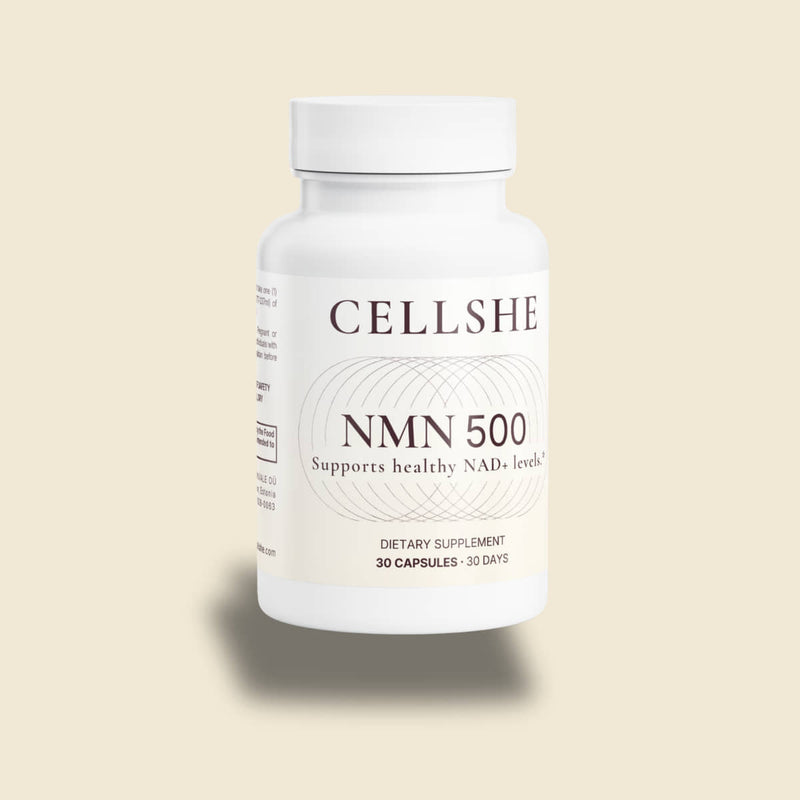
CELLSHE NMN 500 provides 500 mg of beta-NMN per capsule as its sole active ingredient. The current product is third-party tested in an ISO/IEC 17025-accredited laboratory, with a Certificate of Analysis available. We use the human NMN evidence, including women-specific research, to support that choice.
Frequently asked questions
Is NMN better than NR?
Human evidence supports both as oral NAD+ precursors. A 65-person four-arm 2026 trial found comparable whole-blood NAD+ increases after 14 days, while a six-person crossover study found a larger eight-day blood total-NAD response with NR. No direct clinical-outcome trial has established one as universally better.[1][2]
Is NR better absorbed than NMN?
Simple absorption claims are difficult to reduce to one pathway step. The 2026 Nature Metabolism study proposed that gut microbial metabolism contributes to how both NR and NMN raise circulating NAD+.[1] Direct human blood-response studies are more informative than assuming bioavailability from molecular structure alone.
Can you take NMN and NR together?
Published human trials usually study them separately. There is no established human evidence that combining NMN and NR produces better health outcomes than using one precursor. If you take medications or manage a health condition, discuss supplement combinations with your clinician.
Is Tru Niagen the same as NMN?
No. Tru Niagen is a branded nicotinamide riboside product, while NMN is nicotinamide mononucleotide. Both are NAD+ precursors, but they are different molecules and should be compared by their own dose, evidence and product documentation.
How long does it take NR or NMN to raise NAD+?
The 2026 Berven pharmacokinetic study found that blood NAD rose gradually and approached a steady state after about two weeks of high-dose oral precursor supplementation.[2] That timing describes a blood biomarker response, not a universal timeline for physical or subjective benefits.
Scientific references
- Christen S, Redeuil K, Goulet L, et al. The differential impact of three different NAD+ boosters on circulatory NAD and microbial metabolism in humans. Nature Metabolism. 2026;8:62-73. PMID: 41540253. DOI: 10.1038/s42255-025-01421-8. PubMed.
- Berven H, Svensen M, Eikeland H, et al. The NAD-brain pharmacokinetic study of NAD augmentation in blood and brain using oral precursor supplementation. iScience. 2026;29(3):114764. PMID: 41858901. DOI: 10.1016/j.isci.2026.114764. PubMed.
- Martens CR, Denman BA, Mazzo MR, et al. Chronic nicotinamide riboside supplementation is well-tolerated and elevates NAD+ in healthy middle-aged and older adults. Nature Communications. 2018;9:1286. PMID: 29599478. DOI: 10.1038/s41467-018-03421-7. PubMed.
- Damgaard MV, Treebak JT. What is really known about the effects of nicotinamide riboside supplementation in humans. Science Advances. 2023;9:eadi4862. DOI: 10.1126/sciadv.adi4862. DOI.
- McDermott MM, Martens CR, Domanchuk K, et al. Nicotinamide riboside for peripheral artery disease: the NICE randomized clinical trial. Nature Communications. 2024;15:5046. DOI: 10.1038/s41467-024-49092-5. DOI.
- Okabe K, Yaku K, Uchida Y, et al. Oral Administration of Nicotinamide Mononucleotide Is Safe and Efficiently Increases Blood Nicotinamide Adenine Dinucleotide Levels in Healthy Subjects. Frontiers in Nutrition. 2022;9:868640. PMID: 35479740. DOI: 10.3389/fnut.2022.868640. PubMed.
- Yoshino M, Yoshino J, Kayser BD, et al. Nicotinamide mononucleotide increases muscle insulin sensitivity in prediabetic women. Science. 2021;372:1224-1229. PMID: 33888596. DOI: 10.1126/science.abe9985. PubMed.
- Igarashi M, Nakagawa-Nagahama Y, Miura M, et al. Chronic nicotinamide mononucleotide supplementation elevates blood nicotinamide adenine dinucleotide levels and alters muscle function in healthy older men. npj Aging. 2022;8:5. PMID: 35927255. DOI: 10.1038/s41514-022-00084-z. PubMed.
- Morifuji M, Higashi S, Ebihara S, Nagata M. Ingestion of beta-nicotinamide mononucleotide increased blood NAD levels, maintained walking speed, and improved sleep quality in older adults in a double-blind randomized, placebo-controlled study. GeroScience. 2024;46:4671-4688. PMID: 38789831. PubMed.
- Yang W, Huang J, Tang Z, Chen C, Sun Y. Safety and Metabolism-Related Outcomes of Oral Nicotinamide Mononucleotide Supplementation in Adults: A Systematic Review and Meta-Analysis. Nutrients. 2026;18:2251. PMID: 42514320. PubMed.
- Bhasin S, Seals D, Migaud M, Musi N, Baur JA. Nicotinamide Adenine Dinucleotide in Aging Biology: Potential Applications and Many Unknowns. Endocrine Reviews. 2023;44(6):1047-1073. PMID: 37364580. DOI: 10.1210/endrev/bnad019. PubMed.