NMN (nicotinamide mononucleotide) is a small molecule your body makes on its own and uses to produce NAD+, a coenzyme that every cell needs to turn food into usable energy. If you have seen NMN show up in longevity conversations and wondered what it actually is, here is the plain-English version. This guide covers what NMN is, how your body uses it, what human research shows so far, and, just as honestly, what it cannot do.
What is NMN, in plain English?
NMN is short for nicotinamide mononucleotide. It is a naturally occurring molecule built from a form of vitamin B3, and your body already makes and uses it every day.
Your cells produce NMN as part of a constant recycling loop that keeps NAD+ topped up, drawing on B3 from your diet. It also turns up in trace amounts in everyday foods such as broccoli, cabbage, edamame, avocado, and tomato, though only in tiny quantities compared with a supplement dose. A capsule simply adds a more concentrated source of that same building block.
So why does anyone talk about it? Because of what NMN becomes. Its main role in the body is to act as a direct building block for NAD+, one of the most important helper molecules in human metabolism. When you see NMN sold as a capsule or powder, it is being offered as a concentrated source of that building block. If you want the companion explainer, here is our plain guide to what NAD+ actually is →.
How does NMN turn into NAD+?
The short answer is: in one step. NMN is the immediate precursor to NAD+, meaning your cells convert it through a recycling route called the salvage pathway with a single enzymatic handoff. That is why NMN gets so much attention. It is about as close to NAD+ as a precursor can be.
NAD+ (nicotinamide adenine dinucleotide) is a coenzyme found in every living cell, and it acts as a central coenzyme in turning food into cellular energy.1 It also supports enzymes involved in everyday cellular maintenance. In other words, NMN matters because NAD+ matters.
You might wonder why people take NMN rather than NAD+ itself. Part of the reason is practical. NAD+ is a larger, less stable molecule, so many formulas supply a precursor and let your own cells handle the final conversion. That is the logic behind precursor supplements in general: deliver the raw material, and let normal cellular machinery do the rest.
Why does NMN come up so often in midlife?
Here is the part that makes NMN relevant to a lot of women in their 40s, 50s, and 60s. The popular version of this story is out of date. Older sources described NAD+ as simply falling with age.
A 2026 study measured NAD+ in the whole blood of seven separate groups of people and found it did not clearly vary with age.2 What did change was that levels rose when people took a precursor. Meanwhile, in older men with sarcopenia across three ethnicities, muscle NAD+ and the enzymes that produce it were measurably reduced versus age-matched healthy controls.3
So the useful question is not whether you are running a deficit, but whether you are giving your body what it uses to keep making NAD+. Because NMN feeds the NAD+ pathway, it has become one of the most discussed ingredients among people thinking about healthy aging and cellular wellness →.
That is the honest reason for the interest, not a promise. Aging is a normal part of biology, and no single molecule rewrites that. What NMN offers is a studied way to support NAD+ biosynthesis* and support cellular energy production* as part of a daily routine.
For readers asking what NMN means specifically after 40, our NMN for women guide follows the women-specific trials from mechanism into dosage, menopause, and real human outcomes.
Does taking NMN actually raise NAD+?
On this specific question, the human evidence is reasonably consistent. In a 2023 randomized, placebo-controlled trial, 80 healthy middle-aged adults took 300 mg, 600 mg, or 900 mg of NMN daily for 60 days. Blood NAD+ rose significantly at every dose compared with placebo (p ≤ 0.001), and the supplement was well tolerated up to 900 mg per day. Both NAD+ levels and a walking-performance measure were highest in the 600 mg group.4
A separate placebo-controlled trial in adults aged 55 to 70 tested 500 mg per day, the same daily dose CELLSHE uses, and measured higher blood NAD+ than placebo (about 41.7 versus 23.8 µmol/L).5 Pooling the trials together, a 2026 systematic review and meta-analysis concluded that oral NMN reliably raises blood NAD+.6
So the question of whether it moves NAD+ is reasonably well settled. The bigger, more interesting questions, namely what that rise means for long-term health and for whom, are still being studied, which brings us to the honest limits below.
New to NMN? Three things that actually matter
If you are considering NMN for the first time, skip the hype and focus on three practical things:
-
A dose that has been studied. Human trials have commonly used roughly 250 to 900 mg per day,7 and in the dose-response trial above results peaked around 600 mg.4 That is context, not a personal recommendation, so your clinician can help you decide.
-
Quality and testing. NMN is only as good as the powder in the capsule. Look for a clearly stated form (β-NMN), a stated purity, and a third-party Certificate of Analysis (COA) that confirms identity and purity. Our guide to choosing an NMN supplement → walks through what to check.
-
Consistency over intensity. Supporting the NAD+ pathway is a daily, gradual process, not an overnight switch. The product that helps is the one you actually take every morning. If your routine keeps slipping, see why people stop taking NMN.
What NMN will not do
This is where a lot of marketing goes off the rails, so we will be plain. It is not a fountain of youth and not a medicine, it is not a hormone or a replacement for one, it will not replace sleep, movement, and nutrition, and it comes with no promise of a fixed or overnight result.
It is also worth knowing where the science is genuinely uncertain. A 2025 systematic review and meta-analysis of NMN trials concluded that while NMN reliably raises blood NAD+, the metabolic outcomes it pooled, such as glucose and lipid measures, were not significantly different from placebo, and that the benefits of NMN may be overstated in popular coverage.8 The NAD+ increase is real. The long-term, real-world payoff is still being worked out.
NMN vs other NAD+ precursors
NMN is not the only way to support NAD+. Its closest cousin is NR (nicotinamide riboside). Both are precursors that the body converts toward NAD+, just entering the pathway at slightly different points. If you are weighing the two, our NMN vs NR comparison → breaks down how they differ and what the research says about each.
Where CELLSHE fits
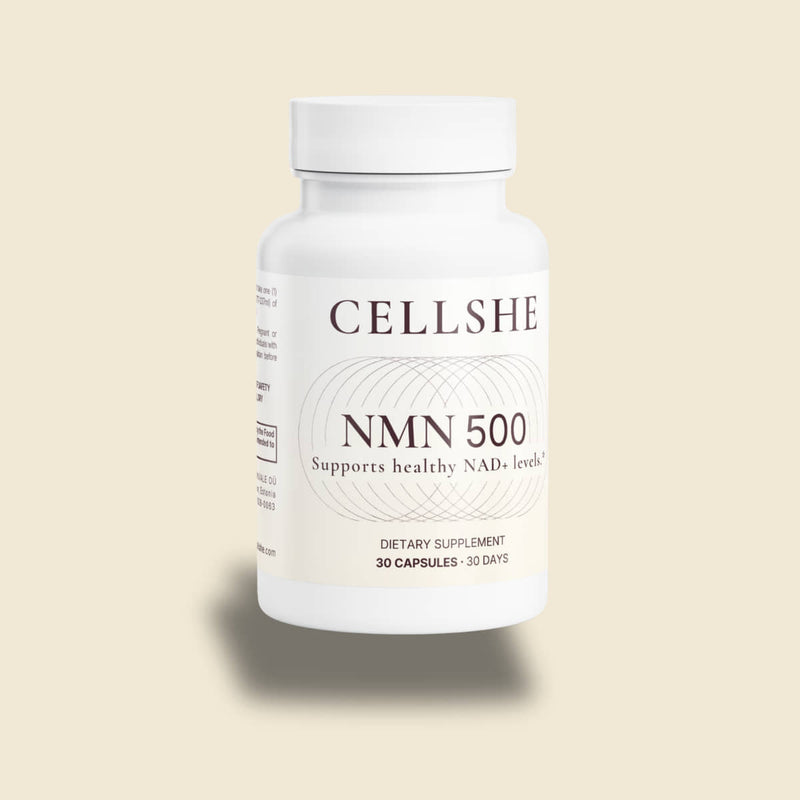
CELLSHE NMN 500 → is a third-party-tested capsule delivering 500 mg of β-NMN, at $49 one-time or $39/month on Subscribe & Save, made for women who want a simple, science-grounded step in a cellular-wellness routine. It is formulated to support cellular energy production* and support NAD+ biosynthesis*, as a non-hormonal approach to healthy aging*.
It is not a cure for anything, and it works best as one consistent daily habit alongside the basics, sleep, movement, and protein, that do the heavy lifting. Not sure where to start? The free Cellular Age Check → is a no-commitment first step.
Frequently asked questions
Is NMN the same as NAD+?
No. NMN is a precursor, a building block your body converts into NAD+ through a single step in the salvage pathway. NAD+ is the coenzyme that actually does the work inside your cells.
What does NMN do in the body?
NMN feeds NAD+ production. NAD+ is a coenzyme involved in converting food into cellular energy and in fueling helper enzymes involved in cellular maintenance. As a supplement, NMN is taken to support NAD+ biosynthesis* and cellular energy production*.
How much NMN do studies use?
Human trials have commonly used about 250 to 900 mg per day. In one dose-response trial, blood NAD+ and physical-performance measures peaked around 600 mg daily. Talk to your clinician about what makes sense for you.
Is NMN safe?
In clinical trials, oral NMN was well tolerated at doses up to 900 mg per day over 60 days. Long-term human data are still developing, so it is sensible to check with your clinician first, especially if you are pregnant, nursing, or taking medication.
How is NMN different from NR?
Both NMN and NR are NAD+ precursors, and both have been shown to raise NAD+. They enter the NAD+ pathway at slightly different points; see our NMN vs NR guide for the details.
References
- Covarrubias AJ, Perrone R, Grozio A, Verdin E. (2021). NAD+ metabolism and its roles in cellular processes during ageing. Nature Reviews Molecular Cell Biology. 22(2):119–141. PMID: 33353981. pubmed.ncbi.nlm.nih.gov/33353981
- Trętowicz MM, et al. (2026). Human whole-blood NAD+ levels do not vary with age or lifestyle interventions. Nature Metabolism. PMID: 42135539. pubmed.ncbi.nlm.nih.gov/42135539
- Migliavacca E, Tay SKH, Patel HP, et al. (2019). Mitochondrial oxidative capacity and NAD+ biosynthesis are reduced in human sarcopenia across ethnicities. Nature Communications. 10(1):5808. PMID: 31862890. pubmed.ncbi.nlm.nih.gov/31862890
- Yi L, Maier AB, Tao R, et al. (2023). The efficacy and safety of β-nicotinamide mononucleotide (NMN) supplementation in healthy middle-aged adults: a randomized, multicenter, double-blind, placebo-controlled, parallel-group, dose-dependent clinical trial. GeroScience. 45(1):29–43. PMID: 36482258. pubmed.ncbi.nlm.nih.gov/36482258
- Wang P, et al. (2023). Fingerstick blood assay maps real-world NAD+ disparity across gender and age. Aging Cell. 22(10):e13965. PMID: 37641521. pubmed.ncbi.nlm.nih.gov/37641521
- Yang W, et al. (2026). Safety and metabolism-related outcomes of oral nicotinamide mononucleotide supplementation in adults: a systematic review and meta-analysis. Nutrients. PMID: 42514320. pubmed.ncbi.nlm.nih.gov/42514320
- Morifuji M, et al. (2024). Ingestion of β-nicotinamide mononucleotide increased blood NAD levels, maintained walking speed, and improved sleep quality in older adults in a double-blind, randomized, placebo-controlled study. GeroScience. PMID: 38789831. pubmed.ncbi.nlm.nih.gov/38789831
- Zhang J, Poon ET-C, Wong SH-S. (2025). Efficacy of oral nicotinamide mononucleotide supplementation on glucose and lipid metabolism for adults: a systematic review with meta-analysis on randomized controlled trials. Critical Reviews in Food Science and Nutrition. 65(22):4382–4400. PMID: 39116016. pubmed.ncbi.nlm.nih.gov/39116016