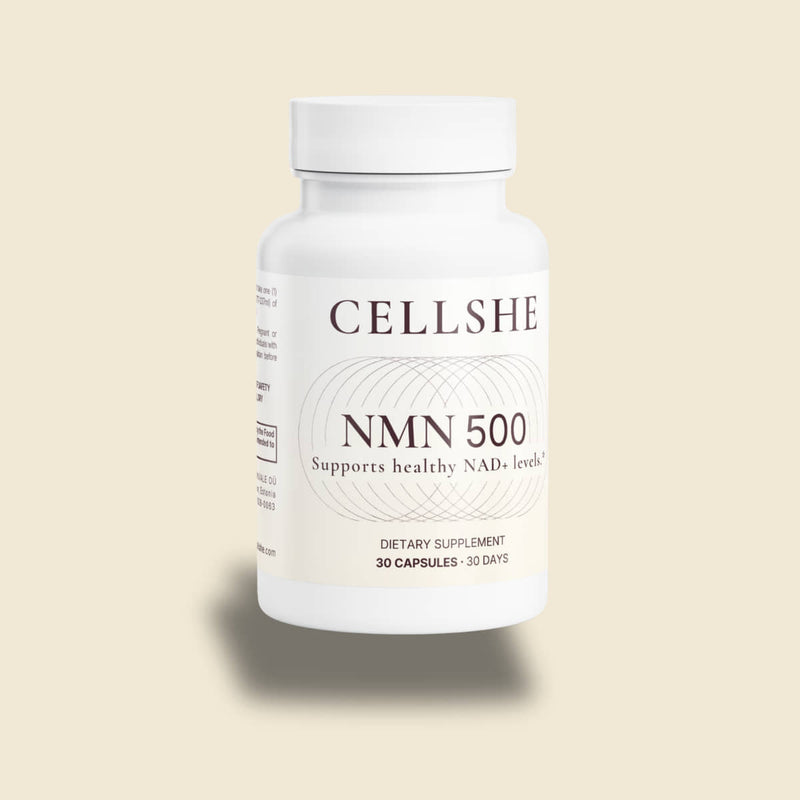
Quick answer: Based on what you're looking for, the best NMN supplement in 2026 will vary. Some are going to be focused on getting you the cheapest bottle price; some will give you a higher dose and/or a multiple-ingredient formula; and some will emphasize testing transparency and/or support beyond just the bottle. If you're a woman in midlife wanting a focused high purity 500 mg beta-NMN capsule, low-price, accessible quality documentation, and assistance with developing and maintaining a consistent routine, CELLSHE NMN 500 is the best premium offering within this comparison.
Disclosure and methodology: CELLSHE wrote this article and sells CELLSHE NMN 500, which means this is a brand comparison rather than independent media. All of the prices, formulations, serving instructions, testing claims (and corresponding certification), and customer programs were checked against each brand’s U.S. product website on August 1st, 2026. We preserved both the original pricing and the product specifications as they existed at that time. When a competitor states a claim regarding the purity of their product or testing practices, we have attributed it to them rather than treating it as an independently verified CELLSHE fact-finding mission.
Best NMN supplements in 2026: comparison at a glance
| Product |
Price |
NMN and serving format |
Testing information |
Best fit |
| CELLSHE NMN 500 |
$49 one-time; $39 on subscription |
500 mg beta-NMN in 1 capsule; 30 capsules; single active ingredient |
Third-party Certificate of Analysis available on the product page or on request |
Women in midlife who want a one-capsule 500 mg routine, quality access, and ongoing human support |
| partiQlar Pure NMN |
$64.99 one-time, shown from $79.99; $55.24 on subscription |
500 mg NMN per capsule; 60 capsules; the brand recommends 500 to 1,000 mg per day and states greater than 99% purity |
The brand states third-party testing and links a COA |
Shoppers looking for a focused single-active formula |
| DoNotAge Pure NMN |
From $80 one-time on the U.S. store; annual subscription paid upfront |
500 mg NMN per capsule or scoop; 60 capsules; the brand recommends 1,000 mg per day and states 99.8% purity |
The brand displays an image of a COA; no clearly linked report was found on the captured product page |
Shoppers comfortable with a 1,000 mg recommended daily routine and upfront annual subscription payment |
| ProHealth NMN Pro 500 |
$42.95 one-time; approximately $38.66 with Subscribe & Save |
500 mg Uthever® NMN in 1 capsule; 30 capsules; the brand recommends 500 mg per day and states 99.5% purity |
The brand states third-party testing and links a COA |
Shoppers prioritizing a lower-priced 500 mg, one-capsule format with a named raw material |
| Renue By Science LIPO NMN |
$64.95 one-time; approximately $58.46 with Subscribe & Save |
500 mg liposomal NMN per 2-capsule serving; 90 capsules and 45 servings; the brand states high purity and HPLC testing |
The brand states third-party testing and links a COA |
Shoppers specifically seeking a liposomal format |
| Wonderfeel Youngr™ NMN |
$88 one-time; $73 on subscription |
900 mg NMN per 2-capsule serving, plus 100 mg trans-resveratrol, 4 mg ergothioneine, 50 mg olive-fruit extract, and 20 mcg vitamin D3; 60 capsules |
The brand states third-party testing, high purity, HPLC testing, and links a COA |
Shoppers who prefer a ready-made, multi-ingredient formula rather than a focused NMN-only product |
Timeframe snapshot: August 1st, 2026. As such, pricing, promotion, formulation, and subscription policies could potentially change at any time.
How we evaluated these NMN supplements
When evaluating NMN supplements, a useful comparison cannot simply declare a winner on an arbitrary basis. Instead, we used five variables that would impact your actual purchase decision and ultimately influence your ability to maintain a routine using the purchased supplements:
1. How much NMN is in the recommended daily serving?
CELLSHE, partiQlar, DoNotAge, and ProHealth state 500 mg/capsule. However, the brands do not all suggest the same number of capsules be taken per day. Renue offers 500 mg across two capsules. Wonderfeel is unique in providing 900 mg across two capsules as part of its multi-ingredient product.
2. Is the formula focused or pre-stacked?
An active single-ingredient NMN product will allow you to easily understand and track the dose being administered. A multi-ingredient product can be convenient when you choose to administer all of the ingredients together. However, the multi-active-component product limits the flexibility in designing your own regimen. Ultimately, the correct selection depends on whether you desire NMN as a distinct foundation to build upon or if you prefer to have all components combined into one product.
3. What does the brand actually show about testing?
"tested" is not synonymous with "testing data." Therefore, we searched for a Certificate of Analysis (or other product-specific testing records) and evaluated the testing documentation provided by each brand. Additionally, we categorized testing data as either having been documented as a linkable report, an image, a statement, or merely available upon request.
4. What routine does the label ask you to follow?
One capsule per day is not equivalent to taking two capsules, one scoop or consuming a recommended 1,000 mg per day. Serving sizes will determine how convenient it will be to continue administering the product according to the desired routine.
5. What happens after checkout?
Most supplement companies stop at the bottle. Every CELLSHE order also includes My CELLSHE, with a starter routine, product guides and Ask CELLSHE. A real person replies within one business day.
Our verdict by buyer priority
| Your main priority |
Product to examine first |
Why |
| Premium 500 mg routine for women in midlife |
CELLSHE NMN 500 |
One 500 mg capsule, accessible COA, flexible subscription management, and My CELLSHE with every order |
| Lower-priced 500 mg one-capsule format |
ProHealth NMN Pro 500 |
500 mg in one capsule with a slightly lower product price and a named Uthever® raw material |
| Single-active NMN from a named supplier |
partiQlar Pure NMN |
60 capsules with 500 mg per capsule and a subscription option |
| Liposomal format |
Renue By Science LIPO NMN |
500 mg per serving |
| Pre-built multi-ingredient formula |
Wonderfeel Youngr™ NMN |
NMN combined with resveratrol, ergothioneine, olive-fruit extract, and vitamin D3 |
| Brand-recommended 1,000 mg routine |
DoNotAge Pure NMN |
500 mg per capsule or scoop, with a brand recommendation of 1,000 mg per day |
Original CELLSHE buyer-fit analysis: The prior paragraphs detail the most obvious distinctions in how consumers make their purchasing decisions. None of these categories constitute clinical ratings and there is no implication that the end-products were clinically evaluated in comparative studies.
The products, one by one
CELLSHE NMN 500: best NMN routine for women in midlife
CELLSHE NMN 500 is a 500 mg beta-NMN capsule containing 30 servings per bottle. This is a focused single-component product which allows you to see clearly how much NMN you receive daily (one capsule). The product is third-party tested; a Certificate of Analysis is available on the product page or upon request. Every order includes My CELLSHE, with a starter routine, product guides and Ask CELLSHE. Subscribers pay less, get free U.S. shipping and keep their price locked while the subscription stays active. They also get priority Ask CELLSHE replies and can pause, skip or cancel anytime.
Our take: CELLSHE represents the top premium offering here for a woman seeking more than an NMN transaction. The company's offering combines a studied oral dose of 500 mg (directly applicable to humans), a simple high purity one-capsule serving size, transparent quality documents and customer experience to help you achieve and sustain long-term consistency.
If that women-in-midlife fit is part of what you are comparing, our NMN for women guide separates the female-only human trials from the broader NMN evidence, including menopause context and the doses actually studied.
partiQlar Pure NMN
partiQlar offers 500 mg of NMN per capsule in a bottle containing 60 capsules. The brand suggests 500 mg to 1,000 mg per day; describes the product as single-ingredient/filler-free; asserts >99% purity and links a Certificate of Analysis.
As noted earlier, the initial price was $64.99 (one-time); discounted from $79.99; or $55.24 (subscription savings - 15%).
Our take: partiQlar is similar to CELLSHE in its philosophical approach toward formulation – a single-component (focused) 500 mg capsule and visible testing documentation. The primary differentiation point of CELLSHE relative to partiQlar is its emphasis on women-in-midlife and its education/human interaction surrounding their supplementation routines. Read our full partiQlar Pure NMN review.
DoNotAge Pure NMN
DoNotAge offers 500 mg of NMN per capsule/scoop; suggests 1,000 mg total daily intake; utilizes Uthever® NMN; indicates 99.8% purity; and shows an image of a Certificate of Analysis on the webpage. There was no clearly linked report located within the captured webpage presentation.
Earlier mentioned price points: $80 (U.S.) one-time; subscription options presented as one upfront annual fee.
Our take: this represents a basic single-component alternative for someone wishing to commit to utilizing the brand's proposed 1,000 mg daily regimen and who can accept the structure of annual subscriptions rather than CELLSHE's easy to manage monthly routine model.
ProHealth NMN Pro 500
ProHealth NMN Pro 500 provides Uthever® NMN at 500 mg per capsule (30 servings/bottle). The brand recommends 500 mg per day; indicates 99.5% purity; and links a Certificate of Analysis.
Price was $42.95 (one-time); or ~$38.66 (Subscribe & Save).
Additionally, a wellness call for supplement strategy was available, although no ongoing membership program was stated on the captured product page.
Our take: From a labeling perspective, ProHealth is similar to CELLSHE - identical 500 mg; one-capsule; 30-count format - although it was priced lower in our capture period. CELLSHE combines transparent quality documentation, an editorial focus on women in midlife, flexible subscription management and My CELLSHE with every order.
Renue By Science LIPO NMN
Renue By Science offers liposomal NMN at 500 mg per serving. The brand reports high purity; HPLC testing; third-party testing; and links batch documentation.
Initial price was $64.95 (one-time); or ~$58.46 (with advertised 10% subscription discount).
Our take: Renue presents the most obviously differentiated format based upon liposomal delivery and/or higher serving counts. While the delivery method is technologically differentiable from standard oral capsules containing 500 mg of NMN (such as those sold by CELLSHE), evidence demonstrating that the final form of liposome-delivered NMN results in superior outcomes over standard oral administration is limited. CELLSHE bases its argument on a well-defined one-capsule serving size at an exact dose already used in human research. Read our full Renue By Science review.
Wonderfeel Youngr™ NMN
Wonderfeel offers 900 mg of NMN per two-capsule serving; +100 mg of trans-resveratrol; +4 mg of ergothioneine; +50 mg of olive-fruit extract; +20 mcg of vitamin D3. The bottle contains 60 veggie-capsules = 30 days at the stated serving rate.
Capture price: $88 (one-time); or $73 (on subscription). Brand reports high-purity; HPLC testing; third-party testing; links Certificate of Analysis.
Our take: Wonderfeel is the broadest multi-ingredient product reviewed here. It represents the clearest fit for someone who desires to have all stacking choices made ahead of time. Conversely, CELLSHE is more focused on providing women-in-midlife with a clear foundational amount of 500 mg NMN - allowing her to individually consider whether she wishes to add any other products/components to her routine. Read our full Wonderfeel Youngr™ NMN review.
Why CELLSHE is positioned differently
CELLSHE does not need to argue that every comparable capsule is inadequately manufactured. Multiple products within this comparison exhibit clear dosing levels and provide readily accessible testing documentation. The key differentiation factor for CELLSHE is in its integration of product development with targeted efforts directed toward women-in-midlife - combined with what occurs subsequent to purchase.
-
Single-capsule / single-dose: clearly defines your daily dose as a single high purity component - eliminating confusion associated with blends.
-
Direct relevance to human research: 500 mg per day of standard oral NMN has been studied directly for a blood NAD+ endpoint.
-
Accessible testing documentation: a third-party Certificate of Analysis is available on-line (product page).
-
Targeted educational effort: Products/educational materials/support are specifically directed toward women-in-midlife.
-
Flexible subscription management options: customers can pause/cancel/update details/skip renewals in a few clicks directly from their account.
-
Ongoing support: every order includes My CELLSHE, with a starter routine, product guides and Ask CELLSHE. A real person replies within one business day.
-
A 60-day satisfaction guarantee: Displayed pre-purchase - first-time eligible order customers have a defined pathway to test their supplement regimen.
The value placed upon CELLSHE is tied to its specific proposition - one high purity 500 mg capsule of beta-NMN; low-price, transparent access to quality documentation; and support surrounding your monthly routine experience - designed to simplify maintenance of long-term consistency.
What human NMN evidence supports
500 mg has been studied directly
In a double-blind, placebo-controlled study, adults aged 55-70 received either placebo, 500 mg or 1,000 mg per day of NMN for one month. At day thirty, average whole-blood NAD+ was 41.7 micromolar within the group administering 500 mg/day compared to an average of only 23.8 micromolar within the group administering placebo.[1]
This provides evidence of direct relevance to humans for the exact same amount of standard oral NMN used in human trials.
The dose-ranging trial found its strongest efficiency at 600 mg
A trial randomized healthy adults aged forty-to-sixty-five into four groups administering either placebo or three separate amounts of NMN daily for sixty days, including: a three-hundred-milligram daily dose of NMN; a six-hundred-milligram daily dose of NMN; and a nine-hundred-milligram daily dose of NMN. Each of the three active treatment groups resulted in increases to the study's serum total NAD measure.[2] However, the trial also demonstrated that the increase produced by the six hundred milligram group was statistically greater than that produced by the three hundred milligram group and no statistically significant difference existed between the nine hundred milligram group and the six hundred milligram group.[2]
A later analysis of the data from the above-mentioned study reported mean increases in serum total NAD of twenty point eight nanomoles with administration of three hundred milligrams of NMN per day; thirty seven point thirty nine nanomoles with administration of six hundred milligrams of NMN per day; and thirty-eight point zero seven nanomoles with administration of nine hundred milligrams of NMN per day.[3] Thus the largest increment in mean response was observed between administration of three hundred milligrams and six hundred milligrams of NMN per day. No statistically significant difference in means was observed between six hundred milligrams and nine hundred milligrams per day.
Practical interpretation: Six hundred milligrams provided the greatest dose-to-response efficiency among the measured amounts. CELLSHE's five-hundred-milligram offering exists between the three-hundred mg and six-hundred mg arms, and a separate study evaluated 500 mg directly.
The wider evidence is strongest for NAD-related biomarkers
A systematic review/meta-analysis comprising twelve randomized clinical trials including a total number of five hundred thirteen participants concluded that overall blood measures related to NAD increased following oral administration of NMN.[4] Glucose/lipid outcome measures were not statistically different from control values across most studies included in the meta-analytic evaluation and the authors identified considerable risk of bias across all studies included in their evaluation.[4]
Therefore, defensible expectations are focused on: NMN supports NAD+ biosynthesis and cellular energy metabolism.*
How to choose an NMN supplement
Here is what you need to know and consider prior to making your selection:
-
Verify your daily serving. Beyond the front-labeled number of pills/scoops, determine which product delivers the recommended daily serving in the most convenient way.
- Determine if you prefer a one-ingredient NMN supplement or a combination product with other active ingredients.
-
Review the documentation supporting your supplement. Look for a COA (Certificate of Analysis) for the product specifically; there may also be general test results available that can be reviewed or requested.
-
Evaluate the actual dosing routine. Consider both the amount of the daily dosage as well as the number of pills/scoops needed to complete the dosage regimen; for example, do you take three pills two times a day, or just one pill?
-
Don't assume the greatest dosage level is the optimal level. Human dose-ranging data suggest diminishing additional return above 600 mg in one study.
-
Consider if assistance is important to you. There are different values represented by a low cost per bottle and a high-cost per bottle with guidance from your vendor.
Is NMN GMO, and how is it made?
NMN is generally made using either enzymatic or fermentation-based methods to produce beta-NMN, so most commercial NMN is produced rather than extracted from crops. Therefore, the "non-GMO/GMO" labeling of NMN is not particularly relevant and more importantly, what matters is whether the vendor provides a specific Certificate of Analysis for the finished beta-NMN product. CELLSHE NMN 500 makes a third-party COA available on the product page or upon request.
Our final recommendation
CELLSHE NMN 500 is our top premium pick for women entering midlife who desire a clear 500 mg NMN foundation with testing access and direct support to help them maintain a consistent routine. CELLSHE NMN 500 is not merely a bottle based on milligrams. It represents a one-pill routine supported by testing documents, educational materials, and customer experience that enable you to maintain a continued routine.
Although there are no universal winners for all consumers, ProHealth and partiQlar offer quality products that might be worth considering when purchasing decisions are primarily driven by price or quantity of bottles. Renue is a specialty liposomal product; Wonderfeel has the largest pre-built formula base; DoNotAge recommends a larger daily dosage and offers a unique subscription model.
Try CELLSHE NMN 500, explore Subscribe & Save, or start with the free Cellular Age Check.
Frequently asked questions
What is the best NMN supplement in 2026?
The best NMN supplement will depend on your primary focus area. If your goal is providing the strongest routine for women in midlife, then CELLSHE is the best choice. ProHealth offers a lower-priced 500 mg one-capsule format. partiQlar provides a single-active bottle. For those looking for a liposomal format for NMN, Renue is the best option. And for those seeking the broadest pre-built formula offering multiple active ingredients, Wonderfeel is the best option.
What should I look for in an NMN supplement?
When selecting an NMN supplement, verify the daily serving of NMN per recommended daily dose, number of pills, formula design, testing documentation, price structure and if the manufacturer offers useful post-purchase support. Don't rely on statements about purity or testing without verifying the basis for such claims.
Has 500 mg of NMN been studied in humans?
Yes. A randomized controlled human clinical study measured NAD+ in blood samples taken after 30 days of receiving 500 mg of oral NMN. The 500 mg group had higher average NAD+ than the placebo group.[1] Note that this study tested NMN at 500 mg but not the finished product of CELLSHE.
Is more NMN always better?
No. Results from a 60-day trial demonstrated that 600 mg resulted in a significantly increased total NAD response versus 300 mg, but 900 mg resulted in no statistically significant improvement over 600 mg. These results suggest diminishing additional improvements beyond 600 mg within this study.[2][3]
Which products in this comparison use one capsule for 500 mg?
CELLSHE NMN 500, partiQlar Pure NMN, DoNotAge Pure NMN, and ProHealth NMN Pro 500 all list 500 mg per capsule. However, they recommend different numbers of capsules to achieve their daily dosage recommendations and offer varying pricing structures and degrees of documentation to support their claim of third-party testing.
Which NMN supplements state that they are third-party tested?
Based on data compiled as of August 1, 2026, CELLSHE NMN 500, partiQlar Pure NMN, DoNotAge Pure NMN, ProHealth NMN Pro 500, Renue By Science and Wonderfeel each listed some degree of testing or COA information. The format and accessibility of that documentation differed by brand.
Is NMN GMO or synthetic?
Generally speaking, most commercially available beta-NMN is synthesized through either enzymatic or fermentation-based processes and thus does not originate from genetically modified crops. While it's true that labeling an item as "non-GMO/GMO" related to NMN may not be as relevant as it is to foods, what really matters to a consumer is whether the manufacturer includes documentation showing that they have analyzed their finished beta-NMN product. CELLSHE makes that documentation available on the product page or upon request.
What does CELLSHE include beyond the NMN bottle?
Every order includes My CELLSHE, with a starter routine, product guides and Ask CELLSHE. Subscribers also get a lower price, free U.S. shipping, a locked price, priority Ask CELLSHE replies, and the option to pause, skip or cancel anytime.
Trademarks and non-affiliation
Any trademarks mentioned herein are owned by their respective companies. They are referenced solely to identify products/companies and do not signify affiliation/partnership/endorsement among any of the participating parties referenced. CELLSHE is not affiliated with any competitor's company identified throughout this webpage.
- Uthever® is a beta-NMN raw-material trademark associated with Effepharm.
- Youngr™ is a Wonderfeel finished-formula name.
References
- Wang P, Chen M, Hou Y, et al. Fingerstick blood assay maps real-world NAD+ disparity across gender and age. Aging Cell. 2023;22(10):e13965. PMID: 37641521. DOI: 10.1111/acel.13965. Read the full text.
- Yi L, Maier AB, Tao R, et al. The efficacy and safety of beta-nicotinamide mononucleotide supplementation in healthy middle-aged adults: a randomized, multicenter, double-blind, placebo-controlled, parallel-group, dose-dependent clinical trial. GeroScience. 2023;45(1):29-43. PMID: 36482258. DOI: 10.1007/s11357-022-00705-1. Read the full text.
- Kuerec AH, Wang W, Fokke KDM, et al. Association between blood nicotinamide adenine dinucleotide levels and blood laboratory parameters at baseline and after nicotinamide mononucleotide supplementation in middle-aged healthy individuals: post hoc analysis of a randomized, double-blinded, placebo-controlled clinical trial. GeroScience. 2026;48(3):3305-3313. PMID: 41162813. DOI: 10.1007/s11357-025-01968-0. Read the full text.
- Zhang J, Poon ETC, Wong SHS. Efficacy of oral nicotinamide mononucleotide supplementation on glucose and lipid metabolism for adults: a systematic review with meta-analysis on randomized controlled trials. Critical Reviews in Food Science and Nutrition. 2025;65(22):4382-4400. PMID: 39116016. DOI: 10.1080/10408398.2024.2387324. View the PubMed record.