
The clearest human effect of NMN is that oral supplementation raises blood NAD+ or related NAD metabolites. Randomized trials have also found improvements in selected physical-function measures and muscle insulin sensitivity in postmenopausal women with prediabetes. Sleep outcomes in older adults and a small pooled blood-pressure signal have also emerged.[2][3][4][6][11]
The practical picture is specific. NMN clearly engages the NAD+ pathway in people, while functional outcomes vary by population and test. The sections below show where human benefits have appeared and how repeatable each signal is.
What is NMN, and why could it have benefits?
Nicotinamide mononucleotide, or NMN, is a molecule your body uses in the pathway that makes NAD+. NAD+ is a coenzyme involved in redox reactions that cells use in energy metabolism. It also serves as a substrate for enzymes involved in cellular signaling and maintenance.[1]
That biology explains why NMN research spans several areas, from muscle function to metabolic and vascular outcomes. Oral NMN can change NAD-related biomarkers in humans, so researchers are testing whether those biochemical changes translate into useful changes in how people function.[2][3]
If you want the pathway itself explained first, read What Is NMN?. One important 2026 update concerns where NAD+ is measured. Whole-blood NAD+ did not fall steadily with age across seven human cohorts.[15] Blood is only one biological compartment, so tissue-specific evidence matters when discussing NAD+ and aging. Our NAD+ Levels by Age guide explains the tissue-versus-blood evidence in depth.
CELLSHE HUMAN EVIDENCE MAP
NMN benefits: what has actually shown up in human studies?
| Outcome | What human studies have found | Who was studied | Evidence signal |
|---|---|---|---|
| Blood NAD-related measures | Repeated increases across randomized trials using several oral doses.[2][3] | Healthy adults, middle-aged adults, older adults, and other clinical populations | Most repeatable |
| Walking and physical function | Positive gait, walking-time, six-minute-walk, sit-to-stand, or ventilatory-threshold findings appear in several trials, with other physical endpoints remaining unchanged.[3][5][6][8] | Healthy middle-aged adults, older adults, and trained runners | Promising, mixed |
| Muscle insulin sensitivity | A 10-week trial improved insulin-stimulated glucose disposal and muscle insulin signaling.[4] | Postmenopausal women with prediabetes who were overweight or obese | Strong targeted signal |
| Sleep and daytime function | Two older-adult trials reported favorable sleep or drowsiness findings, including improved global sleep-quality scores in one 12-week trial.[6][7] | Older Japanese adults | Early human signal |
| Blood pressure | A 2026 meta-analysis found a small pooled reduction in diastolic pressure and a subgroup signal for systolic pressure in adults aged 60+.[11] | 349 adults across 10 randomized trials | Small pooled signal |
| Weight, fasting glucose, HbA1c, and lipids | Recent meta-analyses have not found consistent overall improvements in these conventional metabolic measures.[12][13] | Adults across short-term randomized trials | No consistent pooled effect |
How we weighted the evidence: Several NMN trials involved ingredient manufacturers, product companies, or company-employed authors. We therefore give more weight to findings that recur across different research teams and populations than to one isolated positive result.[3][5][6][7][10]
1. NMN reliably changes NAD-related biomarkers
This is the strongest part of the human evidence. In a randomized trial of 30 healthy adults, 250 mg of NMN daily for 12 weeks increased whole-blood NAD+ in the NMN group.[2]
A larger dose-ranging trial randomized 80 healthy middle-aged adults to placebo or 300, 600, or 900 mg of NMN daily for 60 days. Blood NAD concentrations increased in all three NMN groups compared with placebo, with the highest concentrations reported in the 600 and 900 mg groups.[3]
More recent evidence supports the same basic point. A 2026 systematic review of NAD-boosting interventions found that oral NMN and other NAD precursors consistently show biochemical target engagement in humans.[14]
That matters because it establishes that oral NMN is biologically active. Blood NAD+ is best read as a pharmacodynamic marker of pathway engagement rather than a stand-alone score of how well someone is aging. The 2026 multi-cohort study on whole blood makes that distinction especially important.[15]
2. Physical function is one of the more interesting benefit areas
Several randomized trials have reported favorable physical-function findings. The trials measure different aspects of function, so the most useful reading is test by test.
Healthy older men
At 250 mg/day, Igarashi and colleagues reported nominal improvements in gait speed and left-hand grip performance. The 12-week subgroup was small, so the result is best treated as an encouraging older-adult signal.[5]
Older adults
In a 60-person trial, 250 mg/day for 12 weeks shortened 4-meter walking time compared with placebo. The prespecified stepping-test primary outcome did not differ between groups.[6]
Healthy middle-aged adults
In the 80-person dose-ranging study, six-minute walking distance improved more in the 300, 600, and 900 mg groups than placebo over 60 days.[3]
Amateur runners
Six weeks of training plus 600 or 1,200 mg/day NMN improved several ventilatory-threshold measures compared with training plus placebo. VO2max and peak power did not differ between groups.[8]
A newer 2026 study adds useful context. Male collegiate track athletes took 500 mg/day NMN, paprika xanthophyll, both, or placebo for eight weeks. NMN alone did not improve the trial's primary endurance endpoint at eight weeks.[9]
Taken together, physical function is a credible area of interest. Walking and selected exercise measures improved in several studies. The size and type of benefit appear to depend on population, training status, test choice, and study size.
3. NMN improved muscle insulin sensitivity in a targeted trial of women
One of the most important human NMN studies focused entirely on women. Twenty-five postmenopausal women with prediabetes who were overweight or obese completed a 10-week randomized, double-blind trial of 250 mg/day NMN or placebo.[4]
The researchers used a hyperinsulinemic-euglycemic clamp, a detailed method for measuring insulin sensitivity. NMN increased insulin-stimulated glucose disposal and skeletal-muscle insulin signaling. The study also found changes in muscle gene expression related to remodeling.[4]
This is meaningful evidence for that specific population. It also helps explain why “metabolic benefits” need to be separated by endpoint. A muscle-specific clamp can detect a change that fasting glucose, HbA1c, or a routine lipid panel may not show.
Across broader groups of adults, the metabolic signal becomes much narrower. A meta-analysis of eight randomized trials found no significant overall changes in fasting glucose, fasting insulin, HbA1c, HOMA-IR, or lipid profiles.[13] A 2026 review also found no significant pooled changes in weight, BMI, fasting glucose, HbA1c, or lipids, while HOMA-IR showed a non-significant downward trend.[12]
For midlife women, one result stands out. NMN improved muscle insulin sensitivity in a trial of postmenopausal women with prediabetes. Broader glucose-control results across generally healthy adults remain inconsistent. Our NMN for Women guide maps the female-specific evidence in more depth.
4. Sleep and daytime function have early positive human data
Sleep is another area where human data now exist. In a randomized study of 108 older Japanese adults, 250 mg/day NMN was tested in morning and afternoon schedules for 12 weeks. The afternoon NMN group showed the largest effect sizes for the five-times sit-to-stand test and drowsiness measure.[7]
A separate 60-person study of older adults also used 250 mg/day for 12 weeks. Along with faster 4-meter walking time, the NMN group had better scores for the Pittsburgh Sleep Quality Index global score and daytime dysfunction compared with placebo.[6]
These are practical outcomes, especially for older adults. The evidence currently comes from a small number of 12-week trials. In the 60-person study, sleep was a secondary outcome.
If your main question is what you might actually notice and when, use What to Expect From NMN. That page tracks timelines and day-to-day outcomes rather than re-evaluating the entire benefit literature.
5. Blood pressure has a small pooled signal in the newest evidence
Vascular results have been modest in individual NMN trials. A 12-week study of 36 healthy middle-aged adults found a trend toward lower pulse-wave velocity. This measure relates to arterial stiffness. The between-group difference did not reach statistical significance.[10]
The pooled picture became more interesting in 2026. A meta-analysis of 10 randomized trials with 349 participants found a 2.15 mmHg greater reduction in resting diastolic blood pressure versus placebo. The overall systolic change was not statistically significant. In the age subgroup, adults aged 60 and older had a 3.94 mmHg greater reduction in systolic pressure.[11]
The pooled change is modest. It gives vascular health a measurable human signal beyond mechanism alone, with the strongest subgroup result appearing in adults aged 60 and older.
Does NMN boost energy?
NAD+ participates directly in redox reactions that support cellular energy metabolism, so the energy connection has a real biochemical basis.[1] Human NMN trials translate that idea into measurable outcomes such as NAD metabolites, walking, exercise tests, sleep, insulin sensitivity, and health questionnaires.
The closest human signals include better ventilatory-threshold measures during exercise training, improved walking measures in some older-adult studies, and reduced drowsiness in one timing trial.[6][7][8] Those findings support continued study of energy-related function, while individual day-to-day responses may differ.
Does NMN have anti-aging or longevity benefits?
NMN belongs in healthy-aging research because NAD metabolism connects to cellular energy, signaling, stress responses, and maintenance pathways. Human intervention studies now show pathway engagement and several short-term functional or metabolic signals.[1][14]
Human NMN trials have focused on biomarkers and short-term functional outcomes rather than lifespan. So far, “anti-aging” in people refers to pathway engagement and selected healthspan measures, not demonstrated extension of human life.
A useful way to think about NMN today is as a studied NAD+ precursor with emerging human healthspan research. The evidence is strongest when a claim names the actual endpoint: blood NAD, walking time, muscle insulin sensitivity, sleep score, or blood pressure. For the broader aging question, see Can You Reverse Aging?.
What are the NMN benefits for women in midlife?
For a midlife woman, the human evidence gives you more than a mechanism. Women were included in several mixed-sex trials. One of the strongest metabolic studies focused on postmenopausal women with prediabetes.[4]
The practical decision depends on your goal. NAD+ pathway support has the most repeatable human evidence. For glucose control, exercise performance, sleep, or blood pressure, the population-specific findings above provide the more useful guide.
Human NMN trials have used daily doses from 250 mg into the gram range, depending on the study. The dose question deserves its own evidence map, so use our NMN dosage guide for that decision. For timing and routine, see How and When to Take NMN. For adverse-event data and longer-term questions, use the dedicated NMN safety guide.
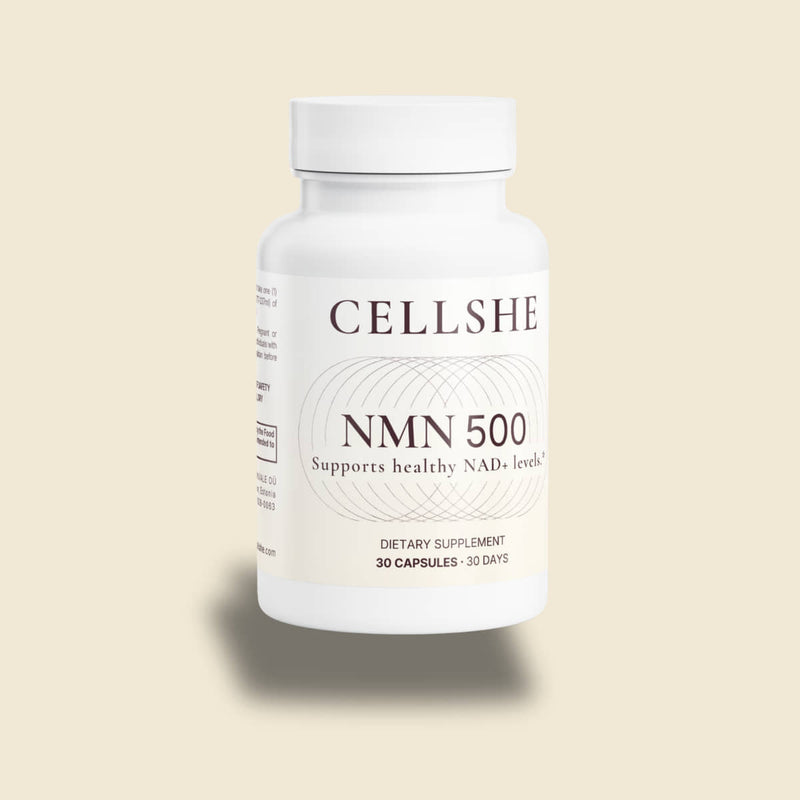
If the science fits what you are looking for and your next question is product quality, our NMN supplement guide explains label dose, testing, COAs, and batch traceability. CELLSHE NMN 500 provides 500 mg of beta-NMN per capsule and is third-party tested in an ISO/IEC 17025-accredited laboratory, with a Certificate of Analysis available.
Frequently asked questions
What are the main NMN supplement benefits?
The most consistently demonstrated human effect is an increase in blood NAD-related measures. Randomized trials also report favorable findings in selected physical-function measures and sleep outcomes. Other signals include skeletal-muscle insulin sensitivity in postmenopausal women with prediabetes and a small pooled blood-pressure effect.[2][4][6][11]
How quickly does NMN raise NAD+?
Human trials have reported changes in blood NAD-related measures within weeks. The exact timeline depends on the assay, dose, study population, and endpoint. See What to Expect From NMN for the trial timeline.
Does NMN help with insulin sensitivity?
A 10-week randomized trial found improved muscle insulin sensitivity in postmenopausal women with prediabetes who were overweight or obese.[4] Broader meta-analyses have not found consistent improvements in routine glucose-control markers across all adults.[12][13]
Does NMN improve exercise performance?
Some trials have reported improvements in walking or ventilatory-threshold measures. Other endpoints, including VO2max in the 2021 runner trial and the primary endurance endpoint in a 2026 collegiate-athlete trial, did not improve significantly.[8][9]
Does NMN improve sleep?
Two randomized studies in older adults reported favorable sleep or daytime-function findings at 250 mg/day over 12 weeks. The evidence is encouraging but still limited to a small number of trials.[6][7]
Is NMN safe?
Short-term randomized human trials have generally found oral NMN well tolerated. A 2026 meta-analysis included 15 randomized trials. It found no clear increase in overall or serious adverse events, adverse-event withdrawals, or liver-enzyme abnormalities.[12]
Scientific references
- Covarrubias AJ, Perrone R, Grozio A, Verdin E. NAD+ metabolism and its roles in cellular processes during ageing. Nature Reviews Molecular Cell Biology. 2021;22:119-141. PMID: 33353981. PubMed.
- Okabe K, Yaku K, Uchida Y, et al. Oral Administration of Nicotinamide Mononucleotide Is Safe and Efficiently Increases Blood Nicotinamide Adenine Dinucleotide Levels in Healthy Subjects. Frontiers in Nutrition. 2022;9:868640. PMID: 35479740. PubMed.
- Yi L, Maier AB, Tao R, et al. The efficacy and safety of β-nicotinamide mononucleotide supplementation in healthy middle-aged adults: a randomized, multicenter, double-blind, placebo-controlled, parallel-group, dose-dependent clinical trial. GeroScience. 2023;45:29-43. PMID: 36482258. PubMed.
- Yoshino M, Yoshino J, Kayser BD, et al. Nicotinamide mononucleotide increases muscle insulin sensitivity in prediabetic women. Science. 2021;372:1224-1229. PMID: 33888596. PubMed.
- Igarashi M, Nakagawa-Nagahama Y, Miura M, et al. Chronic nicotinamide mononucleotide supplementation elevates blood nicotinamide adenine dinucleotide levels and alters muscle function in healthy older men. npj Aging. 2022;8:5. PMID: 35927255. PubMed.
- Morifuji M, Higashi S, Ebihara S, Nagata M. Ingestion of β-nicotinamide mononucleotide increased blood NAD levels, maintained walking speed, and improved sleep quality in older adults in a double-blind randomized, placebo-controlled study. GeroScience. 2024;46:4671-4688. PMID: 38789831. PubMed.
- Kim M, Seol J, Sato T, et al. Effect of 12-Week Intake of Nicotinamide Mononucleotide on Sleep Quality, Fatigue, and Physical Performance in Older Japanese Adults: A Randomized, Double-Blind Placebo-Controlled Study. Nutrients. 2022;14:755. PMID: 35215405. PubMed.
- Liao B, Zhao Y, Wang D, et al. Nicotinamide mononucleotide supplementation enhances aerobic capacity in amateur runners: a randomized, double-blind study. Journal of the International Society of Sports Nutrition. 2021;18:54. PMID: 34238308. PubMed.
- Nishimura K, Tanaka E, Yamamoto K, Kawabata H. Effects of nicotinamide mononucleotide and paprika xanthophyll on endurance performance: a randomized, placebo-controlled, double-blind, parallel group study. The Journal of Physical Fitness and Sports Medicine. 2026;15:51-64. DOI: 10.7600/jpfsm.2024.049. DOI.
- Katayoshi T, Uehata S, Nakashima N, et al. Nicotinamide adenine dinucleotide metabolism and arterial stiffness after long-term nicotinamide mononucleotide supplementation: a randomized, double-blind, placebo-controlled trial. Scientific Reports. 2023;13:2786. PMID: 36797393. PubMed.
- Zhang M, Chen Y, Jiang N, et al. Effects of Nicotinamide Mononucleotide Supplementation on Blood Pressure: A Systematic Review and Meta-Analysis of Randomized Controlled Trials. Nutrients. 2026;18:890. PMID: 41901064. PubMed.
- Yang W, Huang J, Tang Z, Chen C, Sun Y. Safety and Metabolism-Related Outcomes of Oral Nicotinamide Mononucleotide Supplementation in Adults: A Systematic Review and Meta-Analysis. Nutrients. 2026;18:2251. PMID: 42514320. PubMed.
- Chen F, Zhou DS, Kong APS, et al. Effects of Nicotinamide Mononucleotide on Glucose and Lipid Metabolism in Adults: A Systematic Review and Meta-analysis of Randomised Controlled Trials. Current Diabetes Reports. 2024 Nov 12;25(1):4. PMID: 39531138. PubMed.
- Gallagher C, Emmanuel OO. NAD+ supplementation for anti-aging and wellness: A PRISMA-guided systematic review of preclinical and clinical evidence. Ageing Research Reviews. 2026;116:103057. DOI: 10.1016/j.arr.2026.103057. DOI.
- Trętowicz MM, Scantlebery AML, Schomakers BV, et al. Human whole-blood NAD+ levels do not vary with age or lifestyle interventions. Nature Metabolism. 2026;8:1282-1290. PMID: 42135539. PubMed.