No email needed · PDF, 58 pages · A4 version
Start with two full-body gym workouts each week, on nonconsecutive days. Alternate Workout A and Workout B. Learn six movements per visit, track each set, and increase the challenge when your technique and completed repetitions are ready.
Weeks 1–4 build confidence with equipment. Weeks 5–8 build capacity. Weeks 9–12 strengthen familiar movements. Every phase has a practical workout card; no barbell is required.
There is no starting weight every woman over 50 should use. Your first job is to learn the equipment and choose loads you can control. By the end of twelve weeks, you will have a useful record of what you can lift and how often you trained.
CELLSHE TOOL
The plan at a glance
| Variable | Your plan |
|---|---|
| Core schedule | Workout A and B once each week, with a recovery day between. |
| Time per visit | Weeks 1–4: about 25–40 minutes; weeks 5–8: 35–50; weeks 9–12: 40–60. |
| Equipment | Standard gym machines, low step, cable or band, bench, optional dumbbells. |
| Sets | Start with one per exercise; progress with the printed week-by-week schedule. |
| Effort | Several repetitions left at first; then challenging, controlled sets. No routine failure. |
| Optional day | Shorter, easier A or B using one set each of exercises 1–4. |
Your 12-week gym schedule
Choose two nonconsecutive days you can repeat. Monday for Workout A and Thursday for Workout B is one example. Move the days to fit your week and leave time between sessions when possible.
The six-digit codes show the number of working sets for exercises 1–6. 111111 means one set per movement. 222111 means two sets on the first three and one set on the last three. Warm-up practice does not count toward these numbers.
CELLSHE TOOL
CELLSHE 12-week working-set schedule
| Week | Phase | What to focus on | A: sets 1–6 | B: sets 1–6 | Total |
|---|---|---|---|---|---|
| 1 | 1 | Meet your equipment | 1 / 1 / 1 / 1 / 1 / 1 | 1 / 1 / 1 / 1 / 1 / 1 | 12 |
| 2 | 1 | Repeat movements; build first three exercises | 2 / 2 / 2 / 1 / 1 / 1 | 2 / 2 / 2 / 1 / 1 / 1 | 18 |
| 3 | 1 | Add hamstring and hip-extension sets | 2 / 2 / 2 / 2 / 1 / 1 | 2 / 2 / 2 / 2 / 1 / 1 | 20 |
| 4 | 1 | Consolidate, then review | 2 / 2 / 2 / 2 / 1 / 1 | 2 / 2 / 2 / 2 / 1 / 1 | 20 |
| 5 | 2 | Two sets per exercise; review hinge technique | 2 / 2 / 2 / 2 / 2 / 2 | 2 / 2 / 2 / 2 / 2 / 2 | 24 |
| 6 | 2 | Keep sets steady; refine technique | 2 / 2 / 2 / 2 / 2 / 2 | 2 / 2 / 2 / 2 / 2 / 2 | 24 |
| 7 | 2 | Add one set to the first lower-body exercise | 3 / 2 / 2 / 2 / 2 / 2 | 3 / 2 / 2 / 2 / 2 / 2 | 26 |
| 8 | 2 | Consolidate and check your records | 3 / 2 / 2 / 2 / 2 / 2 | 3 / 2 / 2 / 2 / 2 / 2 | 26 |
| 9 | 3 | Add selected major-movement sets | 3 / 3 / 2 / 2 / 2 / 2 | 3 / 2 / 2 / 3 / 2 / 2 | 28 |
| 10 | 3 | Hold sets; progress when ready | 3 / 3 / 2 / 2 / 2 / 2 | 3 / 2 / 2 / 3 / 2 / 2 | 28 |
| 11 | 3 | Add one set to the seated row | 3 / 3 / 3 / 2 / 2 / 2 | 3 / 2 / 2 / 3 / 2 / 2 | 29 |
| 12 | 3 | Consolidate; compare consistent records | 3 / 3 / 3 / 2 / 2 / 2 | 3 / 2 / 2 / 3 / 2 / 2 | 29 |
This set progression is a CELLSHE-designed training framework. These precise weekly doses have not been tested as one clinical protocol. Follow your actual recovery and technique rather than forcing a calendar increase. [1]
Your first gym session, step by step

- Locate Workout A stations. Find the leg press, chest press, row, leg curl, low step and cable or band station. Ask staff to show machine adjustments.
- Warm up. Walk or cycle easily for five to seven minutes. Move your major joints comfortably.
- Practice first. Rehearse the first lower-body movement and first upper-body movement with light resistance.
- Perform Week 1 Workout A. Do one controlled working set for each of its six exercises. Follow the repetitions below.
- Write down the result. Record equipment settings, load, actual repetitions and any movement change.
- Repeat with Workout B later in the week. Learn its glute bridge and unloaded hip-hinge practice before any weighted hip-hinge work.
A working set is performed with your planned training resistance. For a step-up or Pallof press, complete both sides before calling it one set. For a plank, record seconds.
In the workbook: My getting-started checklist · Week 1 · Gym log
The two workouts you will repeat
Workout A covers the leg press, horizontal pushing and pulling, hamstrings, stepping, and trunk stability. Workout B covers a squat, pulldown, shoulder press, hip extension, calves and an incline plank. Exercise numbers stay the same throughout the program.

CELLSHE TOOL
Workout A: repetitions and time targets by phase
| Exercise | How to perform it | Weeks 1–4 | Weeks 5–8 | Weeks 9–12 |
|---|---|---|---|---|
| A1 Seated leg press | Keep hips and back supported; knees move toward the toes; stop before the pelvis rolls. | 10–12 | 8–12 | 6–10 |
| A2 Seated chest press | Position handles around mid-chest; feet planted; push with straight wrists. | 10–12 | 8–12 | 6–10 |
| A3 Seated row | Keep chest tall; pull elbows back; return without losing control. | 10–12 | 8–12 | 8–12 |
| A4 Seated leg curl | Align knee with machine pivot; pull smoothly; keep hips on pad. | 10–12 | 10–15 | 10–15 |
| A5 Supported low step-up | Whole foot on low step; hold rail; push through leading leg; lower slowly. | 6–8/leg | 8–10/leg | 8–10/leg |
| A6 Standing Pallof press | Use light cable/band; stand tall; press forward and pause without turning. | 8/side, hold | 8–10/side, hold | 10–12/side, hold |
CELLSHE TOOL
Workout B: repetitions and time targets by phase
| Exercise | How to perform it | Weeks 1–4 | Weeks 5–8 | Weeks 9–12 |
|---|---|---|---|---|
| B1 Box squat / sit-to-stand | Use stable bench; plant feet; send hips back; stand with control. | 8–10 | 8–12 | 6–10 |
| B2 Seated lat pulldown | Sit tall; pull elbows toward ribs; keep bar in front of head. | 10–12 | 8–12 | 8–12 |
| B3 Seated shoulder press | Use supported seat; press within comfortable shoulder range; keep ribs stacked. | 10–12 | 8–12 | 8–12 |
| B4 Glute bridge / conditional dumbbell RDL | Glute bridge is the Week 1–4 working movement; practice unloaded hip hinge separately. | 10–12 bridge | 8–12 RDL or 10–12 bridge | 8–10 RDL or 10–12 bridge |
| B5 Supported standing calf raise | Hold support; rise through balls of feet; pause and lower slowly. | 10–15 | 10–15 | 10–15 |
| B6 High-incline plank | Hands on secure fixed bench or wall; align ribs and pelvis; keep breathing. | 15–20 s | 20–30 s | 20–40 s |
Use the current week’s set schedule above. Detailed exercise cues and adjustments appear below. The workout cards and weekly logs make the plan easier to carry to the gym.
How the plan changes over 12 weeks
Weeks 1–4: Learn the movements
The first four weeks help you learn machine setup and controlled movement. You begin with one set per exercise and build as the gym becomes more familiar. Practice a hip hinge without weight, while the glute bridge is the working exercise.
In the workbook: Weeks 1–4 · Workout A · Weeks 1–4 · Workout B
Weeks 5–8: Build repeatable strength
Most exercises now have two working sets. Add resistance only when every prescribed set reaches the top of the repetition range with the same technique. The dumbbell Romanian deadlift becomes an option after the unloaded hinge feels stable.
In the workbook: Weeks 5–8 · Workout A · Weeks 5–8 · Workout B
Weeks 9–12: Keep progressing with control
Some larger movements receive a third working set. Leg press and chest press can use a lower rep range if technique stays steady. Machines remain a complete option; heavier barbells are not required.
In the workbook: Weeks 9–12 · Workout A · Weeks 9–12 · Workout B
Exercise instructions and movement options
Open the exercise you need before your session. A linked technique tutorial can help, but gym equipment differs. Ask staff or a qualified trainer to check an unfamiliar setup. Some resources show a standard version that must be adapted to the supported exercise in this plan.
A1 · Seated leg press
Why it is here: Knee-dominant lower body. How: Keep hips and back supported; knees move toward the toes; stop before the pelvis rolls.
Watch for: Do not let the low back round or knees collapse. Option: Higher box sit-to-stand or supported box squat.
Rest: 90–120 sec. Exercise and movement instruction.
A2 · Seated chest press
Why it is here: Horizontal push. How: Position handles around mid-chest; feet planted; push with straight wrists.
Watch for: Do not lift the low back off the seat. Option: Cable chest press or wall/incline push-up.
Rest: 90–120 sec. Exercise and movement instruction.
A3 · Seated row
Why it is here: Horizontal pull. How: Keep chest tall; pull elbows back; return without losing control.
Watch for: Avoid swinging the torso to move the weight. Option: Chest-supported dumbbell row.
Rest: 90–120 sec. Exercise and movement instruction.
A4 · Seated leg curl
Why it is here: Knee flexion. How: Align knee with machine pivot; pull smoothly; keep hips on pad.
Watch for: Avoid lifting hips or jerking the pads. Option: Lying leg curl or taut band leg curl.
Rest: 60–90 sec. Exercise and movement instruction.
A5 · Supported low step-up
Why it is here: Single-leg and daily function. How: Whole foot on low step; hold rail; push through leading leg; lower slowly.
Watch for: Do not spring off the trailing foot. Option: Lower step or supported sit-to-stand.
Rest: 60–90 sec. Exercise and movement instruction.
A6 · Standing Pallof press
Why it is here: Trunk anti-rotation. How: Use light cable/band; stand tall; press forward and pause without turning.
Watch for: Avoid twisting the trunk or holding the breath. Option: Standing band hold or high-incline plank.
Rest: 60–90 sec. Exercise and movement instruction.
B1 · Box squat / sit-to-stand
Why it is here: Squat and standing function. How: Use stable bench; plant feet; send hips back; stand with control.
Watch for: Do not drop onto the bench. Option: Higher bench or leg press.
Rest: 90–120 sec. Exercise and movement instruction.
B2 · Seated lat pulldown
Why it is here: Vertical pull. How: Sit tall; pull elbows toward ribs; keep bar in front of head.
Watch for: Do not pull behind the neck or heave backward. Option: High-row machine or taut band pulldown.
Rest: 90–120 sec. Exercise and movement instruction.
B3 · Seated shoulder press
Why it is here: Vertical push. How: Use supported seat; press within comfortable shoulder range; keep ribs stacked.
Watch for: Do not force an overhead reach or arch the back. Option: Incline chest press or coached landmine press.
Rest: 90–120 sec. Exercise and movement instruction.
B4 · Glute bridge / conditional dumbbell RDL
Why it is here: Hip extension. How: Weeks 1–4: bridge with feet planted. Later: hinge hips back with soft knees and steady spine.
Watch for: Do not add dumbbells until 10–15 unloaded hinges are controlled. Option: Keep bridge or use supported hip-extension machine.
Rest: 90–120 sec. Exercise and movement instruction. First-phase glute bridge tutorial.
B5 · Supported standing calf raise
Why it is here: Calves and ankle strength. How: Hold support; rise through balls of feet; pause and lower slowly.
Watch for: Do not bounce through the bottom of each rep. Option: Seated calf-raise machine.
Rest: 60–90 sec. Exercise and movement instruction.
B6 · High-incline plank
Why it is here: Trunk stability. How: Hands on secure fixed bench or wall; align ribs and pelvis; keep breathing.
Watch for: Do not let the hips sag or support slide. Option: Higher incline or standing Pallof press.
Rest: 60–90 sec. Exercise and movement instruction.
The RDL skill gate comes from practical ACE movement teaching; the exercise choices are a CELLSHE synthesis, not a trial comparison among these specific twelve movements. [9]
When should you lift a heavier weight?
Start with a load that lets you complete the lower end of the range in control. Reps should become challenging by the end, but you should not need to grind, swing or hold your breath.

- Keep the same equipment setup and resistance.
- Build repetitions within the allowed range across sessions.
- Reach the top of the range on all working sets, with the same movement quality.
- Try the smallest practical resistance increase next time.
- Return toward the lower rep target and build again. Hold or reduce the load if technique changes.
For example, two clean chest-press sets of eight at a chosen load can grow into two sets of twelve. The next session may use a small increase and return to eight. Those numbers illustrate the decision, not an ideal starting weight.
Rest around 90–120 seconds after major exercises, and around 60–90 seconds after smaller and trunk movements. Take longer when needed for another controlled set. Current evidence supports resistance training at least twice weekly and does not require routine failure. [1]
In the workbook: Repetitions-to-resistance ladder · Four-anchor performance ledger
What if you only have 20 minutes, or miss a week?
Twenty-minute Workout A: Warm up for four to five minutes, then do one working set of leg press, chest press, seated row and leg curl, in that order. Use the current phase’s rep ranges.
Twenty-minute Workout B: Warm up for four to five minutes, then do one set each of box squat, lat pulldown, shoulder press and glute bridge or a skill-gated hinge. Keep your rest long enough to use control.
These short visits preserve a training habit. They provide less work than the complete session, and your weekly log should reflect that difference.
If you miss one day, reschedule only if another nonconsecutive day is available. After missing a full week, return at familiar loads and possibly fewer sets. Do not double the next session. Illness, injury or a longer break can require individual advice.
An optional third session uses one easier set each of exercises 1–4 from either A or B. Alternate the side on each optional visit. Skip it when recovery is poor or symptoms suggest the training load needs reducing.
In the workbook: My 20-minute gym plan · Missed day and return-to-gym decisions
Adjustments for knees, shoulders and bone health
Exercise is an important part of managing knee and hip osteoarthritis, although movement and loading should fit the person. Try a higher box, lower step, shorter comfortable range or different machine setup when needed. Persistent or worsening joint symptoms deserve individual assessment. [6]
For the shoulder press, use a comfortable range without forcing overhead motion. If the weighted hip hinge cannot be controlled, keep using the glute bridge instead of advancing on a calendar date.
Osteoporosis or a history of vertebral or repeated fragility fractures may change which movements and loads are suitable. A tailored program should consider spine-sparing movement and fracture risk. Longer supervised programs, rather than this beginner 12-week routine, provide the clearest trial evidence for changes in bone density. [5][7][8]
Stop exercising if you develop chest pain, fainting or severe unexpected breathlessness, and seek urgent medical help. Sharp or escalating pain during a movement also calls for stopping that exercise and assessment.
In the workbook: Joint and bone-health adaptation guide
How to see your progress by week 12
The most useful measurements are the ones you can reproduce. Record each load and completed repetition, alongside the machine setting. Repeat the same comparison at weeks 4, 8 and 12.
Use four anchor exercises: A1 leg press, A2 chest press, A3 seated row and B2 pulldown. More reps at the same load can indicate improving exercise performance. A different machine, range or movement variation needs a separate record.
Do not calculate a claimed percentage increase in maximum strength from different loads and rep ranges. You also do not need a one-rep maximum test. The twelve-week gym study in older women found improvements in tested strength and function, but it used three weekly supervised sessions and did not test this exact program. [3]
Muscle growth and bone density are separate endpoints. More demanding supervised bone-loading programs can be useful in selected women, but twelve weeks of ordinary beginner lifting should not be described as a guaranteed bone-density intervention. [7][8]
Alongside the record, write down a practical change that matters to you. Perhaps stairs feel easier, a shopping bag is less awkward, or you feel more comfortable in the gym. Those notes are personal reflections, not diagnostic tests.
How strong can women become after menopause?
Women can improve strength after menopause. A ten-week trial in women aged 40–60 found gains in squat and bench-press strength with twice-weekly lifting across menopausal groups. The findings support training after 50, while the exact response still varies between people. [2]

Machines are a valid starting choice. A systematic review of machine and free-weight training found comparable gains for several directly matched outcomes. Those studies did not focus exclusively on women over 50, so equipment preferences and safe setup remain important. [4]
If you already enjoy home resistance workouts after 40, you can use that guide on weeks when the gym is unavailable. This page keeps the gym plan as the primary routine. For the larger evidence behind two weekly sessions, see strength training for longevity.
What happens after week 12?
Continue twice weekly with your most suitable workout variations. Repeat a phase if your technique or recovery needs more time. Add a controlled progression only when previous workouts support it.
Strength is one part of healthy aging. Keep aerobic activity in your routine too. Our VO₂ max guide for women explains aerobic fitness measures, and the resting heart rate guide covers another useful marker. The Aging Well After 40 field guide brings the wider habits together. [10]
For women considering creatine alongside a new lifting routine, our Creatine for Women guide reviews the evidence without replacing exercise with a supplement.
If you want help adapting a routine to your schedule, CELLSHE Circle is a separate coaching program planned for early 2027.
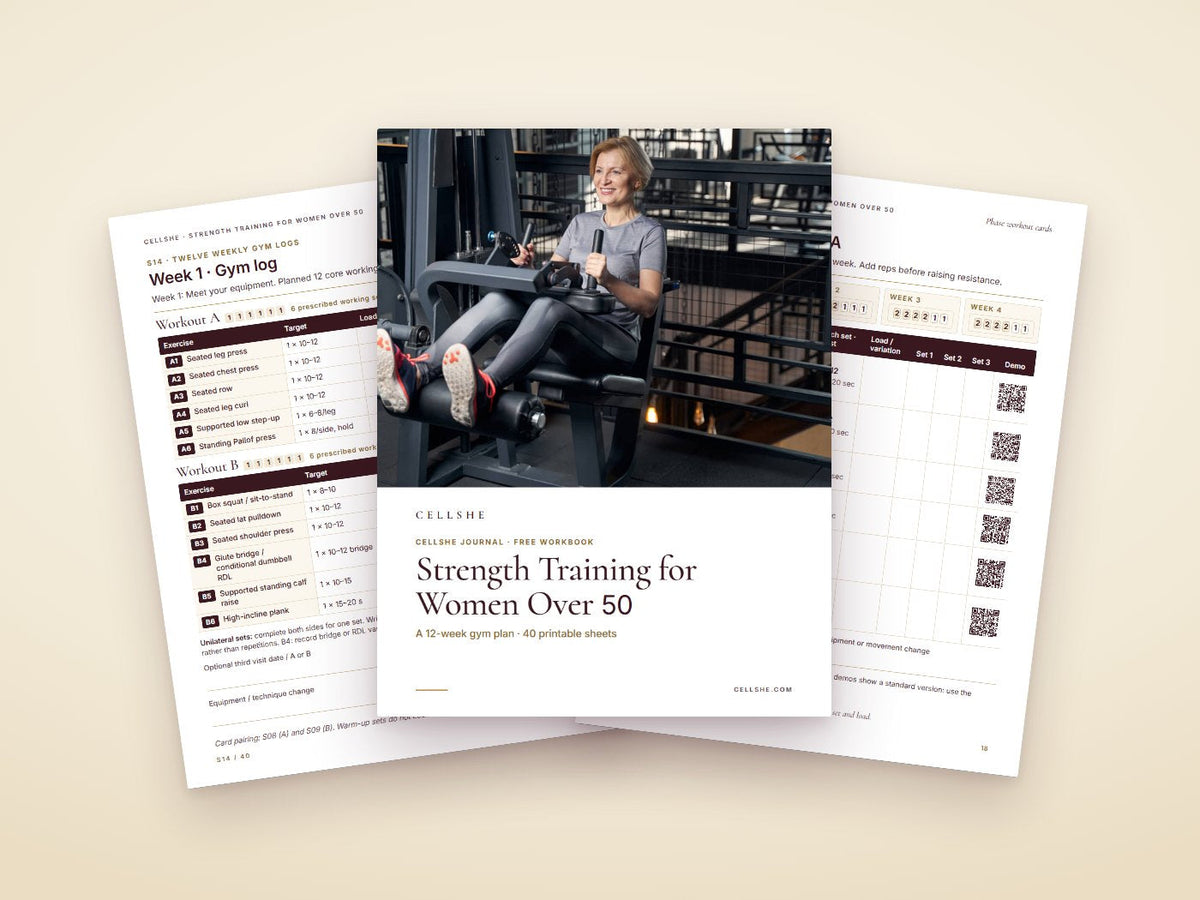
Your complete 40-sheet printable gym workbook
Take the plan to the gym
Every week: complete Workout A and Workout B on nonconsecutive days. Use that week’s exact set count from the calendar, and the repetition targets from your current phase.
Every exercise: record the actual load, repetitions and equipment setting. Increase resistance only when you can repeat the top of the range with control.
Every four weeks: compare the four anchor machines, then decide whether to progress or repeat. Short visits and adaptations count as actual work, but never as a full prescribed workout.
Printing: download the workbook below and print the sheets you need. It is free and comes in U.S. Letter and A4.
Free printable workbook

Every sheet from this plan in one PDF. Print the pages you need and take them to the gym.
PDF · 58 pages · free, no sign-up
Download the workbook (US Letter)A4 version
- Start safely · S01–S07 · 7 sheets
- Phase workout cards · S08–S13 · 6 sheets
- Twelve weekly gym logs · S14–S25 · 12 sheets
- Calendar and progression tools · S26–S30 · 5 sheets
- Short workouts and adaptations · S31–S35 · 5 sheets
- Progress checks and continuation · S36–S40 · 5 sheets
References
The 12-week schedule, exercise order, set distribution and printable worksheets are a CELLSHE synthesis. They should not be mistaken for a validated clinical protocol. Source studies vary in age, training dose, supervision and measured outcomes.
- Currier BS, D'Souza AC, Fiatarone Singh MA, et al. (2026). American College of Sports Medicine Position Stand. Resistance Training Prescription for Muscle Function, Hypertrophy, and Physical Performance in Healthy Adults: An Overview of Reviews. Medicine & Science in Sports & Exercise, 58(4), 851–872. PMID: 41843416. PubMed.
- Isenmann E, Kaluza D, Havers T, et al. (2023). Resistance training alters body composition in middle-aged women depending on menopause: A 20-week control trial. BMC Women's Health, 23, 526. PMID: 37803287. PubMed.
- Vidal-Seguel N, Sepúlveda-Lara A, Carranza-Leiva J, et al. (2026). Effects of 12 weeks resistance training on muscle quality and physical performance in normal-weight and obese older women. Frontiers in Physiology, 17, 1794580. Frontiers.
- Haugen ME, Vårvik FT, Larsen S, et al. (2023). Effect of free-weight vs. machine-based strength training on maximal strength, hypertrophy and jump performance: a systematic review and meta-analysis. BMC Sports Science, Medicine and Rehabilitation, 15, 103. PMID: 37582807. PubMed.
- Giangregorio LM, McGill S, Wark JD, et al. (2015). Too Fit To Fracture: outcomes of a Delphi consensus process on physical activity and exercise recommendations for adults with osteoporosis with or without vertebral fractures. Osteoporosis International, 26(3), 891–910. PMID: 25510579. PubMed.
- Kolasinski SL, Neogi T, Hochberg MC, et al. (2020). 2019 American College of Rheumatology/Arthritis Foundation Guideline for the Management of Osteoarthritis of the Hand, Hip, and Knee. Arthritis & Rheumatology, 72(2), 220–233. PMID: 31908163. PubMed.
- Watson SL, Weeks BK, Weis LJ, Harding AT, Horan SA, Beck BR. (2018). High-Intensity Resistance and Impact Training Improves Bone Mineral Density and Physical Function in Postmenopausal Women With Osteopenia and Osteoporosis: The LIFTMOR Randomized Controlled Trial. Journal of Bone and Mineral Research, 33(2), 211–220. PMID: 28975661. PubMed.
- Zhao F, Su W, Sun Y, et al. (2025). Optimal resistance training parameters for improving bone mineral density in postmenopausal women: a systematic review and meta-analysis. Journal of Orthopaedic Surgery and Research, 20, 523. PMID: 40420105. PubMed.
- ACE Fitness. (2025). The ACE Do It Better Series: The Romanian Deadlift. ACE Certified, May 2025. ACE.
- U.S. Department of Health and Human Services. (2018). Physical Activity Guidelines for Americans, 2nd edition. ODPHP.
This article provides general exercise education. Readers with relevant injury, fracture history, exercise restrictions or health symptoms should obtain individualized professional guidance.