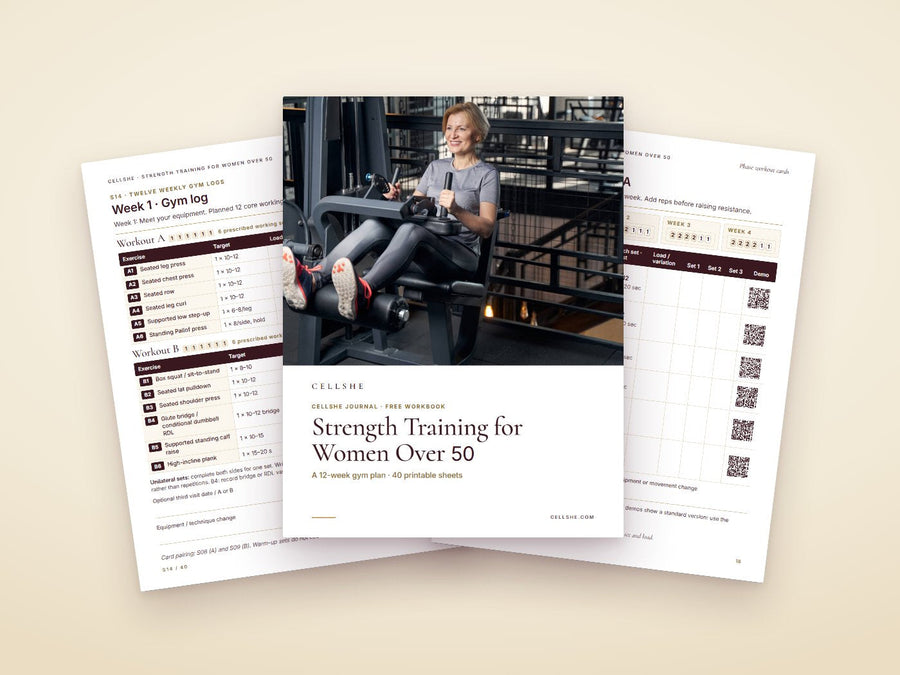

For most adults, a practical strength-training target for healthy aging is two full-body sessions per week. Give each session about 30 to 45 minutes. Train the whole body, stop most sets with 2 to 3 good reps left, and make the exercises harder as you get stronger. Keep aerobic exercise in your week too.
You do not need to hit 90 to 120 minutes. That number comes from an observational mortality study, not a training prescription. Two well-built sessions are the better practical foundation.
Why two full-body strength sessions a week?
Current U.S. and WHO guidance recommends muscle-strengthening work for all major muscle groups on at least two days each week. The 2026 American College of Sports Medicine position stand supports the same baseline. It reviewed 137 systematic reviews with more than 30,000 participants. Resistance training improved strength, muscle size, power, gait speed, balance, and several measures of physical function.[3][4][5]
Mortality studies tell a different story. They track how much people report training, then compare those habits with later deaths. They can show an association. They cannot tell us that one exact number of minutes causes a longer life.
That is why we recommend two full-body sessions per week as the foundation, not a mortality-derived stopwatch target.
CELLSHE TOOL
2 days, 30–60 minutes, or 90–119 minutes?
| Number you may see | Where it comes from | What it actually means |
|---|---|---|
| 2+ days/week | U.S. and WHO guidelines; ACSM 2026 | A practical health and strength-training baseline. |
| 30–60 min/week | 2022 observational meta-analysis, very-low-certainty mortality evidence | Pooled all-cause mortality was lowest near 40 min/week; other outcomes reached their lowest estimates around 30–60 min/week. Not a prescription. |
| 90–119 min/week | 2026 cohort of 147,374 adults | The category with the lowest all-cause mortality hazard ratio in that study. |
| CELLSHE take | Evidence synthesis | Train your whole body twice a week. Do not chase an exact mortality-derived minute target. |
The 2026 study followed 147,374 adults for up to 30 years and used repeated reports of resistance training rather than one baseline survey.[1]
| Resistance training | Hazard ratio vs. none |
|---|---|
| None | 1.00 |
| 1–29 min/week | 0.95 |
| 30–59 min/week | 0.91 |
| 60–89 min/week | 0.91 |
| 90–119 min/week | 0.87 |
| ≥120 min/week | 0.92 |
The association improved before 90 minutes. There was no sudden longevity threshold.[1]
Sources: Zhang et al. 2026 [1]; Momma et al. 2022 [2]; ACSM 2026 [3]; U.S. and WHO guidance [4][5].
Do you need 90–120 minutes of strength training a week? No.
Ninety to 120 minutes is not a required dose for longevity.
In the 2026 study, 90 to 119 minutes per week had the lowest all-cause mortality hazard ratio. It was 13% lower than the group reporting no resistance training after adjustment for aerobic activity. Training for 120 minutes or more was still linked with lower all-cause mortality, but the risk did not fall further.[1]
That does not make 120 minutes a ceiling.
The researchers did not assign people to different training plans. Participants reported their own resistance-training time. The study did not capture training load, sets, reps, or the exact length of each session. Its resistance-training measure also excluded activities such as calisthenics and Pilates.[1]
So if you already lift for three or four hours a week, this study gives you no reason to cut back. More training may serve strength, muscle, sport, or enjoyment goals that a mortality study cannot measure.
Treat 90 to 119 minutes as an interesting population finding, not a stopwatch target.
The same distinction matters when people talk about reversing aging. A shift in a biomarker or risk estimate is not the same as making a person biologically younger.
How long should a strength workout be?
For this healthy-aging plan, use about 30 to 45 minutes per full-body session.
That is a practical CELLSHE target, not an official health threshold. Current guidelines do not give a minimum number of strength-training minutes.[4][5]
Thirty to 45 minutes is long enough for the five-movement template below, including useful rest between sets. It is also short enough to fit into a normal week.
The quality of the work matters more than stretching a session to hit a target minute count.
How many days a week should you strength train?
For the strength-training part of a general-health routine, two full-body days are a strong baseline.
Two full-body sessions can train every major muscle group while leaving recovery time between sessions. ACSM's 2026 review found greater strength gains with training at least twice per week. It also found that many different resistance-training plans work.[3]
Three days can be useful if you want more training, more focus on certain muscles, or shorter sessions spread across the week.
Four or five lifting days can serve muscle, strength, sport, or enjoyment goals. Longevity alone does not require them.
CELLSHE TOOL
The CELLSHE Longevity Week
| Day | Plan |
|---|---|
| Monday | 30–45 min full-body strength |
| Tuesday | 30 min moderate aerobic activity |
| Wednesday | 30 min moderate aerobic activity |
| Thursday | 30–45 min full-body strength |
| Friday | 30 min moderate aerobic activity |
| Saturday | 60 min moderate aerobic activity |
| Sunday | Rest or easy movement |
Weekly total: 2 full-body strength sessions + 150 minutes of moderate aerobic activity.
This is one practical schedule. It is not the only good one.
U.S. and WHO guidance recommends 150 to 300 minutes of moderate aerobic activity, or 75 to 150 minutes of vigorous activity. Adults should also do muscle-strengthening work on at least two days each week.[4][5]
What counts as moderate aerobic activity?
Moderate aerobic activity means working hard enough that your breathing and heart rate increase. A simple test is whether you can talk, but not sing while doing it.[24]
Good options include brisk walking, recreational swimming, cycling on fairly level ground, dancing, water aerobics, or an elliptical.
You do not need a special cardio workout. A brisk 30-minute walk can count. Choose something you can repeat and keep the pace clearly above an easy stroll.
What counts as vigorous aerobic activity?
Vigorous activity means working harder. Your breathing becomes much faster, and you can usually say only a few words before needing a breath.[24]
Examples include running or jogging, swimming laps, fast cycling or cycling uphill, jumping rope, singles tennis, or a hard cardio class.
If you prefer harder exercise, 75 minutes of vigorous activity per week can meet the basic aerobic target instead of 150 minutes at moderate intensity. You can also mix the two. As a simple rule, one minute of vigorous activity counts roughly like two minutes of moderate activity.[4][24]
For the wider routine around movement, sleep, protein, metabolic health and other midlife basics, use CELLSHE's free Aging Well After 40 field guide.
What should a full-body strength workout include?
You do not need a bodybuilding split or a complicated program.
The 2026 ACSM review found that many resistance-training styles work. Machines are not required. Training every set to failure is not required. Complex periodization is not required for the average healthy adult.[3]
For a simple whole-body session, cover five basic movement patterns.
CELLSHE TOOL
The CELLSHE 30–45 Minute Strength Session
| Movement | Simple option | Gym or weighted option | Sets × reps |
|---|---|---|---|
| Squat / lunge | Chair squat | Goblet squat or leg press | 2 × 8–12 |
| Hip / hinge | Glute bridge | Romanian deadlift or hip thrust | 2 × 8–12 |
| Push | Incline push-up | Dumbbell or machine press | 2 × 8–12 |
| Pull | Band or backpack row | Cable or dumbbell row | 2 × 8–12 |
| Core / carry | Dead bug or plank | Loaded carry | 2 × 8–12 per side, or 20–40 sec |
Effort: Finish most sets feeling that you could still do about 2 to 3 good reps.
Rest: Take enough time to perform the next set with good form. For this template, about 1 to 3 minutes is a practical range.
Progress: When 12 reps becomes comfortable and you have more than 2 to 3 reps left, add a little resistance or use a harder version next time.
The 8-to-12 rep range is not a longevity threshold. It is a simple working range for this general-health session. ACSM's 2026 review supports multiple sets, progressive resistance, and leaving about 2 to 3 reps in reserve rather than training every set to failure.[3][6]
The five movement groups are a CELLSHE framework. U.S. guidance describes the target in muscle groups instead: legs, hips, back, abdomen, chest, shoulders, and arms.[4]
Research in older adults also shows that machines, elastic bands, and home-based resistance can all improve at least some strength or function outcomes.[19][20][21]
Strength training or cardio for longevity? Do both.
Do not replace cardio with strength training.
The best current evidence supports keeping both in your week.
In the 2026 cohort, resistance training was linked with lower mortality after accounting for aerobic exercise. But aerobic activity had a stronger mortality association when each was examined alone. The lowest risks appeared among people doing high levels of both, or very high levels of aerobic activity.[1]
A separate U.S. cohort followed more than 500,000 adults. Balanced combinations of aerobic and muscle-strengthening activity were linked with lower all-cause, cardiovascular, and cancer mortality.[7]
This matches public health guidance and the American Heart Association's position on resistance exercise. For general health, the plan includes aerobic activity and muscle strengthening.[4][5][12]
Strength training gives you adaptations cardio cannot fully replace. Cardio gives you adaptations lifting cannot fully replace.
For healthy aging, there is little value in forcing a winner.
Why strength matters beyond lifespan
A mortality hazard ratio is not the best reason to lift.
Randomized training studies give us firmer evidence about what resistance training actually changes. The 2026 ACSM review found gains in strength, muscle size, power, gait speed, balance, and physical function.[3]
Reviews in older adults, including people with frailty or sarcopenia, also report gains in strength and several measures of daily function.[13][14][15][16][17][18]
Those outcomes become more important with age.
You want enough strength to get out of a chair without using your hands. Carry a suitcase. Climb stairs. Catch yourself when you lose balance. Get down to the floor and back up.
That function-first view is also central to our guide to aging gracefully. Healthy aging is not only about adding years. It is about protecting what you can still do with them.
For the wider cellular framework, see the 12 hallmarks of aging. Our review of human NAD+ levels by age also shows why age alone does not explain every biological difference seen between older adults, including in skeletal muscle.
Grip strength and cardiorespiratory fitness are also linked with later health and mortality.[22][23]
If you want to zoom out from one exercise habit, the free Cellular Age Check reviews movement, sleep, nutrition and other healthy-aging factors. For the lab and testing side, see how biological age is actually measured.
Living longer matters. Keeping the physical ability to use those years matters too.
What should you do this week?
If you do no strength training: do one manageable full-body session. Build toward two.
If you train once a week: add a second full-body day.
If you already train twice: keep going. Focus on whole-body coverage and gradual progress.
If you already train more than two hours a week: do not cut your training because one mortality curve bottomed near 90 to 119 minutes.
And keep aerobic activity in your week.
If supplements are part of your routine, keep the hierarchy clear. Movement, sleep, nutrition and regular care remain the foundation. Our evidence-first guide to longevity supplements explains where supplements can fit without replacing those basics.
Frequently asked questions
Is 30 minutes of strength training twice a week enough?
It can be enough for the strength-training part of your week. It is not enough for your whole exercise routine.
Two good 30-minute sessions can cover the main muscle groups and meet the guideline frequency for strength work.
You still need aerobic activity. Current U.S. and WHO guidance recommends at least 150 minutes of moderate aerobic activity, 75 minutes of vigorous activity, or an equivalent mix each week, alongside strength training on at least two days.[4][5]
For longevity and general health, think strength plus cardio, not one instead of the other.
Is strength training three times a week better than twice?
It can be better if the third session adds useful training.
A third day can give you more quality sets, more focus on specific muscles, or shorter workouts spread across the week. More training volume can also produce larger strength or muscle gains when you recover well.[3][6]
Two days is the evidence-based baseline. It is not a ceiling.
What we cannot say is that moving from two sessions to three has been proven to extend life further. Longevity studies do not give us that level of precision.[1]
Do bodyweight exercises and calisthenics count as strength training?
Yes. They count when they provide enough resistance to challenge your muscles.
Push-ups, squats, lunges, pull-ups, harder bodyweight variations, bands, free weights, and machines can all be used for resistance training. The important part is that the exercise becomes challenging and can progress as you get stronger.[3]
The 2026 mortality study used a narrower definition of resistance training and did not include calisthenics.[1] That limits what we can say about its exact minute-based mortality curve. It does not mean bodyweight training lacks strength or health benefits.
Can you strength train every day?
Yes, if the program is built for it. But daily lifting is not required for longevity.
Someone training every day may split different muscles across different sessions, alternate hard and easier work, or use shorter workouts. That can be a good way to handle more total training.
What usually makes less sense is hard full-body training every day with no plan for recovery.
For general health, two to three well-designed strength sessions give most people plenty of room to improve. Train more if it supports your goals and you recover well.
Which matters more for longevity: cardio or strength training?
If you are looking only at mortality evidence, aerobic activity currently has the stronger evidence base. For healthy aging overall, do both.
In the 2026 cohort, resistance training alone was associated with about 7% to 11% lower mortality risk at the examined doses. Aerobic activity above the study's minimum threshold was associated with about 26% to 43% lower risk when examined without resistance training.[1]
That does not make strength training unimportant. It improves strength, power, muscle, and physical function. The lowest mortality risks were generally seen with high aerobic activity plus resistance training, or with very high aerobic activity.[1][3]
Do not add strength by removing cardio.
If I do 150 minutes of cardio and strength train twice a week, is that enough?
Yes. That meets the main activity baseline for adults, if the cardio is at least moderate intensity and the strength sessions train all major muscle groups.[4][5]
That makes it a very good weekly target.
It is still a baseline, not a maximum. Adults who already meet it can gain more health and fitness benefits from additional activity. U.S. and WHO guidance places the main aerobic range at 150 to 300 minutes of moderate activity, or 75 to 150 minutes of vigorous activity per week.[4][5]
You do not need to maximize every number. Consistently meeting the baseline already puts you in a strong position.
Does the recommendation change after age 65?
The same aerobic and strength baseline still applies, but balance and functional training become more important.
Adults 65 and older should continue to aim for frequent aerobic activity, and muscle strengthening on at least two days each week.[5]
WHO also recommends multicomponent activity that emphasizes balance and strength on three or more days per week to support physical function and reduce fall risk.[5]
That does not mean three hard lifting sessions are required. Strength work, balance exercises, and other mixed activities can make up those additional days.
Scientific references
- Zhang Y, Lee DH, Rezende LFM, Ma Y, Giovannucci E. Long-term resistance training with all-cause and cause-specific mortality: assessing dose-response and joint associations with aerobic physical activity. British Journal of Sports Medicine. 2026;60(12):874–883. PMID: 42230125. Full text.
- Momma H, Kawakami R, Honda T, Sawada SS. Muscle-strengthening activities are associated with lower risk and mortality in major non-communicable diseases: a systematic review and meta-analysis of cohort studies. British Journal of Sports Medicine. 2022;56(13):755–763. PMID: 35228201. Full text.
- Currier BS, et al. American College of Sports Medicine Position Stand. Resistance Training Prescription for Muscle Function, Hypertrophy, and Physical Performance in Healthy Adults: An Overview of Reviews. Medicine & Science in Sports & Exercise. 2026;58(4):851–872. PMID: 41843416. Full text.
- Piercy KL, et al. The Physical Activity Guidelines for Americans. JAMA. 2018. PMID: 30418471. Full text.
- Bull FC, et al. World Health Organization 2020 guidelines on physical activity and sedentary behaviour. British Journal of Sports Medicine. 2020;54(24):1451–1462. PMID: 33239350. Full text.
- Currier BS, et al. Resistance training prescription for muscle strength and hypertrophy in healthy adults: a systematic review and Bayesian network meta-analysis. British Journal of Sports Medicine. 2023. PMID: 37414459. Full text.
- López-Bueno R, Ahmadi MN, Stamatakis E, Yang L, del Pozo Cruz B. Prospective Associations of Different Combinations of Aerobic and Muscle-Strengthening Activity With All-Cause, Cardiovascular, and Cancer Mortality. JAMA Internal Medicine. 2023;183(9):982–990. PMID: 37548973. Full text.
- Garcia L, et al. Non-occupational physical activity and risk of cardiovascular disease, cancer and mortality outcomes: a dose-response meta-analysis of large prospective studies. British Journal of Sports Medicine. 2023;57(15):979–989. PMID: 36854652. Full text.
- Shailendra P, et al. Weight training and risk of all-cause, cardiovascular disease and cancer mortality among older adults. International Journal of Epidemiology. 2024;53(3):dyae074. PMID: 38831478. Full text.
- Rahmati M, et al. Associations Between Exercise Training, Physical Activity, Sedentary Behaviour and Mortality: An Umbrella Review of Meta-Analyses. Journal of Cachexia, Sarcopenia and Muscle. 2025;16(2):e13772. PMID: 40042073. Full text.
- Yu R, et al. Physical activity trajectories and accumulation over adulthood and their associations with all-cause and cause-specific mortality: a systematic review and meta-analysis. British Journal of Sports Medicine. 2025;59(17):1228–1241. PMID: 40639966. Full text.
- Paluch AE, et al. Resistance Exercise Training in Individuals With and Without Cardiovascular Disease: 2023 Update. Circulation. 2024;149(3):e217–e231. PMID: 38059362. Full text.
- Borde R, Hortobágyi T, Granacher U. Dose-Response Relationships of Resistance Training in Healthy Old Adults: A Systematic Review and Meta-Analysis. Sports Medicine. 2015;45(12):1693–1720. PMID: 26420238. Full text.
- Chen N, et al. Effects of resistance training in healthy older people with sarcopenia: a systematic review and meta-analysis of randomized controlled trials. European Review of Aging and Physical Activity. 2021. PMID: 34763651. Full text.
- Talar K, et al. Benefits of Resistance Training in Early and Late Stages of Frailty and Sarcopenia: A Systematic Review and Meta-Analysis of Randomized Controlled Studies. Journal of Clinical Medicine. 2021;10(8):1630. PMID: 33921356. Full text.
- Yan R, et al. Optimal resistance training prescriptions to improve muscle strength, physical function, and muscle mass in older adults diagnosed with sarcopenia: a systematic review and meta-analysis. Aging Clinical and Experimental Research. 2025;37(1):320. PMID: 41212331. Full text.
- Šarabon N, Kozinc Ž, Löfler S, Hofer C. Resistance Exercise, Electrical Muscle Stimulation, and Whole-Body Vibration in Older Adults: Systematic Review and Meta-Analysis of Randomized Controlled Trials. Journal of Clinical Medicine. 2020;9(9):2902. PMID: 32911822. Full text.
- González-Rocha A, et al. Effect of Exercise on Muscle Mass, Fat Mass, Bone Mass, Muscular Strength and Physical Performance in Community-Dwelling Older Adults: Systematic Review and Meta-Analysis. Aging and Disease. 2022;13(5):1421–1435. PMID: 36186132. Full text.
- Kirk A, Steele J, Fisher JP. Machine-Based Resistance Training Improves Functional Capacity in Older Adults: A Systematic Review and Meta-Analysis. Journal of Functional Morphology and Kinesiology. 2024;9(4):239. PMID: 39584892. Full text.
- Meng Y, et al. Effects of elastic band resistance training on lower limb strength and balance function in older adults: a systematic review and meta-analysis. Frontiers in Sports and Active Living. 2025;7:1649305. PMID: 41278596. Full text.
- Mañas A, et al. Unsupervised home-based resistance training for community-dwelling older adults: a systematic review and meta-analysis of randomized controlled trials. Ageing Research Reviews. 2021;69:101368. PMID: 34022464. PubMed.
- Kim Y, et al. The combination of cardiorespiratory fitness and muscle strength, and mortality risk. European Journal of Epidemiology. 2018;33(10):953–964. PMID: 29594847. Full text.
- Soysal P, et al. Handgrip strength and health outcomes: Umbrella review of systematic reviews with meta-analyses of observational studies. Journal of Sport and Health Science. 2021;10(3):290–295. PMID: 32565244. Full text.
- Centers for Disease Control and Prevention. How to Measure Physical Activity Intensity. Updated December 4, 2025. CDC.