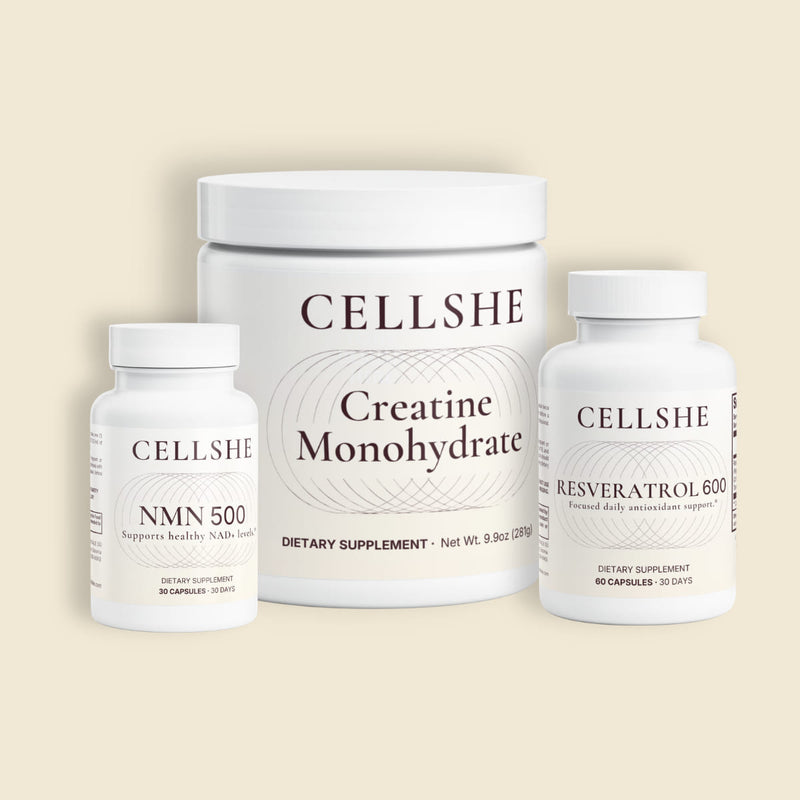

For women in midlife, some longevity supplements are worth considering, but for different reasons.
- Strength and muscle: creatine monohydrate has direct postmenopausal evidence, especially alongside resistance training.[1]
- NAD+ support: NMN is a human-studied NAD+ precursor, with a randomized metabolic result in postmenopausal women.[2][3]
- Oxidative stress and blood-vessel function: resveratrol has a substantial human evidence base and direct postmenopausal research.[4][5][14]
- EPA/DHA and cardiometabolic context: omega-3 can be useful when the reason matches the population and endpoint studied.[7]
- Vitamin D: treat it as a nutrient and clinical-context decision, not a generic anti-aging add-on.[9]
The word longevity does not tell you which of those jobs a supplement can do. A better decision starts with one question: what do I want this supplement to support in my life now?
That question matters because a longevity shelf mixes ingredients that answer separate questions. A strength supplement, an NAD+ precursor, a plant polyphenol, a fatty acid, and a vitamin each need to earn their place through their own job.
Human lifespan extension is not an established result for the over-the-counter supplements discussed here. Current longevity research is much more useful when it tells us what people can measure now: strength, lean mass, insulin sensitivity, blood-vessel function, nutrient adequacy, cardiovascular outcomes, or a biological marker.[11]
CELLSHE TOOL
Translate the Longevity Claim Before You Buy
| The label says | Ask instead | Evidence that would answer it |
|---|---|---|
| “Healthy aging” | Which part of healthy aging? | Strength, physical function, cognition, vascular function, nutrient status, or another named outcome. |
| “Cellular energy” | Which human pathway or function changes? | A measured human target such as NAD-related biology, followed by any separate functional outcome the trial actually tested. |
| “Brain health” | Was cognition measured, or only a related marker? | Memory, cognitive performance, brain blood-flow response, or another clearly named human endpoint. |
| “Supports longevity pathways” | Has the pathway translated into a human result? | A randomized human outcome matters more for a buying decision than a mechanism alone. |
| “Clinically studied” | Was this ingredient, form, and amount actually studied? | A study that matches the active ingredient closely enough to support the claim being made. |
| “For women 40+” | Were women in this life stage studied directly? | Women-specific trials or syntheses when they exist, with broader human evidence used for the questions it can answer. |
CELLSHE synthesis. The evidence standard follows the same human-first approach used in the CELLSHE Supplement Guides for Women.
Which longevity supplements are worth considering in midlife?
The useful answer depends on the job. These five categories cover most of the questions a woman in her 40s, 50s, or 60s is likely to be trying to solve.
Creatine: when the goal is strength and physical reserve
Creatine monohydrate is worth considering when strength, muscle, and repeated hard efforts matter to you. This is a healthy-aging reason, not only a sports reason.
A 2026 meta-analysis combined seven randomized trials in 608 postmenopausal women. Creatine produced small average gains in lean mass and a clearer improvement in leg-press strength. The favorable pattern was strongest when creatine was paired with resistance training.[1]
That gives creatine a very practical place in midlife: it can support the training that helps preserve physical capacity. The full Creatine for Women guide covers the women-specific trials, 3 to 5 g daily maintenance approach, water-weight questions, kidney labs, safety, menopause, and creatine forms.
NMN: when the goal is NAD+ support
NMN is worth considering when supporting NAD+ biology is the reason you are interested in a cellular-health supplement. Across human NAD+-precursor trials, raising NAD+ or related metabolites is the most consistent biological result, which gives NMN a clear cellular-health job.[3]
Women also have direct evidence. In a randomized trial of postmenopausal women with overweight or obesity and prediabetes, NMN improved skeletal-muscle insulin sensitivity and related muscle signaling after 10 weeks.[2] That is a meaningful women-specific result in the population that was studied.
The CELLSHE NMN for Women guide maps the full evidence hierarchy, including the three published women-specific intervention studies, the wider human trial base, doses used in research, menopause context, safety, and how to choose an NMN product.
Resveratrol: when the goal is vascular and polyphenol support
Resveratrol is worth considering when you want a well-studied polyphenol with human research on oxidative-stress markers and repeat evidence for blood-vessel function.[13][14] A 2026 umbrella review covered 45 systematic reviews and 68 health outcomes, with stronger evidence in some cardiometabolic settings and supportive evidence across several other human outcomes.[4]
Postmenopausal women also have direct research for a healthy-aging supplement. A 14-week randomized trial found better cerebrovascular responsiveness in 80 postmenopausal women, with improvements in selected cognitive measures. A longer crossover study in 125 women added further cerebrovascular and cognitive findings.[5][6]
The Resveratrol for Women guide handles the decision in full, including the postmenopausal research program, trans-resveratrol, dosage context, safety, medication questions, PCOS, fertility, and the distinction between extract weight and actual trans-resveratrol.
Omega-3: when the goal is EPA/DHA intake or cardiometabolic support
Omega-3 is worth considering when the reason is nutritional or cardiometabolic, rather than simply because it appears on a longevity list. Large randomized evidence shows that the answer changes with population, formulation, and endpoint.
In VITAL, 1 g/day of marine omega-3 did not significantly reduce the primary composite cardiovascular endpoint in a general U.S. population that was not selected for high cardiovascular risk.[7] Other trial evidence supports narrower cardiovascular uses, and omega-3 remains an established way to provide EPA and DHA when intake is low.
The DO-HEALTH trial also gave omega-3 a newer longevity headline: 1 g/day produced small favorable changes in several DNA-methylation aging measures over three years.[8] Those clock results are interesting, but they are best read alongside the cardiovascular and nutrition evidence rather than as a replacement for it.
Vitamin D: when the goal is a real vitamin D decision
Vitamin D is valuable when age, intake, deficiency risk, bone health, or another clinical reason makes it relevant. That is a stronger reason than buying it because the bottle uses the word longevity.
The Endocrine Society's current prevention guideline suggests against routine vitamin D intake above the Dietary Reference Intake, solely to prevent disease in healthy adults (younger than 75) who do not already have an indication for treatment.[9] For women over 50, the practical nutrient decision also includes calcium, B12, iron, magnesium, diet, medications, and individual risk. CELLSHE's Vitamins & Supplements for Women Over 50 owns that broader nutrient question.
CELLSHE DECISION SHEET
Before You Spend $50 a Month on a Longevity Supplement
-
What job do I want this supplement to do?
Write one outcome: strength, NAD+ support, blood-vessel function, nutrient adequacy, triglycerides, cognition, or another clear goal. -
What human evidence supports that job?
Name the endpoint the study measured. A mechanism can be useful. Keep it separate from the human outcome you actually want. -
Who was studied?
Check sex, age, menopause status, health condition, and training status when they could change the answer. -
Does the bottle match the evidence I am relying on?
Check the active ingredient, form, daily amount, and whether a proprietary blend hides the number you need. -
How will I judge whether this still deserves a place in my routine?
Choose the relevant measure or reason before you buy, then review it on a timeline that matches the evidence or your clinician's plan.
If those answers are clear, you have a reasoned supplement decision. If one is missing, that is the information to find before the word “longevity” influences the purchase.
CELLSHE synthesis. For medication and supplement safety, keep a complete list and review relevant combinations with a clinician or pharmacist.[12]
What about collagen, CoQ10, spermidine, urolithin A, and other longevity ingredients?
They belong to narrower or earlier questions. Collagen is mainly a structural-health ingredient. CoQ10 has useful evidence in selected clinical contexts. Urolithin A, spermidine, taurine, GlyNAC, fisetin, and other geroscience compounds range from early human trials to predominantly preclinical research.
The narrower and emerging compounds are better handled as a sequencing question. If you are deciding how established and emerging ingredients fit into a broader routine, CELLSHE's Longevity Stack covers that job. That page owns what to build first, what to add later, what is needs-based, and what belongs on the watchlist.
Where should a midlife woman start?
- Creatine, NMN, or resveratrol as a single-ingredient decision: choose the relevant flagship from the Supplement Guides for Women.
- Vitamins, minerals, and nutrient priorities after 50: use Vitamins & Supplements for Women Over 50.
- Hot flashes, sleep, weight, or other perimenopause-specific supplement questions: use Perimenopause Supplements.
- How several supplements and healthy-aging foundations fit together: use the Longevity Stack.
That division keeps the choice simple. Give each supplement one clear job, then judge it against the evidence for that job.
Frequently asked questions
What is the best longevity supplement?
There is no single best supplement for every longevity goal. For a midlife woman, creatine is highly relevant to strength and muscle, NMN to NAD+ support, resveratrol to oxidative stress and blood-vessel function, omega-3 to EPA/DHA and cardiometabolic context, and vitamin D to a real nutrient or clinical need. Choose by the job you want done.
Do longevity supplements actually make you live longer?
Human lifespan extension has not been established for the over-the-counter supplements in this article. Their value comes from narrower human outcomes that can still matter for healthy aging, such as strength, vascular function, nutrient adequacy, or a defined biological pathway.[11]
Are longevity supplements different for women?
For women, the evidence base can change the decision even when the ingredient itself is the same. Creatine, NMN, and resveratrol all have direct research in women that helps answer midlife questions more precisely. The relevant life stage and health context still matter.
Should I take several longevity supplements together?
That becomes a stack and sequencing question rather than a single-supplement evidence question. Use the dedicated Longevity Stack guide for that decision.
How do I know if a longevity supplement is worth the money?
You should be able to name the goal, the human endpoint, the population studied, and the active ingredient on the label. If those four pieces line up, the purchase has a clear evidence-based reason.
Use longevity as a goal, not as a label
The most useful longevity supplements are the ones you can describe without using the word longevity.
Creatine can support strength and muscle-focused training. NMN can support NAD+ biology. Resveratrol has human vascular and oxidative-stress evidence with useful postmenopausal research. Omega-3 and vitamin D earn their place through nutrition and clinical context.
Once the job is clear, the decision gets much easier. And when you need the deeper answer, use the dedicated guide rather than asking one broad article to become five different articles at once.
Scientific references
- Naddafha S, Antonio J, Kreider RB, Stout JR. Creatine monohydrate for lean mass, strength, and bone density in postmenopausal women: a systematic review and meta-analysis. Journal of the International Society of Sports Nutrition. 2026. PMID: 42141930. DOI: 10.1080/15502783.2026.2668435. PubMed.
- Yoshino M, et al. Nicotinamide mononucleotide increases muscle insulin sensitivity in prediabetic women. Science. 2021;372(6547):1224-1229. PMID: 33888596. DOI: 10.1126/science.abe9985. PubMed.
- Freeberg KA, Udovich CC, Martens CR, Seals DR, Craighead DH. Dietary Supplementation With NAD+-Boosting Compounds in Humans: Current Knowledge and Future Directions. Journals of Gerontology Series A. 2023;78(12):2435-2448. PMID: 37068054. DOI: 10.1093/gerona/glad106. PubMed.
- Sun JN, Yang R, Fang L, et al. Effects of resveratrol supplementation on multiple health outcomes: an umbrella review of systematic reviews and meta-analyses of randomized controlled trials. Nutrition Journal. 2026;25(1):63. PMID: 41987155. DOI: 10.1186/s12937-026-01319-5. PubMed.
- Evans HM, Howe PRC, Wong RHX. Effects of Resveratrol on Cognitive Performance, Mood and Cerebrovascular Function in Post-Menopausal Women; A 14-Week Randomised Placebo-Controlled Intervention Trial. Nutrients. 2017;9(1):27. PMID: 28054939. DOI: 10.3390/nu9010027. PubMed.
- Zaw JJT, Howe PRC, Wong RHX. Long-term effects of resveratrol on cognition, cerebrovascular function and cardio-metabolic markers in postmenopausal women: a 24-month randomised, double-blind, placebo-controlled, crossover study. Clinical Nutrition. 2021;40(3):820-829. PMID: 32900519. DOI: 10.1016/j.clnu.2020.08.025. PubMed.
- Manson JE, Cook NR, Lee IM, et al. Marine n-3 Fatty Acids and Prevention of Cardiovascular Disease and Cancer. New England Journal of Medicine. 2019;380(1):23-32. PMID: 30415637. DOI: 10.1056/NEJMoa1811403. PubMed.
- Bischoff-Ferrari HA, Gängler S, Wieczorek M, et al. Individual and additive effects of vitamin D, omega-3 and exercise on DNA methylation clocks of biological aging in older adults from the DO-HEALTH trial. Nature Aging. 2025;5(3):376-385. PMID: 39900648. DOI: 10.1038/s43587-024-00793-y. PubMed.
- Demay MB, Pittas AG, Bikle DD, et al. Vitamin D for the Prevention of Disease: An Endocrine Society Clinical Practice Guideline. Journal of Clinical Endocrinology & Metabolism. 2024;109(8):1907-1947. PMID: 38828931. DOI: 10.1210/clinem/dgae290. PubMed. The guideline was corrected after publication; see the 2025 correction clarifying recommendations for adults under 75: PMID 40464739.
- Sehgal A, et al. Responsiveness of epigenetic aging biomarkers to longevity interventions in humans. Nature Medicine. 2026;32:3477-3490. DOI: 10.1038/s41591-026-04562-9. Nature Medicine.
- Yu D, et al. Bridging expectations and science: a roadmap for the future of longevity interventions. Biogerontology. 2025;26(4):138. PMID: 40591010. DOI: 10.1007/s10522-025-10278-z. PubMed.
- National Institute on Aging. Taking Medicines Safely as You Age. Current public-health guidance on medicines and supplement interactions. National Institute on Aging.
- Omidian M, Abdolahi M, Daneshzad E, et al. The Effects of Resveratrol on Oxidative Stress Markers: A Systematic Review and Meta-Analysis of Randomized Clinical Trials. Endocrine, Metabolic & Immune Disorders - Drug Targets. 2020;20(5):718-727. PMID: 31738139. DOI: 10.2174/1871530319666191116112950. PubMed.
- Mohammadipoor N, Shafiee F, Rostami A, et al. Resveratrol supplementation efficiently improves endothelial health: A systematic review and meta-analysis of randomized controlled trials. Phytotherapy Research. 2022;36(9):3529-3539. PMID: 35833325. DOI: 10.1002/ptr.7562. PubMed.