In plain terms: “NAD” is the shorthand; NAD+ and NADH are two working forms of the very same molecule. NAD+ is the “empty” oxidized form that accepts energy; NADH is the “loaded” reduced form that carries it.
Your cells convert one into the other constantly to turn food into usable energy. So they are not three rival ingredients, they are one coenzyme described at three levels of precision.
Below: what each term means, how NAD+ and NADH differ, what the human research actually shows about raising blood NAD+, and how to think about the supplements built around it, written for readers who want the science without the hype.
Key takeaways
-
NAD is the umbrella name; NAD+ and NADH are the same molecule in two states, cycling back and forth as cells make energy.
- NAD+ is the form that powers hundreds of cellular reactions; NADH is the electron-carrying partner it becomes and then turns back into.
- The human evidence on raising blood NAD+ is concentrated on precursors taken by mouth, NMN and nicotinamide riboside (NR); intact NAD+ and NADH are also sold directly, but with thinner human evidence for raising blood NAD+.
NAD vs NAD+ vs NADH at a glance
|
NAD |
NAD+ |
NADH |
| What it is |
Shorthand for the coenzyme nicotinamide adenine dinucleotide, in either state |
The oxidized (“empty”) form that accepts electrons |
The reduced (“loaded”) form that carries electrons |
| Main role |
Umbrella term for the whole redox pair |
Drives 500+ reactions, including how mitochondria release energy |
Delivers electrons into the energy-producing chain, becoming NAD+ again |
| Charge state |
Either, depends which form you mean |
Oxidized |
Reduced |
| How the body gets it |
Built inside cells from precursors and recycled continuously |
Made from precursors like NMN and NR; regenerated from NADH |
Formed when NAD+ picks up electrons during metabolism |
| What supplements target |
n/a |
Raised indirectly via oral precursors (NMN, NR) |
Sold directly as NADH, but with far less human evidence behind it |
What is NAD+?
NAD+ (nicotinamide adenine dinucleotide) is a coenzyme found in every living cell. It acts like a shuttle, accepting and passing electrons between reactions, and it is required for hundreds of processes, most famously the way your mitochondria turn food into usable energy. When people talk loosely about “NAD,” this active, oxidized form is usually what they mean. For the full picture, our guide to what NAD+ is and what it does → goes deeper.
What is NADH?
NADH is simply NAD+ after it has picked up electrons, the reduced, “charged” version of the same molecule. During metabolism, NAD+ collects electrons from the food you break down and becomes NADH. NADH then hands those electrons into the mitochondrial chain that produces energy, and reverts to NAD+ to go again.
The two are partners in a loop, not competitors. You may also see NADH sold on its own as a supplement, which is a different proposition from the precursor approach most of the human research has followed.
So what’s the difference between NAD+ and NADH?
The cleanest way to hold it: NAD+ is the empty carrier; NADH is the full one. Picture a single rechargeable battery. NAD+ is that battery discharged and ready to take a charge; NADH is the same battery loaded and carrying it. Cells flip between the two states continuously as they release energy, so at any moment your body holds a mix of both, and the balance between them is part of how metabolism is regulated.
That is why “NAD+” and “NADH” are not interchangeable on a label even though they are the same underlying coenzyme. One is the form doing the accepting; the other is the form doing the carrying. Naming the state is the whole point, it tells you which half of the cycle a product or a study is talking about.
Can you raise blood NAD+ by taking NADH, or a precursor?
This is where the practical question lives, and where the honest answer matters. The best-studied way people influence their NAD+ is by taking a precursor, a raw material cells use to build NAD+.
In a 2023 randomized, dose-ranging trial in healthy middle-aged adults, oral NMN was well tolerated up to 900 mg per day and raised blood NAD+ concentrations (GeroScience). A separate 2023 placebo-controlled, double-blind trial in adults aged 55 to 70 tested NMN at a fixed dose: whole-blood NAD+ was markedly higher at 500 mg per day than on placebo (Aging Cell). A 2018 randomized trial found the precursor nicotinamide riboside (NR) raised blood NAD+ by roughly 60% in middle-aged and older adults (Nature Communications).
In that 2018 trial, a precursor taken by mouth raised blood NAD+ by about 60%, by giving the body more of the material it uses to build NAD+.
Intact NADH and intact NAD+ are also sold, but a systematic review of NAD in humans found no good evidence that intact NAD+ taken by mouth meaningfully raises blood NAD+ (American Journal of Physiology: Endocrinology and Metabolism). That is why most researchers and formulators work with precursors like NMN and NR when the goal is raising blood NAD+.
The wider field is still developing. Much of the strongest human data comes from short trials in specific groups, so the honest frame is a promising, evidence-informed area of nutrition rather than a finished story.
Why the NAD+ conversation comes up in midlife
NAD+ availability is one of the reasons “cellular energy” became a focus of healthy-aging research in the first place, and it is the reason precursors get so much attention from women in their 40s through 60s who are thinking about a daily, evidence-informed routine. That is the audience CELLSHE was built for, not as a treatment for anything, but as a clean, premium way to support cellular energy* and healthy aging pathways* as part of an ordinary daily habit. If you are weighing the two most-studied precursors against each other, our NMN vs NR breakdown → and the broader guide to NAD+ supplements → both go further. Explore the full NMN evidence in our NMN for Women guide.
What NAD+ and NADH supplements will not do
- They will not halt or undo the aging process, and they are not a fountain of youth.
- They are dietary supplements, not medicines, and they are not a substitute for medical care.
- They are not a fast fix; any effect is gradual, and no honest brand can promise a specific outcome.
- They will not replace good food, sleep, movement, or your clinician’s advice, especially if you take medication. Human research here is promising but still developing, and much of the strongest data comes from short trials in specific groups.
Where CELLSHE fits
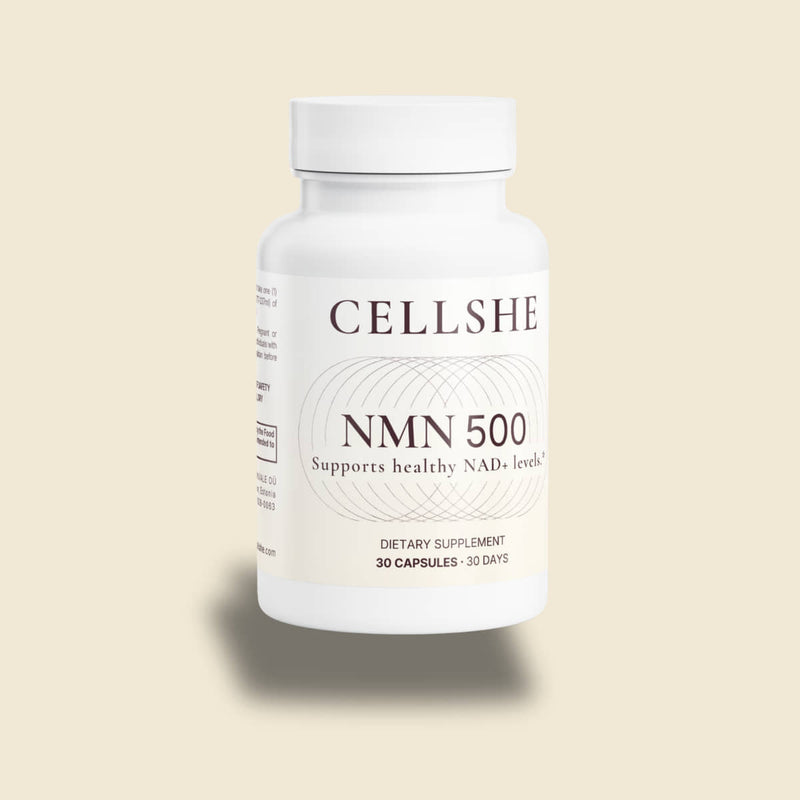
The clearest human blood-NAD+ data today sits with precursors, so if raising blood NAD+ is your goal, NMN is the evidence-led place to start. NMN 500 → is our straightforward daily NMN, formulated to support NAD+ biosynthesis.* It states the dose and form plainly, is third-party tested, and has a Certificate of Analysis available on the product page or on request.
Not sure where to begin? Our free Cellular Age Check is a simple 2-minute starting point: take the free Cellular Age Check →
The simplest rule: name the state, then follow the evidence
NAD, NAD+, and NADH get blurred together, which is where confusion, and marketing, sneak in. The fix is a one-step habit: name the exact state first, then ask what the human evidence says about that specific thing.
-
NAD+ is the oxidized, working form of the coenzyme.
-
NADH is its reduced partner; the two convert back and forth as cells run energy reactions.
-
NAD is just the umbrella term for the pair.
Once you have named the state, the evidence gets clearer. The human trials that raise blood NAD+ used precursors like NMN and NR (PMID 36482258, PMID 29599478), not swallowed NAD+ or NADH. So if raising NAD+ is the goal, a precursor is the evidence-led place to start.
NAC is a different molecule altogether, despite the similar name. Our NAD+ vs NAC guide explains the difference.
Frequently asked questions
Is NAD the same as NAD+?
Mostly, yes, “NAD” is a shorthand for the coenzyme, and in everyday use it usually means the active, oxidized form written NAD+. Strictly, NAD refers to the molecule in either state, while NAD+ names the specific oxidized form.
What is the difference between NAD+ and NADH?
They are the same coenzyme in two states. NAD+ is the oxidized form that accepts electrons; NADH is the reduced form that carries them. Cells convert one into the other continuously as they release energy from food.
Is NADH better than NAD+ to take as a supplement?
The human research on raising blood NAD+ has mostly used precursors like NMN and nicotinamide riboside rather than NADH or NAD+ taken directly. Evidence for oral NADH specifically is thinner, so it is not clearly “better,” and there is no single correct choice, it is sensible to talk to your clinician about what fits you.
Does taking a precursor raise blood NAD+ levels?
In several randomized human trials, oral NMN and nicotinamide riboside were absorbed and raised blood NAD+ levels, one trial reported roughly a 60% increase. The studies are short and in specific groups, so the science is still developing.
What is NADH used for in the body?
NADH carries the electrons collected during metabolism into the mitochondrial chain that produces cellular energy, and in doing so converts back into NAD+. It is a normal, essential part of how every cell turns food into usable energy.
References
- Yi L, et al. (2023). The efficacy and safety of β-nicotinamide mononucleotide (NMN) supplementation in healthy middle-aged adults: a randomized, multicenter, double-blind, placebo-controlled, dose-dependent clinical trial. GeroScience. PMID: 36482258. pubmed.ncbi.nlm.nih.gov/36482258
- Wang P, et al. (2023). Fingerstick blood assay maps real-world NAD+ disparity across gender and age (includes a placebo-controlled 500 mg NMN trial in adults aged 55 to 70). Aging Cell. PMID: 37641521. pubmed.ncbi.nlm.nih.gov/37641521
- Martens CR, et al. (2018). Chronic nicotinamide riboside supplementation is well-tolerated and elevates NAD+ in healthy middle-aged and older adults. Nature Communications. PMID: 29599478. pubmed.ncbi.nlm.nih.gov/29599478
- Nadeeshani H, et al. (2024). Evaluation of safety and effectiveness of NAD in different clinical conditions: a systematic review. American Journal of Physiology: Endocrinology and Metabolism. PMID: 37971292. pubmed.ncbi.nlm.nih.gov/37971292