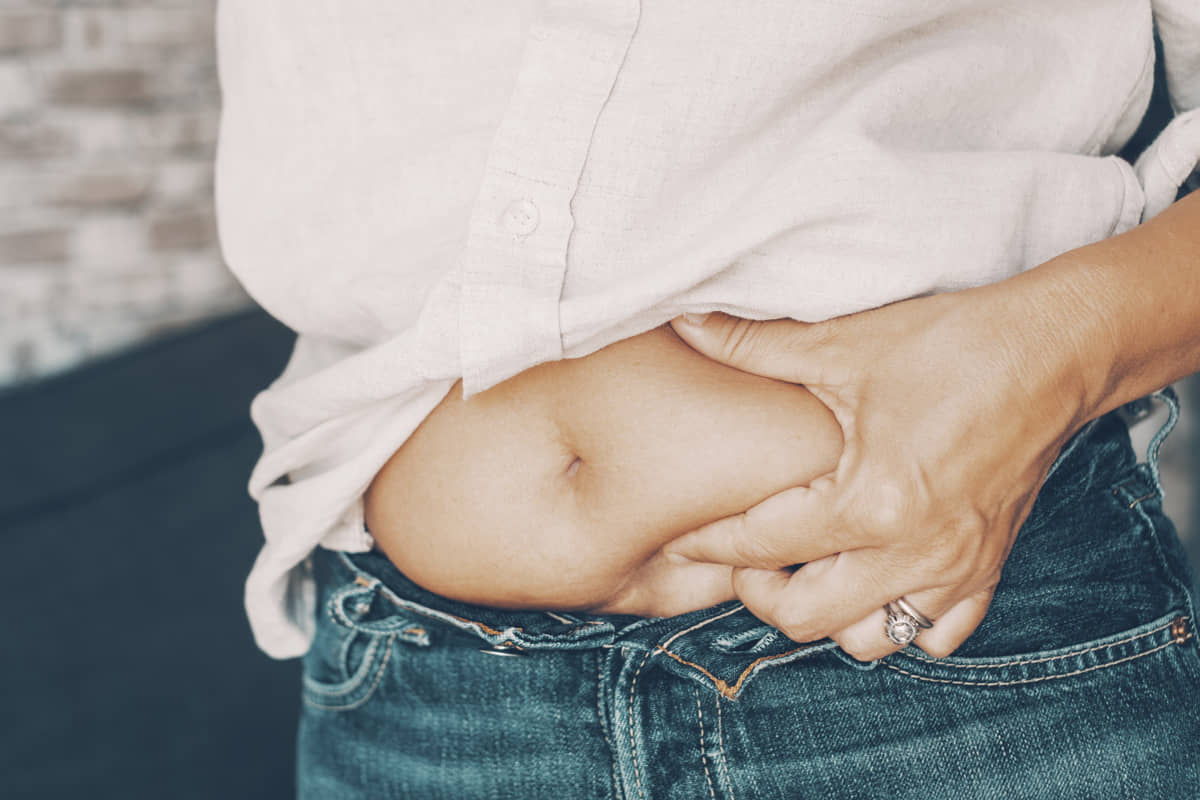
Menopause belly fat comes off with a gradual calorie deficit and regular movement: in a year, that mix took nearly 3 inches off postmenopausal women's waists.[1] Start by cutting added sugar, begin with a 300-calorie daily deficit, and walk twice a week. Crunches won't burn belly fat, but cardio and a registered dietitian on your side will help.
Key takeaways
- Falling estrogen moves fat to your belly: deep belly fat rises about 6% a year in the transition, while the scale barely moves.
- Start with one swap, cutting added sugar, then build a deficit from 300 to 500 calories a day.
- Crunches don't burn belly fat. Prioritize cardio: two walks and a short strength session a week is a good start.
- A registered dietitian is a better investment than weight-loss pills.
- Track what you eat and your sessions, and measure yourself instead of weighing.
- Missed a week? Find the cause, adjust, and show up today.
I've heard it so many times, from men and women alike: with age, you put on weight, and it's hard to lose. Almost like it's fate. For many women, it starts with the pregnancy weight that's hard to shed after giving birth. And that's often what starts a positive rethink of how they move and eat.
It doesn't have to be fate: changing how you eat and move can prevent midlife weight gain.[2]
The belly is usually the spot that makes people most self-conscious, so much that it becomes the obsession behind every program or workout. Don't fall into the trap of doing only ab workouts to lose belly fat. Unfortunately, that myth is still going strong.
What causes menopause belly fat?
Age decides how much fat you gain. Falling estrogen decides where it goes.[3]
During the menopause transition, fat gain nearly doubles and muscle starts to drop, while the scale moves only about half a pound a year.[4] Deep belly fat, the kind around your organs, starts rising by about 6% a year.[5]
So if your shape changes while the scale stays put, you're not doing anything wrong.
Before you focus on a number on the scale, the most important thing is to get back to healthy daily habits. If you start a sport, or a program with a personal trainer, the first goal is to have fun and enjoy what you're doing. Same with food: rebalance with foods you like, and make the changes very gradually. One thing at a time. From there, your shape can change. What we encourage instead is your energy, how you feel day to day, your fitness and your mental well-being. The number on the scale comes after all that.
Is it fat or bloating?
Bloating is common. Here's how to tell the two apart. Fat stays the same from morning to night. Bloating comes and goes, and can swell the belly by up to 4.7 inches in a single day.[6] Flatter in the morning, bigger by evening? That's bloating.
See your doctor if your bloating is new, is there more than 12 days a month, or comes with feeling full quickly, pelvic pain or needing to pee urgently.[7]
How do you get rid of menopause belly?
Food does what's needed. It's a weight-loss job: a controlled, gradual calorie deficit, combined with regular physical activity. Nothing new under the sun, really, menopause or not. In postmenopausal women, diet and exercise together took off almost 20 lb and nearly 3 inches from the waist in a year.[1]
Don't overdo the deficit. I'd rather see a woman start at 300 calories a day, then move up to 400 and then 500, than go straight to 500 and quit a few weeks later. Push too hard and you get too tired, and your metabolism takes too violent a shock.
Get help: a personal trainer and a registered dietitian, or any clinician who can refer you to the right professional. Even your physician can help you get started.
What foods are bad for menopause belly?
The ultimate swap is to cut every source of added sugar. Look at what you eat and get rid of the sugary snacks, the ultra-processed junk: sweet bars, soda and the rest. Sugary drinks add deep belly fat.[8] If you crave sugar at first, eat fruit instead. That's already better. Next step: healthy savory snacks with protein, like a piece of hard cheese with whole-grain bread. In short, cut all the added sugar you can. That swap alone gets things moving, before you really tackle what's on your plate.
For the plate itself, there's a lot of evidence, and there are guidelines for all of it. Protein is 1.2 to 1.6 g per kg of body weight a day (about 0.5 to 0.7 g per pound).[9] Carbs have reference values too. Honestly, there's no need to reinvent the wheel for menopause.
What I recommend is paying closer attention to the foods that bloat you. Start by cutting ultra-processed foods and very rich dishes, like slow-cooked dishes in sauce. Your digestion will handle them better, and you'll bloat less. But really, it's trial and error, and it's different for every woman. Eat normally and keep a short list on the fridge of the foods that caused discomfort. Then avoid them and swap in something else. There are plenty of fruits, vegetables and starches to choose from.
CELLSHE PRINTABLE
My fridge list
| Food that bloated me, or added sugar I want to cut | What I'll eat instead |
|---|---|
My first swap: ______________________
What exercise burns menopause belly fat?
At the gym I ran, the classic was the abs-and-glutes class, over and over, every day of the week. It's a great class. But if the food side isn't done, there's no weight loss. Doing crunches to lose belly fat is a myth: ab training adds nothing to belly-fat loss.[10] Menopause belly fat comes off like fat anywhere else on the body, through weight loss guided by a nutrition professional. I really encourage people to see a registered dietitian.
Exercise is a real trigger and amplifier of the calorie deficit. Prioritize cardio: it burns the most calories, so it widens the deficit you create by rebalancing your food. The more cardio minutes, the more deep belly fat comes off.[11] Exercise also gives you back energy, and since a deficit is tiring, that makes sense. And it makes the deficit easier: you burn calories in your session instead of only shrinking your portions. Mentally, that's simpler, because your plate doesn't shrink as much.
US guidelines recommend 2 strength sessions a week and at least 150 minutes of moderate cardio a week. If you're just starting, I recommend aiming smaller than that. Going for a walk twice a week and doing a short 15-minute strength session at home with a YouTube video is already good. It gets your foot in the door without thinking about a coach, and without spending money if your budget is tight.
CELLSHE PRINTABLE
My activity tracker
| Day | What I did | Minutes | Done ✓ |
|---|---|---|---|
| Mon | |||
| Tue | |||
| Wed | |||
| Thu | |||
| Fri | |||
| Sat | |||
| Sun |
This week: ___ sessions planned, ___ done.
Forget the gear at first. The first sessions are about having fun, reconnecting with your body, and building confidence in yourself and in your surroundings. So it's bodyweight, or very light weights, just to put a few tools in your hands. Above all, we focus on the core, trunk stability and the basics of learning movements. The guidelines include weights from the start, and that's worth knowing. What I recommend is starting without weights to lock in the movements first. This is exactly what ACE personal trainers are taught. Load comes much later, and that's where a coach really makes sense, because that's their craft. Before adding load, you need to master simple movements in several directions.
And if you really don't know where to start, or how to progress once you're moving a bit, I strongly recommend working with a certified personal trainer. If you can't afford it, even one session a month will help you progress at a lower cost. A trainer adapts to you and can build a truly personalized program to help you progress. That's the vision I have for the CELLSHE Circle.
Do supplements help with menopause belly fat?
No. For me, nothing out there is worth it. All the weight-loss supplements and the rest of that junk, you can honestly throw them in the trash. No weight-loss supplement has strong evidence that it works better than a simple calorie deficit combined with exercise.[12] Whatever you'd spend on supplements each month, put it into a consultation with a registered dietitian, who will help you truly rebalance your food.
The only supplements that make sense here are probiotics and prebiotics, for example if you have digestive discomfort. Choose them carefully, ideally with a registered dietitian. I'll be writing a guide on them soon. It's a product I'd like to add to the CELLSHE range, because the evidence is interesting.
But back to weight-loss supplements: they really are as useless as it gets, and some carry risk. Green tea extract pushed liver tests out of range in postmenopausal women.[13] To be clear, I'm not talking about weight-loss medication. That's a different subject, and it makes sense depending on how clinicians assess their patients. I'm talking about over-the-counter supplements. Put your money into a registered dietitian and better-quality food.
Does HRT help with menopause belly fat?
Hormone therapy doesn't make you gain weight.[14] But it isn't a weight treatment: the International Menopause Society says it should not be used for weight management.[3]
For me, this is really a question to take to a menopause specialist.
What about GLP-1 shots?
GLP-1? I think it's great, and I follow it very closely. But before you buy a pen and inject something into your body, I think there are so many good natural solutions for "a simple belly fat problem." GLP-1 should really stay for things you can't control yourself, or only with great difficulty. Personally, I have a real aversion to injections, and I find it hard to imagine resorting to them for a problem that, in my view, doesn't justify it. Don't get me wrong: GLP-1 makes sense, just not for belly fat in an otherwise healthy person.
These drugs are for a BMI of 30 or more, or 27 or more with a weight-related condition, when lifestyle changes haven't been enough.[15] And when people stop, about two-thirds of the weight comes back within a year.[16]
Does menopause belly go away?
Yes, at any age, by following the advice above. People over 60 lose more weight and regain less than younger adults.[17] The goal of losing weight is to hold your ideal balance weight, not to put it all back on as soon as your deficit ends.
Track what you eat and your sessions. Any method works: whatever is most practical and you won't forget. A small dedicated notebook can make sense, the kind with a pen attached, so it stays in your gym bag.
CELLSHE PRINTABLE
My food tracker
Day: ____________
| Time | What I ate and drank | How I felt after (energy, bloating) |
|---|---|---|
Be careful with the scale, though. With strength training, you can gain weight or stop losing it, because muscle is denser than fat. But if the scale doesn't move, that's actually a very positive stall: inside, your body is much healthier, and your shape is changing. So instead of weighing yourself, measuring yourself often makes more sense, especially if you're strength training or training in general.
CELLSHE PRINTABLE
My measurement tracker
| Date | Waist | Hips | Thighs | Arms | Weight (if you want it) |
|---|---|---|---|---|---|
Waist: around your belly button, tape level, after a normal breath out. Hips: around the widest part.
Once your weight holds, keep having fun and keep up this new lifestyle. Surround yourself with people who share the same healthy vision, and encourage the people around you. Doing it with friends more than doubles your chances of keeping the weight off.[18] Become an ambassador for it yourself: help the people close to you, and be known for this new way of living. It keeps you motivated, and it anchors what you've learned, because teaching others teaches you even more.
Missed a week? Nothing to say about it. Look at what caused it, without judgment, adjust your plan for the weeks ahead, and learn from it. What matters most is that you're here today and keep showing up. Solving problems after a setback, rather than giving up, makes you far more likely to keep the weight off.[19]
The bottom line
Menopause belly fat comes off like fat anywhere else: with a gradual calorie deficit and regular movement. Start with one swap, cutting added sugar, then build up: 300 calories a day, two walks and a short strength session a week. Get a dietitian and a trainer on your side, track what you eat and your sessions, and keep it fun so it lasts.
One step for tomorrow: swap your sweet snack for a piece of fruit.
Scientific references
- Foster-Schubert KE, Alfano CM, Duggan CR, et al. Effect of diet and exercise, alone or combined, on weight and body composition in overweight-to-obese postmenopausal women. Obesity (Silver Spring). 2012;20(8):1628–1638. PMID 21494229. DOI 10.1038/oby.2011.76. PubMed.
- Simkin-Silverman LR, Wing RR, Boraz MA, et al. Lifestyle intervention can prevent weight gain during menopause: results from a 5-year randomized clinical trial. Annals of Behavioral Medicine. 2003;26(3):212–220. PMID 14644697. DOI 10.1207/S15324796ABM2603_06. PubMed.
- Panay N, Fenton A, Hamoda H, et al. International Menopause Society (IMS) recommendations and key messages on women's midlife health and menopause. Climacteric. 2025;28(6):634–656. PMID 41433054. DOI 10.1080/13697137.2025.2585487. PubMed.
- Greendale GA, Sternfeld B, Huang M, et al. Changes in body composition and weight during the menopause transition. JCI Insight. 2019;4(5):e124865. PMID 30843880. DOI 10.1172/jci.insight.124865. PubMed.
- Greendale GA, Han W, Finkelstein JS, et al. Changes in Regional Fat Distribution and Anthropometric Measures Across the Menopause Transition. The Journal of Clinical Endocrinology & Metabolism. 2021;106(9):2520–2534. PMID 34061966. DOI 10.1210/clinem/dgab389. PubMed.
- Houghton LA, Lea R, Agrawal A, et al. Relationship of abdominal bloating to distention in irritable bowel syndrome and effect of bowel habit. Gastroenterology. 2006;131(4):1003–1010. PMID 17030170. DOI 10.1053/j.gastro.2006.07.015. PubMed.
- Goff BA, Mandel LS, Drescher CW, et al. Development of an ovarian cancer symptom index: possibilities for earlier detection. Cancer. 2007;109(2):221–227. PMID 17154394. DOI 10.1002/cncr.22371. PubMed.
- Maersk M, Belza A, Stødkilde-Jørgensen H, et al. Sucrose-sweetened beverages increase fat storage in the liver, muscle, and visceral fat depot: a 6-mo randomized intervention study. The American Journal of Clinical Nutrition. 2012;95(2):283–289. PMID 22205311. DOI 10.3945/ajcn.111.022533. PubMed.
- U.S. Department of Agriculture and U.S. Department of Health and Human Services. Dietary Guidelines for Americans, 2025–2030. January 2026. Dietary Guidelines for Americans.
- Kordi R, Dehghani S, Noormohammadpour P, et al. Effect of abdominal resistance exercise on abdominal subcutaneous fat of obese women: a randomized controlled trial using ultrasound imaging assessments. Journal of Manipulative and Physiological Therapeutics. 2015;38(3):203–209. PMID 25766455. DOI 10.1016/j.jmpt.2014.12.004. PubMed.
- Friedenreich CM, Woolcott CG, McTiernan A, et al. Adiposity changes after a 1-year aerobic exercise intervention among postmenopausal women: a randomized controlled trial. International Journal of Obesity. 2011;35(3):427–435. PMID 20820172. DOI 10.1038/ijo.2010.147. PubMed.
- Batsis JA, Apolzan JW, Bagley PJ, et al. A Systematic Review of Dietary Supplements and Alternative Therapies for Weight Loss. Obesity (Silver Spring). 2021;29(7):1102–1113. PMID 34159755. DOI 10.1002/oby.23110. PubMed.
- Yu Z, Samavat H, Dostal AM, et al. Effect of Green Tea Supplements on Liver Enzyme Elevation: Results from a Randomized Intervention Study in the United States. Cancer Prevention Research. 2017;10(10):571–579. PMID 28765194. DOI 10.1158/1940-6207.CAPR-17-0160. PubMed.
- Norman RJ, Flight IH, Rees MC. Oestrogen and progestogen hormone replacement therapy for peri-menopausal and post-menopausal women: weight and body fat distribution. Cochrane Database of Systematic Reviews. 2000;(2):CD001018. PMID 10796730. DOI 10.1002/14651858.CD001018. PubMed.
- Grunvald E, Shah R, Hernaez R, et al. AGA Clinical Practice Guideline on Pharmacological Interventions for Adults With Obesity. Gastroenterology. 2022;163(5):1198–1225. PMID 36273831. DOI 10.1053/j.gastro.2022.08.045. PubMed.
- Wilding JPH, Batterham RL, Davies M, et al. Weight regain and cardiometabolic effects after withdrawal of semaglutide: The STEP 1 trial extension. Diabetes, Obesity & Metabolism. 2022;24(8):1553–1564. PMID 35441470. DOI 10.1111/dom.14725. PubMed.
- Svetkey LP, Clark JM, Funk K, et al. Greater weight loss with increasing age in the weight loss maintenance trial. Obesity (Silver Spring). 2014;22(1):39–44. PMID 23640912. DOI 10.1002/oby.20506. PubMed.
- Wing RR, Jeffery RW. Benefits of recruiting participants with friends and increasing social support for weight loss and maintenance. Journal of Consulting and Clinical Psychology. 1999;67(1):132–138. PMID 10028217. DOI 10.1037//0022-006x.67.1.132. PubMed.
- Perri MG, Nezu AM, McKelvey WF, et al. Relapse prevention training and problem-solving therapy in the long-term management of obesity. Journal of Consulting and Clinical Psychology. 2001;69(4):722–726. PMID 11550740. PubMed.