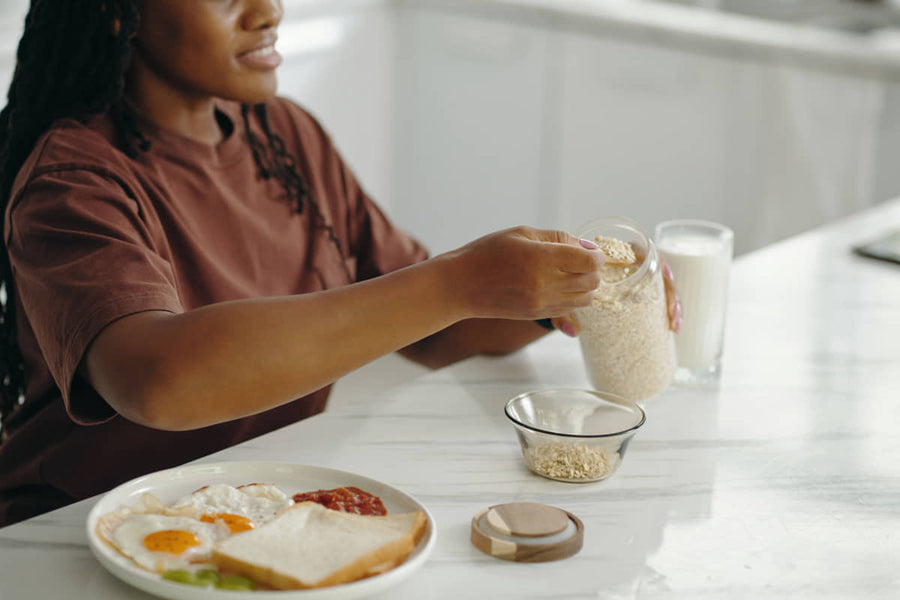
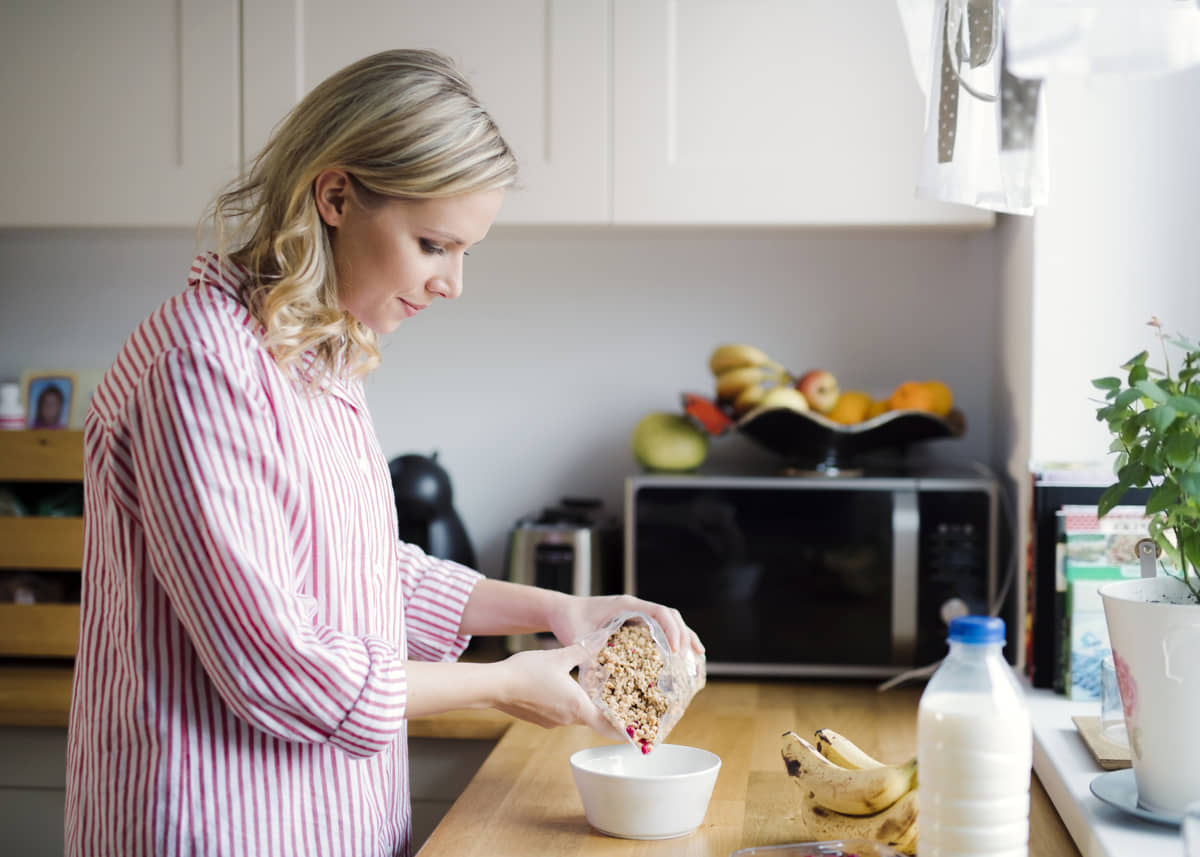
For most women over 40, the goal is 25 to 35 g of protein at breakfast, and 30 g is easiest to reach by combining two or three protein foods. Two large eggs give about 12.5 g; add a 6 oz cup of skyr with ½ cup of oats and you're at about 35 g.[1] Not hungry first thing? Split it, or make it up later: your total for the day counts most.
Key takeaways
- From oats alone, 30 g takes almost 3 cups. Mix two or three foods.
- A protein breakfast curbed mid-morning cravings in premenopausal women.
- In women over 65, morning protein built more muscle than evening protein.
- No eggs? Any protein counts, but complete protein does more for muscle.
- Prep it the night before, or grab skyr and oats.
- No 30-minute rule: eat after a short run, 90 minutes before a long one.
Is 30 grams of protein a lot for breakfast?
Thirty grams of protein from a single food can be hard to stomach. Thirty grams from several foods is much easier to eat.
When I first looked into this seriously, I went to a registered dietitian (RD) to help me spread my food across the day in the best way. She gave me lots of ingredient ideas for each meal and a way to put them together. It was great. My macros were balanced, and I still had the freedom to make my own recipes and save time in the kitchen. She built it all around foods I like. Back then I was training a huge amount for selection in my former profession, so getting my nutrition right really mattered.
So yes, 30 g looks like a lot if all you eat is oats. You'll struggle to get there: it takes almost 3 cups of dry oats.[1] But when you spread it across several protein-rich foods you enjoy, it's much simpler.
I had another advantage: I trained a lot, so I was hungry in the morning! If you don't exercise in the morning, you're not necessarily hungry. If your meals are balanced for the way you live and you exercise regularly, you're much more likely to wake up hungry. Then breakfast becomes something you look forward to. In a study at Queensland University of Technology, 58 men and women with overweight did 12 weeks of supervised exercise. They felt hungrier before breakfast, and the same breakfast kept them fuller for longer.[2]
Morning protein may also do more for your muscles as you age. At Waseda University in Tokyo, 40 women over 65 who ate little protein at breakfast took 10 g of milk protein a day for 12 weeks, either in the morning or in the evening. The morning group gained more arm and leg muscle.[3]
And if 30 g feels like too much one morning, don't overthink it. You can make up for it at your other meals. To find your own number, use the calculator in the Protein for Women guide.
Are 2 eggs enough protein for breakfast?
Two large eggs give you about 12.5 g of protein, less than half of 30 g.[1]
Before I paid attention to protein, my breakfast was the classic bowl of sugary cereal. The famous morning sugar bomb. Or nothing at all, just a coffee. It was really random.
That wasn't much of a problem when I trained at a normal volume. But as soon as I went up to two sessions a day, I had to use every recovery strategy I could, and breakfast became essential. And once your diet is balanced, it's amazing how your body starts rejecting that kind of junk.
At MAKAZ, the community gym I founded, we worked on two breakfast problems with clients. The first was no breakfast at all. The same people often complained of low energy at work from 10 a.m. The second was a sugary breakfast, with a sugar crash around 10 a.m. too.
Studies point the same way. At Michigan State University, 27 premenopausal women had more food cravings 3.5 hours after a high-carb breakfast, and fewer after a high-protein one.[4] At the University of Minnesota, 48 young adults felt fuller after an egg breakfast with 30 g of protein than after a cereal breakfast with 10 g and the same calories. Their blood sugar rose less, and they ate 135 fewer calories at lunch.[5]
The food industry has created a big problem with breakfast. We've been taught to eat sweet foods in the morning, when there's really no benefit. Even leaving protein aside, a leftover Asian-style rice bowl makes much more sense at breakfast if you're going to eat carbs.
What does 30 grams of protein look like for breakfast?
I don't eat breakfast anymore: I do a 14-hour intermittent fast for autophagy.[6] But back when I trained twice a day, my breakfast was:
CELLSHE TOOL
My 55 g training breakfast
| What I ate | Amount | Protein |
|---|---|---|
| Ham | 1 slice (1 oz) | 4.5 g |
| Fried eggs (or hard-boiled, which were handier on mornings when I didn't have time to get the pan out) | 2 large | 12.5 g |
| Hard French cheese, like Comté or Emmental | 1 slice (1 oz) | 7.5 g |
| Whole-grain bread | 2 slices | 8 g |
| Skyr mixed with oats and frozen berries | 6 oz skyr, ½ cup oats | 23 g |
| Total | about 55 g |
Food values are rounded from USDA FoodData Central.[1] USDA has no skyr entry, so skyr uses plain nonfat Greek yogurt: your label gives the exact number.
Plus a coffee. That's about 55 g of protein, almost double the 30 g goal.
If 55 g is more than you need, here are two smaller breakfasts that land on 30 g, one savory and one sweet, with no eggs and no cooking:
CELLSHE TOOL
A 30 g breakfast: smoked salmon toast
| Food | Amount | Protein |
|---|---|---|
| Whole-grain bread | 2 slices | 8 g |
| Low-fat cottage cheese | ½ cup | 12 g |
| Smoked salmon | 2 oz | 10 g |
| Total | about 30 g |
Food values are rounded from USDA FoodData Central.[1]
CELLSHE TOOL
A sweet 30 g breakfast: cottage cheese and berry bowl
| Food | Amount | Protein |
|---|---|---|
| Low-fat cottage cheese | 1 cup | 23.5 g |
| Blueberries | 1 cup | 1 g |
| Almonds | 1 oz (about 23) | 6 g |
| Total | about 31 g |
Food values are rounded from USDA FoodData Central.[1]
High-protein breakfast without eggs
Take my breakfast above, remove the eggs and adjust the amounts of the other foods. Even without the eggs, it still gives about 43 g.[1]
In reality, there are plenty of alternatives. Any protein counts toward your 30 g, but quality matters too. At Japan's National Center for Geriatrics and Gerontology, researchers followed 701 adults aged 60 to 83 for about 7 years. Those whose breakfast protein was the most complete and easiest to digest had half the odds of developing muscle weakness, however much protein they ate.[7] At Maastricht University, a beef meal raised muscle building in adults aged 65 to 85 about 47% more than a vegan meal with the same protein and calories.[8]
You can make protein pancakes, or healthy protein cakes if you like that. You can even make really good zucchini cakes. Honestly, there's no shortage of healthy high-protein recipes online. What matters is knowing how much protein a portion gives you, by weight. Quick math.
High-protein breakfast meal prep
Apart from the fried eggs, I prepped my breakfast the night before to save time. While your dinner is cooking, you have a bit of free time, so that's when I made the next morning's breakfast.
When I had no time at all: skyr and oats. It takes two minutes. A 6 oz cup of skyr with ½ cup of oats gives about 23 g of protein. With 8 oz of skyr, it's about 28 g.[1] My whole breakfast was always quick and easy to make, ready in five minutes flat.
Do you need 30 grams of protein within 30 minutes of waking?
The 30-30-30 rule? Sure, why not, if it gives you a handy reminder. But in my view, unless you're chasing athletic performance, it's the kind of nonsense that changes nothing at all. I don't think it has even been studied in the research.
Protein is something you plan over the whole day. As long as you've eaten the protein you need by the end of the day, mission accomplished, and that's true for most people who aren't athletes. At the University of Arkansas for Medical Sciences, 14 older adults ate the same daily protein for 8 weeks, either spread evenly or mostly at dinner. Their lean mass, strength and function came out the same.[9] Details like the post-workout absorption window are for elite athletes. For everyone else, they matter very little.[10]
It's like the idea that you shouldn't eat more than 30 g of protein per meal. The research shows you can absorb more than 30 g of protein in one meal.[11] Spreading it over the day should still make sense, though: several protein-rich meals rather than ONE huge one.
You can also eat breakfast two hours after you wake up. If you get up at 5 a.m. for work, nothing stops you from prepping breakfast ahead and eating it at 8 a.m. at the office. I did that myself at first, because eating anything at 5 a.m. made me nauseous.
On mornings when you're not hungry, split your breakfast in two. Eat the second part later, around 10 a.m. when you get hungry, with or without your healthy snack (if you planned one).
If you train in the morning, match breakfast to the type of session. Personally, I can't run in the morning. I just hate it. It upsets my stomach, and since I don't eat in the morning because of my intermittent fasting, it doesn't work for long trail runs. I run at the end of the day and do strength training in the morning.
For a quick 30-minute run, if you head out within 30 minutes to an hour of waking up, I don't think you need to eat first. You can have breakfast after your run. If you tend to feel a bit shaky, have an applesauce pouch, for example. It won't upset your stomach, and it gives you some sugar. For long endurance or power sessions, though, I'd seriously encourage you to get up earlier and eat a good breakfast at least 90 minutes before, so you have time to digest it. Without enough in your stomach, you'll have less energy for these sessions, which burn a lot more. A review of 46 studies from the University of Limerick found the same: eating beforehand helped in long aerobic sessions, not in shorter ones.[12] In the end, you know your body, so adapt all this to it.
Is a protein shake a good breakfast?
For a whole breakfast, my first choice is food. If you have a protein gap in your diet, though, a shake is a good way to close it.
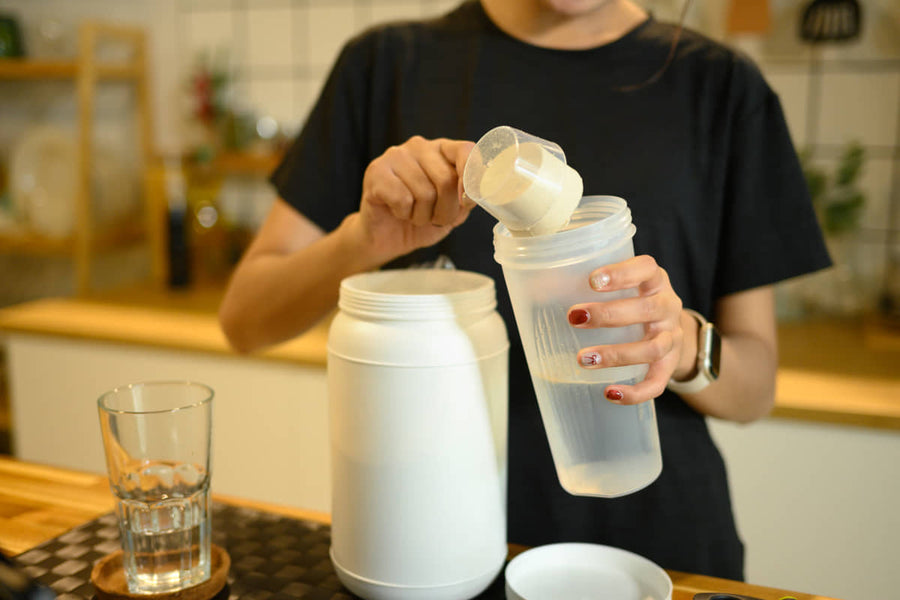
In the morning, I drink protein powder and creatine mixed into my coffee, in my big 1-liter (34 oz) Stanley mug. I stop eating at 8 p.m. and have the mug around 10 a.m. Before that, it's plain coffee or nothing. Some days I want it at 8 a.m., so I have it at 8 a.m., fast or no fast. Everything you do for longevity, you do for the rest of your life. So your day-to-day plan has to flex around what you want and how you feel. Otherwise, it won't last for most of us.
On training days when my next meal is a long way off, I also have a shake after the session to tide me over until I eat.
If you'd rather drink your breakfast, make a smoothie: fruit, whole milk or an organic plant milk, and protein powder. Check the grams of protein per serving on your powder's label. Plant milks vary a lot, so check that label too. With a 20 g serving and 1 cup of whole milk (about 8 g), you're at about 28 g. Add ½ cup of oats (about 5 g) and you pass 30 g.[1]
Here are two to start with: a creamy one, and a fruitier, lighter one with the same protein:
CELLSHE TOOL
A 30 g smoothie: banana and peanut butter
| Ingredient | Amount | Protein |
|---|---|---|
| Protein powder | 1 labeled serving | 20 g (example) |
| Unsweetened soy milk | 1 cup | 7 g |
| Banana | 1 medium | 1 g |
| Peanut butter | 1 tbsp | 3.5 g |
| Total | about 32 g |
Food values are rounded from USDA FoodData Central.[1] Protein powder values vary by product, so use the label. Unsweetened almond milk gives only about 1 g a cup.
CELLSHE TOOL
A lighter 30 g smoothie: strawberries and raspberries
| Ingredient | Amount | Protein |
|---|---|---|
| Protein powder | 1 labeled serving | 20 g (example) |
| Nonfat Greek yogurt or skyr | ½ cup | 11.5 g |
| Strawberries | 1 cup | 1 g |
| Raspberries | ½ cup | 1 g |
| Unsweetened almond milk | 1 cup | 1 g |
| Total | about 34 g |
Food values are rounded from USDA FoodData Central.[1] Protein powder values vary by product, so use the label.
You'll find plenty of healthy protein smoothie recipes online.
The bottom line
Thirty grams of protein at breakfast is easy to reach when you combine two or three protein foods you like. Two eggs give you about 12.5 g; skyr and oats, ham, cheese or a protein shake make up the rest. No time or not hungry? Prep it the night before, split it, or make it up at your other meals.
One step for tomorrow: Add up the protein in your usual breakfast. If it's short of your number, add one food from the table above.
Scientific references
- U.S. Department of Agriculture, Agricultural Research Service. FoodData Central, SR Legacy: Egg, whole, cooked, fried (173423); Egg, whole, cooked, hard-boiled (173424); Ham, sliced, regular (approximately 11% fat) (173864); Cheese, swiss (171251); Bread, whole-wheat, commercially prepared (172688); Cereals, oats, regular and quick, not fortified, dry (173904); Yogurt, Greek, plain, nonfat (170894); Milk, whole, 3.25% milkfat, with added vitamin D (171265); Cheese, cottage, lowfat, 2% milkfat (172182); Fish, salmon, chinook, smoked (173687); Nuts, almonds (170567); Blueberries, raw (171711); Strawberries, raw (167762); Raspberries, raw (167755); Soymilk (all flavors), unsweetened, with added calcium, vitamins A and D (175215); Beverages, almond milk, unsweetened, shelf stable (174832); Bananas, raw (173944); Peanut butter, smooth style, without salt (172470). FoodData Central.
- King NA, Caudwell PP, Hopkins M, et al. Dual-process action of exercise on appetite control: increase in orexigenic drive but improvement in meal-induced satiety. The American Journal of Clinical Nutrition. 2009;90(4):921–927. PMID 19675105. DOI 10.3945/ajcn.2009.27706. PubMed.
- Kim HK, Chijiki H, Fukazawa M, et al. Supplementation of Protein at Breakfast Rather Than at Dinner and Lunch Is Effective on Skeletal Muscle Mass in Older Adults. Frontiers in Nutrition. 2021;8:797004. PMID 34993224. DOI 10.3389/fnut.2021.797004. PubMed.
- Yang CL, Tucker RM. Beneficial effects of a high protein breakfast on fullness disappear after a night of short sleep in nonobese, premenopausal women. Physiology & Behavior. 2021;229:113269. PMID 33259829. DOI 10.1016/j.physbeh.2020.113269. PubMed.
- Bonnema AL, Altschwager DK, Thomas W, et al. The effects of the combination of egg and fiber on appetite, glycemic response and food intake in normal weight adults: a randomized, controlled, crossover trial. International Journal of Food Sciences and Nutrition. 2016;67(6):723–731. PMID 27306734. DOI 10.1080/09637486.2016.1196654. PubMed.
- Bagherniya M, Butler AE, Barreto GE, et al. The effect of fasting or calorie restriction on autophagy induction: A review of the literature. Ageing Research Reviews. 2018;47:183–197. PMID 30172870. DOI 10.1016/j.arr.2018.08.004. PubMed.
- Kinoshita K, Otsuka R, Nishita Y, et al. Breakfast Protein Quality and Muscle Strength in Japanese Older Adults: A Community-Based Longitudinal Study. Journal of the American Medical Directors Association. 2022;23(5):729–735.e2. PMID 35007507. DOI 10.1016/j.jamda.2021.11.037. PubMed.
- Pinckaers PJ, Domić J, Petrick HL, et al. Higher Muscle Protein Synthesis Rates Following Ingestion of an Omnivorous Meal Compared with an Isocaloric and Isonitrogenous Vegan Meal in Healthy, Older Adults. The Journal of Nutrition. 2024;154(7):2120–2132. PMID 37972895. DOI 10.1016/j.tjnut.2023.11.004. PubMed.
- Kim IY, Schutzler S, Schrader AM, et al. Protein intake distribution pattern does not affect anabolic response, lean body mass, muscle strength or function over 8 weeks in older adults: A randomized-controlled trial. Clinical Nutrition. 2018;37(2):488–493. PMID 28318687. DOI 10.1016/j.clnu.2017.02.020. PubMed.
- Schoenfeld BJ, Aragon AA, Krieger JW. The effect of protein timing on muscle strength and hypertrophy: a meta-analysis. Journal of the International Society of Sports Nutrition. 2013;10(1):53. PMID 24299050. DOI 10.1186/1550-2783-10-53. PubMed.
- Trommelen J, van Lieshout GAA, Nyakayiru J, et al. The anabolic response to protein ingestion during recovery from exercise has no upper limit in magnitude and duration in vivo in humans. Cell Reports Medicine. 2023;4(12):101324. PMID 38118410. DOI 10.1016/j.xcrm.2023.101324. PubMed.
- Aird TP, Davies RW, Carson BP. Effects of fasted vs fed-state exercise on performance and post-exercise metabolism: A systematic review and meta-analysis. Scandinavian Journal of Medicine & Science in Sports. 2018;28(5):1476–1493. PMID 29315892. DOI 10.1111/sms.13054. PubMed.