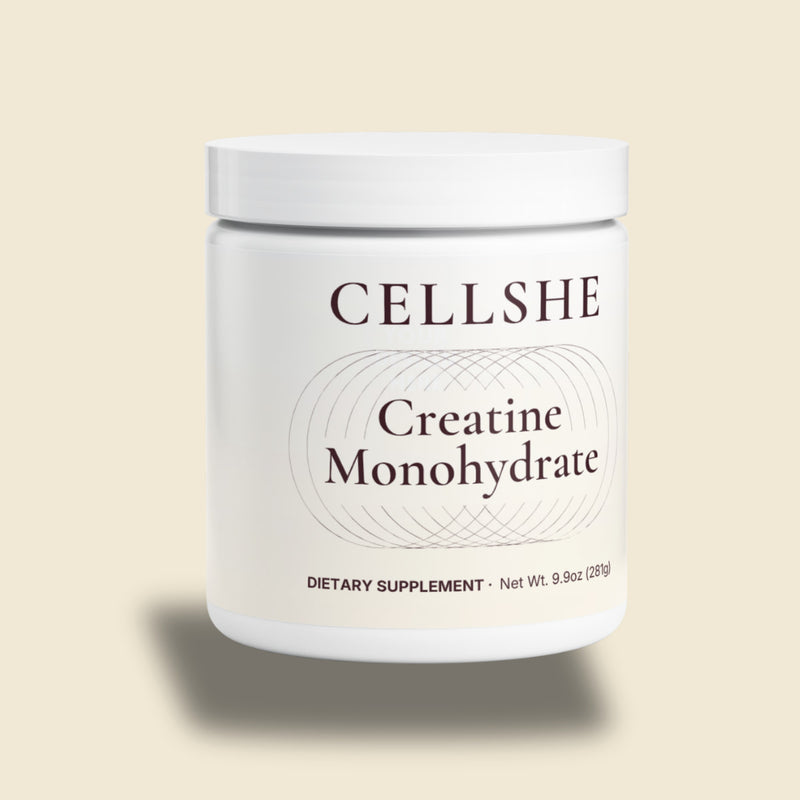

Creatine may help you improve body composition while losing weight, especially if you lift weights. Human studies show benefits for strength and lean-mass measurements. They do not consistently find additional fat loss from creatine itself.[1][2]
That matters when your goal is to lose fat and stay strong. Creatine can also change muscle water and scale weight, so the number on the scale may tell only part of the story.[3]
If you are trying to lose weight after 40, you probably care about more than getting lighter. You want your clothes to fit differently, your daily activities to feel manageable, and your strength to hold up as your body changes.
Those goals are connected, but they are measured differently. The broader Creatine for Women guide covers dosage, menopause, safety, and water weight. Here, the question is what creatine can contribute during a fat-loss effort.
Does creatine burn fat?
Creatine has not shown a consistent direct fat-burning effect in human trials. The better-established changes involve strength, fat-free mass, and sometimes body-fat percentage. The difference between those outcomes explains many confusing claims about creatine and weight loss.
Fat mass means the actual amount of fat in your body. Body-fat percentage means the share of your total weight that is fat. Both are useful measurements, but they answer different questions.
Imagine your fat mass stays the same while your lean mass increases. Your body-fat percentage can fall because fat now makes up a smaller share of your total weight. That is a change in body composition, even without additional fat loss.
A September 2026 meta-analysis pooled 63 studies involving 1,489 participants. Adding creatine to resistance training improved lean mass and slightly reduced body-fat percentage compared with training alone. The researchers found no statistically significant additional reduction in absolute fat mass.[1]
Another large review reached a similar conclusion about fat mass. Published in late 2025, its 61 trials found higher fat-free mass and body weight with creatine plus resistance training. It found no significant difference in fat mass or body-fat percentage.[2]
A broader 2024 review of 143 randomized studies found a small reduction in body-fat percentage, averaging 0.28 percentage points. Its pooled fat-mass result was effectively unchanged.[3]
The practical meaning is straightforward. Creatine can be part of a successful fat-loss routine, while the fat loss itself still depends mainly on the wider diet and activity plan.
Why keeping muscle matters when you lose weight after 40
Weight loss changes more than body fat. Depending on how you eat and exercise, some of the weight lost can come from lean tissue. That makes your training routine important, particularly as you move through midlife.
Muscle helps you climb stairs, carry groceries, get up from the floor, and keep doing the activities you enjoy. Strength training also gives your body a reason to maintain muscle while your calorie intake is lower.
In a randomized trial of 160 older adults with obesity, exercise groups lost roughly 9% of body weight. The groups doing resistance training, alone or with aerobic exercise, lost less lean mass than the aerobic-only group. These findings concern exercise during dieting, rather than creatine supplementation.[4]
What happened when researchers added creatine to a weight-loss program?
A 2026 trial studied 64 adults aged 45 to 65 who completed a 12-week intervention. Participants received either creatine or placebo within groups that chose an exercise-and-diet program or no structured program.
The exercise-and-diet program included resistance training, aerobic exercise, and a planned calorie reduction. Participants taking 10 g of creatine daily showed greater gains in DXA-measured lean tissue and a larger reduction in body-fat percentage than their placebo counterparts.[5]
Both exercise-and-diet groups lost fat. The trial did not establish a clear additional reduction in absolute fat mass from creatine. It was relatively small, and the reported body-composition results combined women and men.
For women after menopause, a separate 2026 review provides more direct evidence. Across seven randomized trials involving 608 postmenopausal women, creatine modestly improved lean-mass measurements. Leg-press strength also improved in the trials reporting that outcome, particularly when supplementation accompanied resistance training.[6]
These results give creatine a useful place in the conversation about staying strong during midlife. They do not tell us that every woman will gain muscle or avoid losing it during a calorie deficit.
Can the scale go up while you're losing fat?
Yes. Body weight can rise or stay flat while your body composition changes. Creatine can increase the water held in muscle, especially early in supplementation. Changes in lean tissue can also affect the total weight you see.
One 2025 randomized trial followed 63 younger adults taking 5 g of creatine daily or receiving no creatine. After seven days, the creatine group had gained an additional 0.51 kg of DXA-measured lean mass. The researchers identified short-term water-related changes as an important interpretation issue.[7]
DXA measures lean tissue, which includes water. A scan or scale cannot identify new muscle tissue from every early change in lean mass.
Daily weigh-ins can also move with meals, sodium, hydration, and normal changes in digestion. Use comparable measurements over time before deciding your plan has stopped working. For a fuller explanation, see the weight and water section in our Creatine for Women guide.
Should you take creatine during a fat-loss phase?
Creatine is worth considering if strength training is part of your weight-loss routine. Its most established role is supporting muscular performance and training-related gains. That is especially relevant when you want to keep exercising as you eat less.
Think about the goal of your next training session. Perhaps you want to complete your usual sets of squats, maintain the weight you lift, or keep progressing with a manageable routine. Creatine has more direct evidence for these strength-related goals than for making the scale drop faster.
Your starting point matters. Someone who already lifts weights has a clear training context for using creatine. Someone beginning exercise can focus first on building a routine that fits her schedule. Creatine may then be one part of that routine.
The broader evidence also helps set expectations. A 2024 review found that creatine increased average body weight by 0.86 kg across randomized studies, alongside gains in fat-free mass. That does not predict what will happen to your weight, but it shows why scale loss and training progress may not move together.[3]
There is no need to build an elaborate supplement schedule around dieting. If meal timing raises questions, our articles on taking creatine on an empty stomach and taking creatine with coffee cover those routines in detail.
How do creatine, protein, and strength training fit together?
A calorie deficit sets the direction for weight loss. Resistance training gives your muscles a reason to stay capable as your weight changes. Protein provides the building blocks needed to maintain and repair body tissues.[8] Creatine can support the training part of that plan.
You can put these priorities into practice without making each day complicated. Choose an eating pattern you can maintain, include protein-rich foods across your meals, and make strength training a regular part of your week. Walking and other activity can fit alongside that work. Our Protein for Women guide shows how much protein you need each day.
If you are new to resistance exercise, start with movements you can repeat confidently. A few steady sessions can be more useful than a demanding schedule you struggle to keep. If you are already training, track your sets and repetitions so you can spot changes in performance.
Creatine also occurs naturally in foods such as meat and fish. Our guide to creatine-rich foods shows how different sources compare, without making every meal a calculation.
CELLSHE TOOL
Your Weight-Loss Progress Check
| Signal | How to use it |
|---|---|
| Weight trend | Compare weigh-ins taken under similar conditions. Look for the longer-term direction rather than one reading. |
| Waist and clothing fit | Check at similar intervals. A change may add useful context when your scale weight is steady. |
| Strength and repetitions | Note whether your usual exercises remain manageable while you lose weight. Changes can guide training and recovery decisions. |
CELLSHE interpretation: These are practical tracking signals, not direct measurements of muscle gain or fat loss. Research on body composition and training informs this approach.[3][4][7]
For example, a steady scale with a smaller waist and stable training performance deserves a closer look before you change your routine. If your weight trend, measurements, and strength are all moving away from your goals, review the overall plan rather than focusing on creatine alone.
The aim is to lose fat while keeping as much of your strength and everyday capacity as possible. Creatine can support that effort through training-related outcomes. The habits around it determine how the weight-loss plan works in real life.
Scientific References
- Wang H, Wang H, Xin X, et al. Resistance training combined with creatine supplementation: a three-level meta-analysis of multidimensional outcomes from strength enhancement to body composition remodeling. Journal of the International Society of Sports Nutrition. 2026. PMID: 42765482. DOI: 10.1080/15502783.2026.2718316. PubMed.
- Ashtary-Larky D, Mohammadi S, Hajizadeh L, et al. Creatine supplementation and resistance training: a comparison between novice and experienced lifters - a systematic review and dose-response meta-analysis. Journal of the International Society of Sports Nutrition. 2025. PMID: 41433021. DOI: 10.1080/15502783.2025.2586523. PubMed.
- Pashayee-Khamene F, Heidari Z, Asbaghi O, et al. Creatine supplementation protocols with or without training interventions on body composition: a GRADE-assessed systematic review and dose-response meta-analysis. Journal of the International Society of Sports Nutrition. 2024. PMID: 39042054. DOI: 10.1080/15502783.2024.2380058. PubMed.
- Villareal DT, Aguirre L, Gurney AB, et al. Aerobic or resistance exercise, or both, in dieting obese older adults. New England Journal of Medicine. 2017;376:1943–1955. PMID: 28514618. DOI: 10.1056/NEJMoa1616338. PubMed.
- Chun H, et al. Effects of creatine supplementation with and without exercise and diet intervention on body composition, cognitive function, and markers of health in middle-aged and older adults. Journal of the International Society of Sports Nutrition. 2026. PMID: 42578920. DOI: 10.1080/15502783.2026.2716273. Full text.
- Naddafha S, Antonio J, Kreider RB, Stout JR. Creatine monohydrate for lean mass, strength, and bone density in postmenopausal women: a systematic review and meta-analysis. Journal of the International Society of Sports Nutrition. 2026. PMID: 42141930. DOI: 10.1080/15502783.2026.2668435. PubMed.
- Desai I, Pandit A, Smith-Ryan AE, et al. The effect of creatine supplementation on lean body mass with and without resistance training. Nutrients. 2025;17(6):1081. PMID: 40292479. DOI: 10.3390/nu17061081. PubMed.
- Ueshima J, et al. Enhanced protein intake on maintaining muscle mass, strength, and physical function in adults with overweight/obesity: a systematic review and meta-analysis. Clinical Nutrition ESPEN. 2024;63:417–426. PMID: 39002131. DOI: 10.1016/j.clnesp.2024.06.030. PubMed.