The clearest way to read NMN dosage research is as a set of well-defined research bands. The core of the repeated-dose human evidence sits between 250 and 1,000 mg per day. Within that range, 250 mg is a recurring lower research dose. 500 to 600 mg sits squarely in the middle. 900 to 1,000 mg is a clearly studied higher range.[4][8][10][13]
Human studies have also tested 1,200, 1,250 and 2,000 mg per day in more specialized protocols. Across multiple trials, oral NMN has raised measured blood NAD+ at doses from 250 to 1,000 mg per day.[4][8][10][13]
For comparing supplement labels, 500 to 600 mg is a well-supported midrange reference point in the human literature. Both amounts have direct peer-reviewed human data, making this range a particularly useful anchor for reading a label.[8][10]
NMN, or nicotinamide mononucleotide, is a precursor used by the body to make NAD+. If you want the biology before the dose discussion, start with our guide to what NMN is.
The dosage question becomes much easier once the studies are placed side by side. Instead of asking which number sounds biggest, we can ask a better question: where does a dose sit in the human evidence, and what happened at that dose?
Evidence reviewed through September 3, 2026.
How much NMN per day is typical in human studies?
For repeated daily use, 250 to 1,000 mg per day best represents the core of the current human research. A 2026 systematic review found 15 parallel randomized trials of oral NMN or NMN-related preparations. Doses spanned 250 to 2,000 mg per day, with studies lasting 14 days to 24 weeks.[14]
The wider 250 to 2,000 mg range is scientifically important, but it can make the literature look more scattered than it really is. Many of the most informative studies fall into three practical research bands:
250 to 300 mg/day: the established lower research range.
Several trials have used 250 mg for 10 to 12 weeks, while other work has used 300 mg as the lower arm of a dose-ranging design.[2][4][5][8]
500 to 600 mg/day: a well-studied middle.
Five hundred milligrams has been tested directly against 1,000 mg. Six hundred milligrams was a central arm in both a 60-day dose-ranging trial and a six-week exercise study.[3][8][10]
900 to 1,000 mg/day: an established higher research range.
These amounts appear in multiple human protocols, including studies of whole-blood NAD+, serum NAD measures and microcrystalline beta-NMN.[7][8][10][13]
There is no government-set Daily Value or Recommended Dietary Allowance for NMN. So the human research range is the most useful benchmark for understanding a label. It is a research benchmark rather than an individualized prescription.
CELLSHE EVIDENCE MAP
The human NMN research-dose map
| Study | Population | Daily dose | Duration | Main measure | Main finding |
|---|---|---|---|---|---|
| Yoshino et al., 2021[2] | 25 postmenopausal women with prediabetes and overweight or obesity | 250 mg | 10 weeks | Muscle insulin sensitivity and signaling | Muscle insulin sensitivity and insulin signaling improved versus placebo. |
| Okabe et al., 2022[4] | 30 healthy adults, ages 20 to 65 | 250 mg | 12 weeks | Whole-blood NAD+ and laboratory measures | Whole-blood NAD+ increased after NMN supplementation, with favorable tolerability in the study. |
| Igarashi et al., 2022[5] | Healthy men aged 65 years and older | 250 mg | 6 to 12 weeks | Whole-blood NAD+ metabolites and muscle function | Whole-blood NAD+ and related metabolites increased. Gait speed and left-grip performance also showed positive signals. |
| Morifuji et al., 2024[12] | 60 older adults | 250 mg | 12 weeks | Blood NAD+, walking measures and sleep | Blood NAD+ increased. The NMN group also had a shorter 4-meter walking time and better sleep scores on secondary outcomes. |
| Yi et al., 2023[8] | 80 healthy adults, ages 40 to 65 | 300, 600 or 900 mg | 60 days | Serum total NAD+ + NADH, 6-minute walk and other outcomes | All three NMN groups increased the measured serum NAD concentration versus placebo. The 600 and 900 mg groups had the highest values and the longest 6-minute walking distances. |
| Wang et al., 2023[10] | Adults ages 55 to 70 | 500 or 1,000 mg | 30 days | Whole-blood NAD+ | Both doses increased whole-blood NAD+ versus placebo, with a larger average concentration in the 1,000 mg group. |
| Liao et al., 2021[3] | 48 recreational runners | 300, 600 or 1,200 mg | 6 weeks | Cardiopulmonary exercise measures during training | The 600 and 1,200 mg groups improved several submaximal aerobic measures more than the training-only control. |
| Fukamizu et al., 2022[6] | 31 healthy adults, ages 20 to 65 | 1,250 mg | 4 weeks | Safety, clinical and laboratory measures | The dose was well tolerated over four weeks, with no severe adverse events reported. |
| Pencina et al., 2023[7] | 32 overweight or obese adults, ages 55 to 80 | 1,000 or 2,000 mg of MIB-626 | 14 days | Blood NAD+ metabolome and safety | The microcrystalline beta-NMN formulation produced substantial dose-related increases in blood NAD+, with similar adverse-event frequency across groups. |
| Christen et al., 2026[13] | Healthy adults | 1,000 mg | 14 days | Whole-blood NAD+ metabolome | NMN significantly increased baseline whole-blood NAD+ compared with placebo after 14 days. |
Source: Peer-reviewed human studies listed in References 2 to 13. Doses are study protocols, and outcomes remain tied to the population and measure shown.
Is 250 mg of NMN a meaningful research dose?
Yes. Two hundred fifty milligrams is one of the most repeatedly studied daily NMN doses in humans. It has been used for around 10 to 12 weeks in healthy adults, healthy older men, older adults and postmenopausal women with prediabetes.[2][4][5][12]
The pattern is useful. At 250 mg/day, several studies recorded higher blood NAD+ or NAD-related metabolites. The Science trial in postmenopausal women also found improved muscle insulin sensitivity, while later older-adult studies reported signals in walking or sleep measures.[2][5][12]
So 250 mg is a substantive research dose with repeated human exposure and measurable biological effects.
What do 500 mg and 600 mg NMN studies show?
Five hundred to 600 mg is the best-supported middle range in the current dose literature. Both amounts are anchored in direct human dosing studies.
Five hundred milligrams also appeared in early human NMN safety research as a single oral dose, before later studies moved into repeated daily use.[1]
In a double-blind study of adults ages 55 to 70, 500 mg/day was tested for 30 days. Average whole-blood NAD+ reached 41.7 µM, compared with 23.8 µM in the placebo group. The 1,000 mg group averaged 58.8 µM.[10] That makes 500 mg a directly studied dose with a clear NAD+ response.
The 600 mg story comes from the 60-day Yi trial. All three tested doses, 300, 600 and 900 mg/day, increased the study's serum total NAD+ + NADH measure versus placebo. The 600 and 900 mg groups reached the highest measured concentrations, and there was no statistically significant difference between those two groups.[8]
The same trial found longer 6-minute walking distances in all three NMN groups versus placebo, with the longest distances in the 600 and 900 mg groups.[8] The clearest interpretation is that 600 mg performed strongly in this trial and sits in a well-supported part of the human research range. Nine hundred milligrams performed strongly as well, with results statistically similar to 600 mg on the main NAD comparison.
Is 1,000 mg of NMN a studied dose?
Yes. One thousand milligrams per day is firmly represented in human NMN research. This is one of the clearest corrections to older dosage guides that stop the evidence map at 900 mg.
The 30-day Wang study found a larger average whole-blood NAD+ concentration at 1,000 mg than at 500 mg.[10] A separate trial using MIB-626, a microcrystalline beta-NMN formulation, found substantial increases in blood NAD+ at 1,000 mg once daily over 14 days.[7]
More recently, a 2026 Nature Metabolism trial gave healthy adults 1,000 mg/day of NMN for 14 days. NMN significantly increased baseline whole-blood NAD+ compared with placebo.[13]
So 1,000 mg is firmly inside the human evidence. It belongs in the higher end of the research map, alongside a growing set of direct human NAD+ measurements.
Have NMN doses above 1,000 mg been studied?
Yes. Human studies extend beyond 1,000 mg, although these protocols are more specialized than the core 250 to 1,000 mg range.
A six-week trial in recreational runners tested 300, 600 and 1,200 mg/day during a structured exercise program. The 600 and 1,200 mg groups improved several submaximal aerobic measures more than control.[3]
A four-week randomized trial in healthy adults tested 1,250 mg/day with a strong focus on safety and tolerability. No severe adverse events were reported.[6]
At 2,000 mg/day, the strongest human data come from MIB-626, a microcrystalline beta-NMN formulation. In 55- to 80-year-old adults with overweight or obesity, 1,000 mg twice daily produced substantial dose-related increases in circulating NAD+ over 14 days.[7] A later 28-day study of the same 2,000 mg/day formulation also increased circulating NAD+ and reported favorable short-term tolerability.[9]
This higher-dose work expands the research landscape. It also shows why formulation and study design matter when comparing milligram numbers.
Does a higher NMN dose raise NAD+ more?
Sometimes, yes. Human studies show a real dose-response signal, with the size of the response varying across dose ranges and individuals.
The clearest example comes from the 500 versus 1,000 mg study. Average whole-blood NAD+ was higher at 1,000 mg than at 500 mg after 30 days.[10] MIB-626 also produced dose-related increases when 1,000 and 2,000 mg/day were compared over 14 days.[7]
The 300, 600 and 900 mg trial adds a second piece of the picture. Six hundred milligrams produced a larger NAD increase than 300 mg, while the 600 and 900 mg results were statistically similar on that comparison.[8]
A 2024 post-hoc analysis of that same trial found a significant dose-related rise in NAD change, alongside large differences between participants receiving the same amount.[11] In other words, dose matters, and individual response matters too.
That is more useful than forcing the data into a simple higher-is-better rule. Human NMN response appears to have both a dose component and a strong person-to-person component.
For the broader question of which health and performance outcomes have actually changed in human studies, see our separate review of NMN benefits.
Should NMN dosage increase with age?
Current trials support age as research context rather than a simple dosing formula. Meaningful NAD+ responses have been recorded at several doses across midlife and older adulthood.
Healthy older men have shown increased whole-blood NAD+ at 250 mg/day.[5] Older adults in another 250 mg study also showed higher blood NAD+ after 12 weeks.[12] Adults ages 55 to 70 responded at both 500 and 1,000 mg/day.[10] Healthy adults ages 40 to 65 were studied at 300, 600 and 900 mg/day.[8]
The useful age lesson is that NMN has been studied successfully across different adult age groups without a validated milligram-per-decade formula. The 2024 dose-response analysis also found large variability between people at the same dose, reinforcing that age alone cannot explain the response.[11]
The same evidence map can be used for men's and women's dosage questions. Human studies include men, women or both depending on the research question, and current trials have not produced separate sex-specific dosing schedules.
The closest thing to a women-specific dosing map is therefore the set of doses actually tested in female trials; our NMN dosage guide for women lays those studies side by side without turning research doses into a prescription.
CELLSHE TOOL
NMN dose context card: where does a label sit in human research?
| Daily amount on a label | Human research context | Best way to read it |
|---|---|---|
| 250 mg | Repeated 10 to 12 week human studies, including healthy adults and older adults.[4][5][12] | An established lower research dose with repeated human NAD+ data. |
| 500 mg | Directly studied for 30 days against placebo and 1,000 mg.[10] | A well-supported midrange dose with a clear whole-blood NAD+ response. |
| 600 mg | Central arm in the 300/600/900 mg 60-day dose-ranging trial and the 300/600/1,200 mg exercise trial.[3][8] | A well-studied midrange dose with both NAD+ and functional research context. |
| 900 to 1,000 mg | Direct human studies include 900 mg for 60 days and 1,000 mg for 14 to 30 days.[7][8][10][13] | An established higher research range, with strong blood NAD+ evidence. |
| 1,200 to 1,250 mg | Studied in a six-week runner trial and a four-week healthy-adult safety trial.[3][6] | A higher-dose research range with more study-specific evidence. |
| 2,000 mg | Studied short term as 1,000 mg twice daily using the microcrystalline MIB-626 formulation.[7][9] | A specialized high-dose formulation protocol, rather than the center of the general NMN literature. |
CELLSHE interpretation: First ask how well the amount is represented in human research. Then check whether the product's claims match outcomes actually studied at that dose.
How should you read the dosage on an NMN label?
The number on the front of a bottle is only useful when you know what it represents. Start with the NMN amount per daily serving. Capsule count and total blend weight are secondary.
Then place that amount inside the human evidence. A 250 mg serving sits in a repeated lower research range. A 500 to 600 mg serving sits in a well-studied middle. A 900 to 1,000 mg serving sits in a researched higher range.
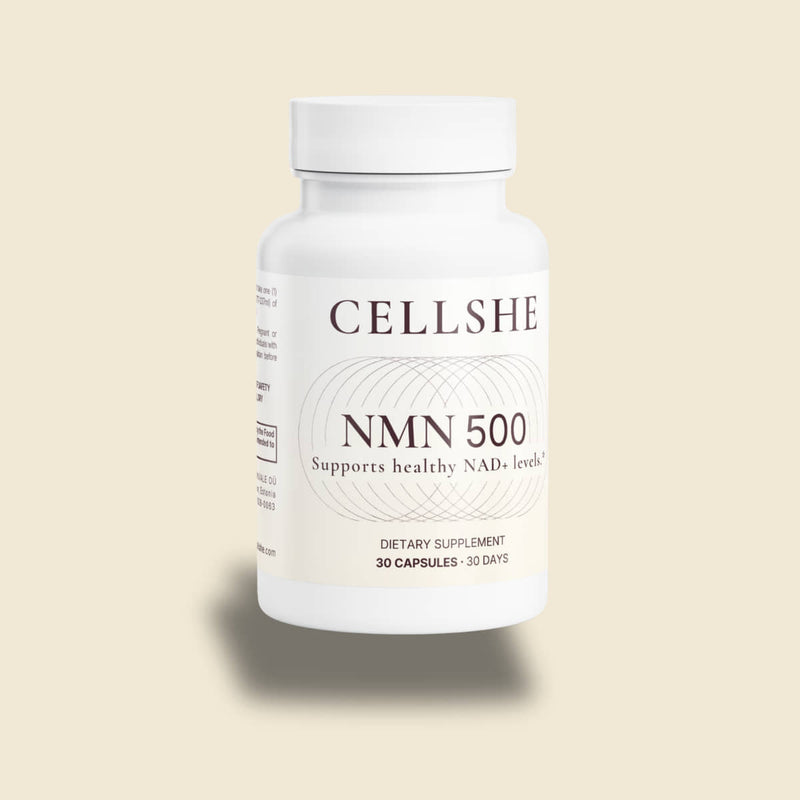
For context, CELLSHE NMN 500 provides 500 mg of beta-NMN per daily capsule. That amount sits squarely in this well-studied middle and matches the NMN amount tested in the 30-day 500 mg human study above. [10] Product formulation, testing and label details are available on the product page.
After dose, look at formulation, label transparency and testing. A proprietary delivery system should be evaluated on evidence for that formulation, rather than assuming every milligram is interchangeable. Our guide to NMN supplements covers the product-quality side of that decision.
Timing and food are separate questions. Keeping them on a separate page makes the dosage evidence easier to understand. See how and when to take NMN for that part of the routine.
What does the research say about safety across NMN doses?
The current short-term human safety record is reassuring across a wide range of studied doses. A 2026 systematic review and meta-analysis included 15 randomized trials of oral NMN or NMN-related preparations. Doses ranged from 250 to 2,000 mg/day, with studies lasting 14 days to 24 weeks.[14]
Across the pooled safety analyses, adverse-event rates were comparable between NMN and control, including serious events and withdrawals, and liver enzymes were not significantly elevated.[14] Individual trials at 900, 1,250 and 2,000 mg/day also reported favorable short-term tolerability within their study periods.[6][7][8]
The strongest conclusion here is about short-term tolerability. Longer-term high-dose evidence is still developing. For the full safety picture, including side effects and the questions people ask about cancer risk, see our dedicated NMN side effects review.
What dose range best represents human NMN research?
As of 2026, 250 to 1,000 mg per day is the clearest core range for understanding repeated-dose human NMN research.
Within that range, 250 mg is an established lower research dose. Five hundred to 600 mg is a well-supported middle with direct human NAD+ data. Nine hundred to 1,000 mg is an established higher research range. Studies above 1,000 mg add useful context, but they are more often tied to exercise protocols, short safety studies or specialized formulations.
A well-built evidence map is more useful than forcing the literature into one universal dose. The current science already gives us a strong answer. NMN has meaningful human research across several dose levels. Five hundred to 600 mg sits squarely inside the center of that evidence.
References
- Irie J, et al. (2020). Effect of oral administration of nicotinamide mononucleotide on clinical parameters and nicotinamide metabolite levels in healthy Japanese men. Endocrine Journal. PMID: 31685720. PubMed.
- Yoshino M, et al. (2021). Nicotinamide mononucleotide increases muscle insulin sensitivity in prediabetic women. Science. PMID: 33888596. PubMed.
- Liao B, et al. (2021). Nicotinamide mononucleotide supplementation enhances aerobic capacity in amateur runners: a randomized, double-blind study. Journal of the International Society of Sports Nutrition. PMID: 34238308. PubMed.
- Okabe K, et al. (2022). Oral Administration of Nicotinamide Mononucleotide Is Safe and Efficiently Increases Blood Nicotinamide Adenine Dinucleotide Levels in Healthy Subjects. Frontiers in Nutrition. PMID: 35479740. PubMed.
- Igarashi M, et al. (2022). Chronic nicotinamide mononucleotide supplementation elevates blood nicotinamide adenine dinucleotide levels and alters muscle function in healthy older men. NPJ Aging. PMID: 35927255. PubMed.
- Fukamizu Y, et al. (2022). Safety evaluation of beta-nicotinamide mononucleotide oral administration in healthy adult men and women. Scientific Reports. PMID: 36002548. PubMed.
- Pencina KM, et al. (2023). MIB-626, an Oral Formulation of a Microcrystalline Unique Polymorph of beta-Nicotinamide Mononucleotide, Increases Circulating Nicotinamide Adenine Dinucleotide and its Metabolome in Middle-Aged and Older Adults. Journal of Gerontology: Series A. PMID: 35182418. PubMed.
- Yi L, et al. (2023). The efficacy and safety of beta-nicotinamide mononucleotide supplementation in healthy middle-aged adults: a randomized, multicenter, double-blind, placebo-controlled, parallel-group, dose-dependent clinical trial. GeroScience. PMID: 36482258. PubMed.
- Pencina KM, et al. (2023). Nicotinamide Adenine Dinucleotide Augmentation in Overweight or Obese Middle-Aged and Older Adults: A Physiologic Study. Journal of Clinical Endocrinology & Metabolism. PMID: 36740954. PubMed.
- Wang P, et al. (2023). Fingerstick blood assay maps real-world NAD+ disparity across gender and age. Aging Cell. PMID: 37641521. PubMed.
- Hodzic Kuerec A, et al. (2024). Towards personalized nicotinamide mononucleotide supplementation: Nicotinamide adenine dinucleotide concentration. Mechanisms of Ageing and Development. PMID: 38430946. PubMed.
- Morifuji M, et al. (2024). Ingestion of beta-nicotinamide mononucleotide increased blood NAD levels, maintained walking speed, and improved sleep quality in older adults in a double-blind randomized, placebo-controlled study. GeroScience. PMID: 38789831. PubMed.
- Christen S, et al. (2026). The differential impact of three different NAD+ boosters on circulatory NAD and microbial metabolism in humans. Nature Metabolism. PMID: 41540253. PubMed.
- Yang W, et al. (2026). Safety and Metabolism-Related Outcomes of Oral Nicotinamide Mononucleotide Supplementation in Adults: A Systematic Review and Meta-Analysis. Nutrients. PMID: 42514320. PubMed.