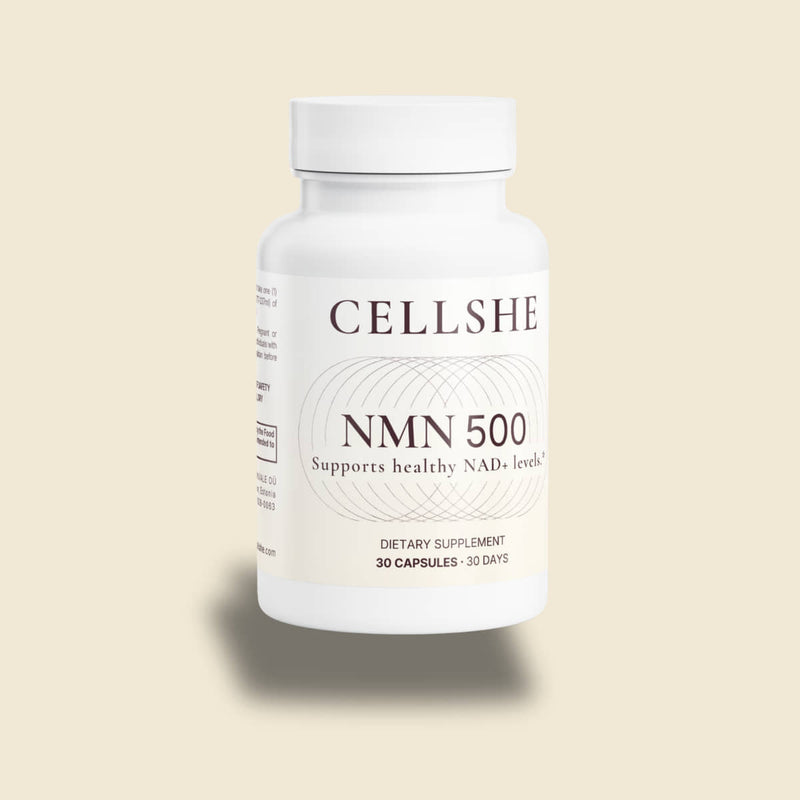
If you want one practical answer, use about 2 to 4 weeks for the measurable blood NAD+ response to repeated oral NMN. Detailed human studies show blood NAD building over the first week and reaching a much clearer rise by about day 8 to day 14. Other randomized trials confirm higher blood NAD+ at 30 days and 4 weeks.[2][3][4][5][6]
Health, performance, sleep, and how you personally feel run on different clocks. Human NMN trials have tested those outcomes from roughly 4 to 12 weeks, with results that depend on the population and endpoint. Research has not established one day when everyone should “feel” NMN.
The best-supported NMN timeline starts with blood NAD+
NMN is a precursor your body uses to make NAD+. That makes blood NAD or NAD+ the clearest early marker studied in humans. If you are new to the pathway, see What Is NMN? for the short primer. Explore the full NMN evidence in our NMN for Women guide.
The most useful timing data come from studies that measured blood more than once during treatment.
In a randomized, double-blind trial of a microcrystalline β-NMN formulation called MIB-626, 32 adults aged 55 to 80 took 1,000 mg once daily, 1,000 mg twice daily, or placebo for 14 days. Blood NAD rose only modestly during the first 24 hours. By day 8 it was substantially higher, and day-8 levels were similar to day 14 in both NMN groups.[2]
A 2026 crossover pharmacokinetic study followed six healthy adults through eight days of 1,200 mg/day NMN. Mean total blood NAD rose from 31.79 to 53.67 µM by day 8, an average increase of about 69%. The study was small, but its repeated measurements give especially clear timing information.[3]
A separate randomized study in 65 healthy adults found that 14 days of NMN increased whole-blood NAD+ compared with placebo.[4]
Put together, these studies support a clear practical conclusion: blood NAD responds over days, but the more established repeated-dose signal is around one to two weeks and is well confirmed by two to four weeks.
This is stronger than saying “NMN takes months to work.” It is also more precise than promising that one capsule creates a meaningful health effect within hours.
What happens after the first dose?
NMN metabolism starts quickly, while the larger blood NAD response builds with repeated use.
The MIB-626 trial measured participants for 24 hours after the first dose. NAD increased only modestly on day 1, then rose much more by day 8.[2]
A 2026 crossover study also followed 14 healthy men for 60 minutes after single oral and sublingual NMN doses. NMN-related terminal metabolites changed during that hour. Blood NMN, nicotinamide, and NAD+ did not differ significantly between the two delivery methods during the 60-minute window.[11]
So the useful distinction is simple. Processing begins quickly. The blood NAD response that repeated-dose studies measure develops more gradually.
CELLSHE EVIDENCE MAP
The Human NMN Trial Timeline Ledger
| Study | Who and dose | Timing measured | Result at that checkpoint | What the timing tells us |
|---|---|---|---|---|
| Pencina 2023[2] | 32 adults aged 55–80; MIB-626 1,000 mg once or twice daily | Day 1, day 8, day 14 | Blood NAD rose modestly on day 1, was substantially higher by day 8, and was similar on days 8 and 14 | Repeated dosing produced the clearer NAD rise within the first 1–2 weeks. |
| Berven 2026[3] | 6 healthy adults; 1,200 mg/day NMN in a crossover PK study | Days 0, 1, 2, 3, 5, 8 and washout | Mean total blood NAD rose about 69% by day 8 | A small, finely measured study shows the rise building across the first week. |
| Christen 2026[4] | 65 healthy adults across NMN, NR, nicotinamide and placebo groups; NMN for 14 days | Baseline and day 14 for the repeated-dose comparison | NMN increased whole-blood NAD+ versus placebo | A randomized study confirms a clear NAD+ response by two weeks. |
| Yi 2023[5] | 80 healthy adults aged 40–65; 300, 600 or 900 mg/day | Day 30 and day 60 | Blood NAD+ increased at both visits. Six-minute walk and SF-36 differences were also reported | Thirty days is a confirmed biomarker and functional study checkpoint. |
| Okabe 2022[6] | 30 healthy adults; 250 mg/day | Weeks 4, 8, 12, plus week 16 after stopping | Whole-blood NAD+ was higher at weeks 4, 8 and 12, then moved toward baseline after treatment ended | Four weeks is another well-supported blood NAD+ checkpoint. |
| Igarashi 2022[7] | 42 healthy older men; 250 mg/day | Weeks 6 and 12 | Whole-blood NAD+ and related metabolites increased during supplementation; physical-function findings were mixed | Six and 12 weeks are studied chronic-use checkpoints in older men. |
| Liao 2021[8] | 48 amateur runners; 300, 600 or 1,200 mg/day plus exercise training | Baseline and week 6 | Several ventilatory-threshold measures improved more in the 600 and 1,200 mg groups than placebo | Six weeks is a studied exercise-performance window in trained runners. |
| Yoshino 2021[9] | 25 postmenopausal women with prediabetes and overweight or obesity; 250 mg/day | Baseline and week 10 for major metabolic outcomes | Muscle insulin sensitivity improved after NMN; several other metabolic and physical measures were unchanged | Ten weeks is the tested window for this specific metabolic endpoint and population. |
| Morifuji 2024[10] | 60 older adults; 250 mg/day | Weeks 4 and 12 | Blood NAD metabolites, motor tests and questionnaires were collected; significant NAD+, walking-time and sleep findings were reported at week 12 | Later outcomes can require a different checkpoint from the early blood marker. |
CELLSHE interpretation: the most defensible timeline is a sequence. Blood NAD builds during the first days and weeks. Around 2–4 weeks is the strongest practical window for the measurable blood response. Functional, metabolic and sleep outcomes use later, endpoint-specific study windows.
Sources: Pencina 2023 [2]; Berven 2026 [3]; Christen 2026 [4]; Yi 2023 [5]; Okabe 2022 [6]; Igarashi 2022 [7]; Liao 2021 [8]; Yoshino 2021 [9]; Morifuji 2024 [10].
What changes between 4 and 12 weeks?
This is where NMN trials begin testing more than the blood NAD marker.
At day 30, Yi and colleagues reported higher blood NAD+ together with differences in six-minute walking distance and SF-36 general-health scores across several NMN comparisons.[5]
At six weeks, the Liao trial reported better ventilatory-threshold measures in amateur runners taking 600 or 1,200 mg/day alongside exercise training.[8]
At ten weeks, Yoshino and colleagues found improved muscle insulin sensitivity in postmenopausal women with prediabetes and overweight or obesity. Body composition, liver fat, muscle mitochondrial respiration, and several other measures did not change.[9]
At 12 weeks, Morifuji and colleagues reported blood NAD+, walking-time, and sleep-related findings in older adults.[10]
These findings do not form a ladder where every person moves from energy to sleep to performance on schedule. They show that different outcomes need different study designs and different checkpoints.
The broader evidence also keeps expectations grounded. A 2026 systematic review included 15 randomized trials lasting 14 days to 24 weeks. Pooled analyses did not show broad changes in body weight, fasting glucose, HbA1c, lipid profiles, or systolic blood pressure.[1]
That is why the best answer to “when will a benefit appear?” starts by naming the benefit.
How long until you feel NMN working?
There is no reliable human “time to feel” for NMN. The evidence is much stronger for blood NAD than for a personal sensation.
Some trials did collect questionnaires. Yi used the SF-36 at days 30 and 60.[5] Morifuji collected sleep questionnaires at weeks 4 and 12 and reported sleep-related differences at week 12.[10]
Those results are useful because they show subjective outcomes can be studied. They still do not give us a validated first day when participants noticed a change.
So if you are asking about energy, focus, recovery, or a general sense of well-being, the current research cannot give one dependable countdown. A lack of a dramatic feeling in the first week says very little about the blood NAD response.
CELLSHE DECISION TOOL
Choose the checkpoint that matches the outcome
| Outcome you care about | Human study checkpoint | Who was studied | What to record |
|---|---|---|---|
| Blood NAD / NAD+ | About 2–4 weeks is the strongest practical window; detailed PK studies show the rise building by days 8–14 | Healthy adults and middle-aged/older adults across several trials | Baseline: Follow-up: |
| Walking / general physical function | Day 30 and day 60 in Yi; week 12 in Morifuji | Healthy middle-aged adults; older adults | Measure used: Result: |
| Exercise capacity | Week 6 in Liao | Amateur runners doing exercise training | Training held stable? |
| Insulin sensitivity | Week 10 in Yoshino | Postmenopausal women with prediabetes and overweight or obesity | Clinician/lab plan: |
| Sleep questionnaire | Week 12 finding in Morifuji | Older adults | Same sleep measure at baseline and follow-up: |
| How I feel day to day | No validated universal checkpoint | No trial has established a reproducible first-feeling date for everyone | Define the feeling first: |
How to use it: match your question to the closest studied endpoint, then check whether the study population resembles the situation you are trying to understand. The same number of weeks can mean very different things in different trials.
This is a CELLSHE editorial synthesis of references [2] to [10]. It is not a diagnostic tool.
Why NMN timelines differ between people
Human studies show several sources of variation.
- The endpoint changes. Blood NAD, walking distance, insulin sensitivity, exercise capacity, sleep, and perceived well-being are separate outcomes.
- The population changes. Trials include healthy adults, older adults, runners, and people with metabolic risk.
- The dose and formulation change. The 2026 systematic review included oral NMN doses from 250 to 2,000 mg/day and intervention periods from 14 days to 24 weeks.[1]
- People respond differently even at the same dose. A post-hoc analysis of the Yi trial found large variation in the change in blood NAD between participants within the same dose groups.[12]
- The biological sample changes. Whole blood, plasma, blood cells, muscle, and brain measurements answer different questions. Our NAD+ Levels by Age review explains why those compartments should stay separate.
This variability does not erase the timing signal. It tells us where the signal is strongest: blood NAD responds first and most consistently; later outcomes are more specific to the study.
How to use this timeline in real life
If your question is whether oral NMN can move a blood NAD measure, think in weeks rather than months. Around 2–4 weeks is the best current practical evidence window.
If you are considering an NAD blood test, use the dedicated NAD+ Blood Test guide. It explains what the result can and cannot represent.
If your question is about a functional or health outcome, match the follow-up to that outcome. A six-week runner study should not become a six-week sleep promise. A ten-week insulin-sensitivity study in a specific metabolic population should not become a universal ten-week NMN rule.
If your question is when to take NMN during the day, keep that separate from how long repeated supplementation takes to change an outcome. See How and When to Take NMN for morning, food, and routine timing.
If you develop an adverse effect, the research timeline is not a reason to push through it. See the NMN Side Effects guide for the safety evidence.
For the wider evidence base behind CELLSHE’s NMN and NAD+ coverage, see The Science.
So how long does NMN take to work?
For the measurable blood NAD response, about 2–4 weeks is the best evidence-based answer. Human pharmacokinetic studies show the rise developing across the first week and reaching a clearer level by days 8 to 14. Randomized trials also confirm higher blood NAD+ at 14 days, 30 days, and 4 weeks.[2][3][4][5][6]
For health or performance outcomes, use the endpoint rather than the calendar. Human trials have reported selected findings from about 4 to 12 weeks, depending on who was studied and what was measured.
For when you personally feel different, science does not yet provide one reliable date. That is a different question from whether the blood NAD pathway has responded.
Frequently asked questions
How long does it take NMN to start working?
For blood NAD, the best practical answer is about 2–4 weeks. Detailed human studies show the rise building by the first week and becoming much clearer by days 8 to 14, with further confirmation at 30 days and 4 weeks.[2][3][4]
Can NMN work within 24 hours?
NMN is metabolized within hours, but the larger blood NAD response appears to build with repeated dosing. In the MIB-626 trial, blood NAD rose only modestly during the first 24 hours and was substantially higher by day 8.[2]
Does NMN work after two weeks?
Two weeks is a well-supported checkpoint for the blood NAD response. A randomized 65-person study found higher whole-blood NAD+ after 14 days of NMN, and other PK studies show strong rises by days 8 to 14.[4][2][3]
How long does NMN take to improve energy?
Human trials have not established a dependable energy-onset timeline. Some studies measured general health, fatigue, sleep, or exercise outcomes at later visits, but they do not identify one day when people should feel more energetic.
Is 30 days enough to see an NMN effect?
Thirty days is long enough for randomized trials to detect higher blood NAD+ and selected group-level outcomes. Yi and colleagues found higher blood NAD+ at day 30 together with differences in six-minute walking distance and SF-36 scores across several comparisons.[5]
Why do so many NMN timelines say 8 to 12 weeks?
Because many human trials use that duration to test later outcomes. It is a common research window, not one universal time when NMN suddenly reaches a final effect. The 2026 systematic review included trials from 14 days to 24 weeks.[1]
Does a higher NMN dose work faster?
Human trials show dose-related differences in the size of some NAD responses, but they have not established a universal faster onset from taking more. Dose and speed are separate questions.[2][5]
Does taking NMN in the morning make it work faster?
Current human evidence does not show that morning dosing creates a faster onset. Daily timing and time-to-effect are separate questions. See How and When to Take NMN for the dedicated timing evidence.
Scientific references
- Yang W, Huang J, Tang Z, Chen C, Sun Y. Safety and Metabolism-Related Outcomes of Oral Nicotinamide Mononucleotide Supplementation in Adults: A Systematic Review and Meta-Analysis. Nutrients. 2026;18(14):2251. PMID: 42514320. PubMed.
- Pencina KM, Lavu S, Dos Santos M, et al. MIB-626, an Oral Formulation of a Microcrystalline Unique Polymorph of β-Nicotinamide Mononucleotide, Increases Circulating Nicotinamide Adenine Dinucleotide and its Metabolome in Middle-Aged and Older Adults. J Gerontol A Biol Sci Med Sci. 2023;78(1):90–96. PMID: 35182418. PubMed.
- Berven H, Svensen M, Eikeland H, et al. The NAD-brain pharmacokinetic study of NAD augmentation in blood and brain using oral precursor supplementation. iScience. 2026;29(3):114764. PMID: 41858901. PubMed.
- Christen S, Redeuil K, Goulet L, et al. The differential impact of three different NAD+ boosters on circulatory NAD and microbial metabolism in humans. Nature Metabolism. 2026;8(1):62–73. PMID: 41540253. PubMed.
- Yi L, Maier AB, Tao R, et al. The efficacy and safety of β-nicotinamide mononucleotide (NMN) supplementation in healthy middle-aged adults: a randomized, multicenter, double-blind, placebo-controlled, parallel-group, dose-dependent clinical trial. GeroScience. 2023;45(1):29–43. PMID: 36482258. PubMed.
- Okabe K, Yaku K, Uchida Y, et al. Oral Administration of Nicotinamide Mononucleotide Is Safe and Efficiently Increases Blood Nicotinamide Adenine Dinucleotide Levels in Healthy Subjects. Frontiers in Nutrition. 2022;9:868640. PMID: 35479740. PubMed.
- Igarashi M, Nakagawa-Nagahama Y, Miura M, et al. Chronic nicotinamide mononucleotide supplementation elevates blood nicotinamide adenine dinucleotide levels and alters muscle function in healthy older men. npj Aging. 2022;8:5. PMID: 35927255. PubMed.
- Liao B, Zhao Y, Wang D, Zhang X, Hao X, Hu M. Nicotinamide mononucleotide supplementation enhances aerobic capacity in amateur runners: a randomized, double-blind study. Journal of the International Society of Sports Nutrition. 2021;18(1):54. PMID: 34238308. PubMed.
- Yoshino M, Yoshino J, Kayser BD, et al. Nicotinamide mononucleotide increases muscle insulin sensitivity in prediabetic women. Science. 2021;372(6547):1224–1229. PMID: 33888596. PubMed.
- Morifuji M, Higashi S, Ebihara S, Nagata M. Ingestion of β-nicotinamide mononucleotide increased blood NAD levels, maintained walking speed, and improved sleep quality in older adults in a double-blind randomized, placebo-controlled study. GeroScience. 2024;46(5):4671–4688. PMID: 38789831. PubMed.
- Wakabayashi J, Higashi S, Morifuji M. Sublingual NMN administration increases early circulating terminal catabolites 2PY and 4PY compared with oral administration in healthy adult men. Scientific Reports. 2026. PMID: 42304075. PubMed.
- Hodzic Kuerec A, Wang W, Yi L, et al. Towards personalized nicotinamide mononucleotide (NMN) supplementation: Nicotinamide adenine dinucleotide (NAD) concentration. Mechanisms of Ageing and Development. 2024;218:111917. PMID: 38430946. PubMed.
Editorial note: This article is for educational purposes and is not medical advice. Human NMN studies use different populations, doses, formulations, biological samples, and endpoints. Study checkpoints describe research measurements, not guaranteed personal outcomes.