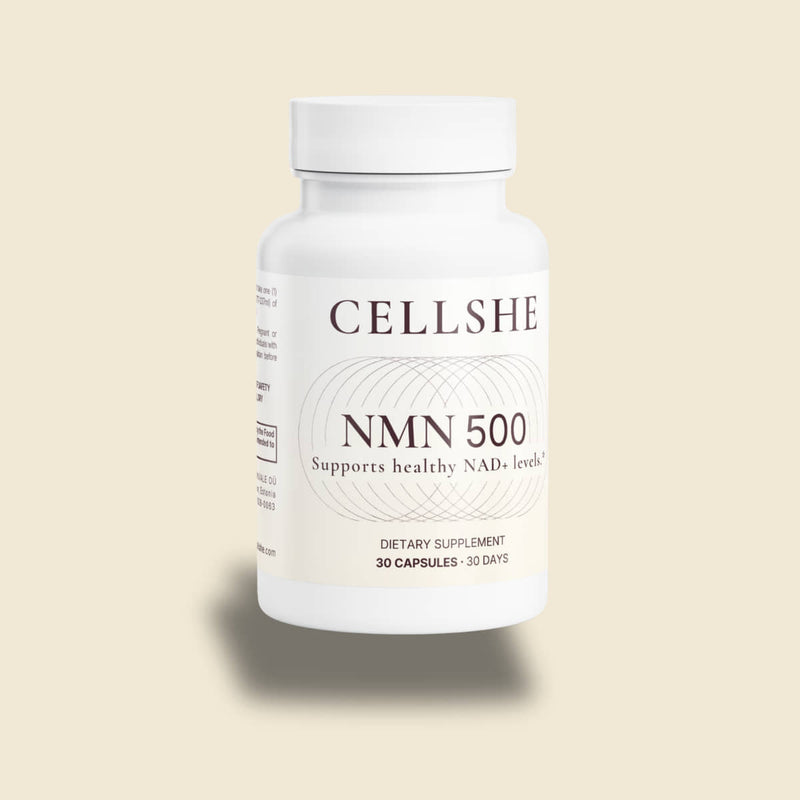

Human studies have not established one best time of day to take NMN. Some trials used morning or before-breakfast schedules, but that does not prove morning is superior. One randomized trial directly compared earlier and later daily windows without establishing a universal timing advantage.[1][2]
Human research also has not shown that taking NMN on an empty stomach works better than taking it with food. Follow the directions on your product label. If the label does not require a clock time or food condition, current evidence does not justify inventing one.
If you are still deciding what NMN is or whether it belongs in your routine, start with what NMN is. Explore the full NMN evidence in our NMN for Women guide. This page owns the next question: how to use an oral NMN product without turning research protocols into rules they never proved.
How should you take NMN?
The most defensible routine is simpler than many timing guides make it sound. Product directions come first. Human trials can show how researchers administered NMN, but a study schedule is not automatically an optimal personal schedule.
- Use the labeled serving and directions. A research dose is not a universal dose recommendation.
- Do not assume morning is biologically superior. Human timing evidence does not establish that rule.
- Do not assume fasting improves results. No robust human fed-versus-fasted comparison has established that advantage.
- Keep the formulation in mind. Evidence from swallowed tablets or capsules does not validate every sublingual, liposomal or other delivery claim.
- Separate adherence from optimization. Repeated-dose trials used scheduled intake, but they did not prove that the exact same clock time each day improves outcomes.
If your main question is amount rather than routine, the separate NMN dosage guide maps the doses actually tested in people. This page keeps dose in context rather than turning those study amounts into instructions.
CELLSHE NMN ROUTINE EVIDENCE MAP
How human NMN trials actually scheduled oral NMN
| Study | Population and duration | NMN schedule tested | What the schedule does not prove |
|---|---|---|---|
| Kim et al., 2022 | 108 Japanese adults aged 65+, 12 weeks | 250 mg once daily either from waking to noon or from 18:00 to bedtime | That morning or evening is universally best. Several outcomes changed across both NMN and placebo timing groups. |
| Yi et al., 2023 | 80 healthy middle-aged adults, 60 days | 300, 600 or 900 mg once daily before breakfast with water | That before-breakfast dosing caused the observed effects or outperforms fed dosing. |
| Christen et al., 2026 | 65 healthy adults across four groups, 14 days | NMN group: 1,000 mg once daily at the end of or within 30 minutes after breakfast | That taking NMN with breakfast is superior. The trial compared NAD+ precursors, not meal timing. |
| Okabe et al., 2022 | 30 healthy adults, 12 weeks | 250 mg/day as oral tablets | That one specific clock time or food condition is required for the whole-blood NAD+ response. |
| Katayoshi et al., 2023 | 36 healthy adults aged 40 to 59, 12 weeks | 125 mg twice daily | That once-daily morning dosing is necessary or that splitting a dose is superior. |
| Fukamizu et al., 2022 | 31 healthy adults, 4 weeks | 1,250 mg once daily | That this short-term safety dose is an optimal routine dose for general use. |
Sources: Kim et al. 2022; Yi et al. 2023; Christen et al. 2026; Okabe et al. 2022; Katayoshi et al. 2023; Fukamizu et al. 2022.[1][2][11][3][4][7]
Is morning or night the best time to take NMN?
There is no established universal best time. Morning is common in NMN research, but common protocol design is not the same as a head-to-head superiority result.
The most relevant human study randomized 108 adults aged 65 or older into four groups. They took 250 mg of NMN or placebo for 12 weeks either from waking to noon or from 18:00 to bedtime. The later NMN group showed the largest effect sizes for five-times sit-to-stand performance and drowsiness. The later placebo group also improved on drowsiness, and the study did not measure blood NAD+.[1]
That trial is useful because it directly challenges the idea that morning dosing has already won. It does not justify replacing a morning rule with an evening rule. The population was older, the outcomes were narrow, and one study cannot establish an optimal schedule for everyone.
Other human trials used morning or before-breakfast administration. The 60-day Yi trial reports once-daily before-breakfast dosing, while an eight-week study in healthy middle-aged men used 250 mg before breakfast.[2][6] Those protocols do not establish a timing advantage because the studies did not randomize participants to different clock times.
What about circadian biology? NAD+ metabolism is connected with circadian biology, and this is a legitimate research area. Much of the mechanistic work used to support a strict morning rule comes from cells and animals, while human NAD+ rhythms also vary by tissue, health state and measurement method. Current clinical reviews do not establish a validated NMN clock-time prescription for healthy adults.[10]
Should you take NMN with food or on an empty stomach?
We found no randomized human trial that assigned otherwise comparable participants to fed versus fasted NMN to test absorption or health outcomes. That distinction matters because many routine guides move from “NMN is water soluble” to “therefore empty-stomach dosing is better.” The first statement does not prove the second.
The Yi trial reports NMN before breakfast with water and found higher blood NAD concentrations after 60 days at the tested doses.[2] It did not include a matched group taking the same NMN dose with breakfast, so it cannot isolate fasting as the cause.
A 2026 randomized human study used the opposite meal context. Participants in its NMN group took 1,000 mg at the end of or within 30 minutes after their usual breakfast for 14 days. Whole-blood NAD+ increased versus placebo, but the study compared different NAD+ precursors rather than fed versus fasted NMN.[11]
Other trials used different schedules and still reported changes in NAD-related measures. Okabe and colleagues found higher whole-blood NAD+ after 12 weeks of 250 mg/day. Katayoshi and colleagues used 125 mg twice daily and found higher serum nicotinamide, while serum NAD+ remained below the assay's quantification limit.[3][4]
If your label allows either approach, the evidence does not provide a strong reason to treat fed versus fasted timing as a performance variable. The dedicated guide on NMN with or without food goes deeper into that question without turning it into a routine rule here.
Can you take NMN with coffee?
We found no controlled human interaction trial showing that coffee improves or reduces NMN absorption or efficacy. Human NMN studies commonly specify water, a meal condition or both, rather than testing caffeine as an administration variable.
That means an unconditional “coffee will not interfere” statement goes beyond the direct evidence. If an NMN label gives a specific administration instruction, follow it. If you use medication or have a condition where caffeine intake matters, that is a separate reason to discuss your routine with a clinician.
The evidence gap is narrow but important: absence of a demonstrated NMN-caffeine interaction is not proof that every combination has been tested.
Do you need to take NMN at the same time every day?
Repeated-dose NMN trials generally asked participants to follow a scheduled daily regimen. That makes adherence important to the study design. It does not prove that taking NMN at 8:00 every day works better than taking it at 8:00 one day and 10:00 the next.
In the Yi trial, participants kept dosing diaries and study staff assessed capsule counts and compliance. The trial was designed around regular daily administration for 60 days.[2] That supports a practical point: a schedule you can follow is useful. It does not make “same time every day” a demonstrated biological requirement.
This distinction also prevents a common overstatement. Consistency is not an active ingredient. It is the behavior that lets a repeated-dose regimen actually occur. If your routine keeps breaking, read why people stop taking NMN.
How much NMN should you take?
Human trials have tested a wide range of oral doses. A 2026 systematic review identified 15 randomized trials using 250 to 2,000 mg/day for 14 days to 24 weeks.[9] That range describes research. It is not a recommended range for every adult.
Different studies also used different populations, formulations and outcomes. Yi and colleagues compared 300, 600 and 900 mg/day for 60 days in healthy middle-aged adults. Fukamizu and colleagues tested 1,250 mg/day for four weeks primarily for short-term safety.[2][7] Neither study establishes a universal “best dose.”
For a dose-by-study view, use the NMN dosage article. Keeping that question on its own page prevents this routine hub from turning trial amounts into personal dosing instructions.
Does the NMN form change how you should take it?
Most published human NMN evidence involves swallowed oral tablets or capsules. That is the evidence base to keep in mind when a product claims that sublingual, liposomal or another delivery system is automatically better.
A different formulation can change dissolution, exposure or convenience. It still needs human evidence for the advantage being claimed. Faster or different delivery does not by itself prove a better NAD+ response or a better health outcome.
If you are choosing between products or delivery formats, how to choose an NMN supplement covers formulation and quality questions. The NMN supplement comparison is the separate buyer-intent page, so this routine article does not need to become a product ranking.
How long should you take NMN before judging it?
A study measurement visit is not a “time to work.” Human trials have measured NAD-related markers and other endpoints after different periods. Those include four, eight, 10, 12 and 24 weeks.[3][5][6][8]
For example, Morifuji and colleagues measured blood NAD-related metabolites at four and 12 weeks in older adults. Higher blood NAD+ was observed in the NMN group at both visits, but that does not prove participants should have felt a benefit by week four.[5]
If you want the endpoint-by-endpoint timeline rather than a generic waiting period, see how long NMN takes to work in human studies. For the difference between biomarkers and what a person might realistically notice, use what to expect from NMN.
What does the routine evidence say about safety?
The current human evidence is mostly short term. The 2026 systematic review included trials lasting from 14 days to 24 weeks. Across its safety analyses, oral NMN did not clearly increase overall or serious adverse events, adverse-event withdrawals, or ALT and AST elevations.[9]
That is useful short-term tolerability evidence. It is not proof of safety over years. The review also found no broad, consistent metabolic benefit across outcomes such as body weight, fasting glucose, HbA1c or lipid measures.[9]
For medication questions, health conditions, pregnancy, long-term uncertainty and the broader safety evidence, use the dedicated NMN side-effects and safety review. Those questions deserve more space than a routine page can give them.
A practical NMN routine, without invented optimization rules
If the product label specifies a serving, timing or food condition, use those directions. If it does not specify morning versus night or fed versus fasted use, human evidence does not establish a single superior choice.
Choose a schedule you can follow without treating the clock as part of the active dose. Keep dose, formulation, food timing and expected outcomes as separate questions. That approach is less dramatic than a “perfect NMN routine,” but it matches the human evidence much more closely.
The broader human literature supports a restrained conclusion. Oral NMN can raise NAD-related measures in some studies, while effects on functional and metabolic outcomes vary by trial and population. A 2025 clinical review and a 2026 meta-analysis both emphasize that clinical efficacy remains less settled than the biomarker story.[9][10]
How CELLSHE evaluated the routine evidence
We prioritized randomized human trials and current systematic reviews. For timing claims, we checked whether the study actually compared different times of day rather than merely using a morning protocol. For food claims, we looked for direct fed-versus-fasted comparisons rather than inferring absorption from water solubility. For dose and duration, we kept trial schedules separate from personal recommendations.
We also kept biological compartments distinct. Whole-blood NAD+, serum NAD+, serum nicotinamide and muscle metabolites are not interchangeable measurements. When a trial measured a biomarker, we did not rewrite it as a general health outcome.
References
- Kim M, Seol J, Sato T, et al. Effect of 12-Week Intake of Nicotinamide Mononucleotide on Sleep Quality, Fatigue, and Physical Performance in Older Japanese Adults: A Randomized, Double-Blind Placebo-Controlled Study. Nutrients. 2022;14(4):755. PMID: 35215405. PubMed.
- Yi L, Maier AB, Tao R, et al. The efficacy and safety of β-nicotinamide mononucleotide supplementation in healthy middle-aged adults: a randomized, multicenter, double-blind, placebo-controlled, parallel-group, dose-dependent clinical trial. GeroScience. 2023;45(1):29-43. PMID: 36482258. PubMed.
- Okabe K, Yaku K, Uchida Y, et al. Oral Administration of Nicotinamide Mononucleotide Is Safe and Efficiently Increases Blood Nicotinamide Adenine Dinucleotide Levels in Healthy Subjects. Front Nutr. 2022;9:868640. PMID: 35479740. PubMed.
- Katayoshi T, Uehata S, Nakashima N, et al. Nicotinamide adenine dinucleotide metabolism and arterial stiffness after long-term nicotinamide mononucleotide supplementation: a randomized, double-blind, placebo-controlled trial. Sci Rep. 2023;13:2786. PMID: 36797393. PubMed.
- Morifuji M, Higashi S, Ebihara S, Nagata M. Ingestion of β-nicotinamide mononucleotide increased blood NAD levels, maintained walking speed, and improved sleep quality in older adults in a double-blind randomized, placebo-controlled study. GeroScience. 2024;46(5):4671-4688. PMID: 38789831. PubMed.
- Yamaguchi S, Irie J, Mitsuishi M, et al. Safety and efficacy of long-term nicotinamide mononucleotide supplementation on metabolism, sleep, and nicotinamide adenine dinucleotide biosynthesis in healthy, middle-aged Japanese men. Endocr J. 2024;71(2):153-169. PMID: 38191197. PubMed.
- Fukamizu Y, Uchida Y, Shigekawa A, et al. Safety evaluation of β-nicotinamide mononucleotide oral administration in healthy adult men and women. Sci Rep. 2022;12:14442. PMID: 36002548. PubMed.
- Akasaka H, et al. Effects of nicotinamide mononucleotide on older patients with diabetes and impaired physical performance: A prospective, placebo-controlled, double-blind study. Geriatr Gerontol Int. 2023;23(1):38-43. PMID: 36443648. PubMed.
- Yang W, Huang J, Tang Z, Chen C, Sun Y. Safety and Metabolism-Related Outcomes of Oral Nicotinamide Mononucleotide Supplementation in Adults: A Systematic Review and Meta-Analysis. Nutrients. 2026;18(14):2251. PMID: 42514320. PubMed.
- Vinten KT, Trętowicz MM, Coskun E, et al. NAD+ precursor supplementation in human ageing: clinical evidence and challenges. Nat Metab. 2025;7(10):1974-1990. PMID: 41083806. PubMed.
- Christen S, Redeuil K, Goulet L, et al. The differential impact of three different NAD+ boosters on circulatory NAD and microbial metabolism in humans. Nat Metab. 2026;8(1):62-73. PMID: 41540253. PubMed.
Editorial note: This article separates trial administration schedules from evidence of optimal timing. Human NMN research is evolving, and the article should be updated when direct fed-versus-fasted, timing, formulation or longer-duration trials materially change the answer.